Key Results of the Laboratory 2023-2024
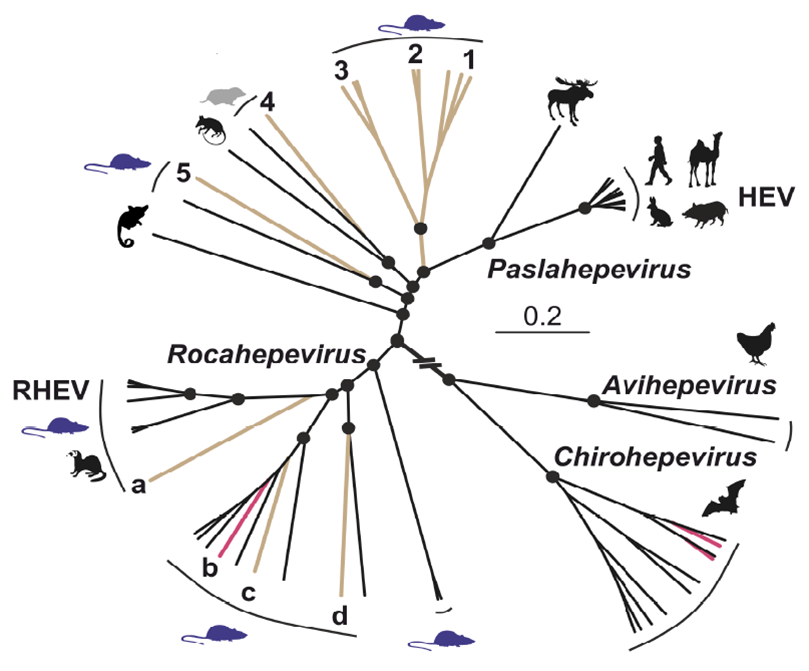
1. A large-scale study of small mammals (2565 specimens of 108 rodent and shrew species) from Africa, Asia, and Latin America revealed substantially greater diversity of hepeviruses than previously assumed. Twenty-four new complete genomes were described, and the key role of rodents in the origin and evolution of hepeviruses was revealed. A recent direct origin of the human hepatitis E virus from artiodactyl hepeviruses was demonstrated, along with a more ancient origin from rodent hepeviruses. The use of certain rodent species was proposed as new models for studying the pathogenesis of hepatitis E virus and developing preclinical therapy for it. The need for genomic epidemiological surveillance of rodent-associated hepeviruses was substantiated.
Опубликовано: JoW.K., Cassiano M.H.A., de Oliveira-Filho E.F., Brünink S., Yansanjav A., Yihune M., Koshkina A.I., Lukashev A.N., Lavrenchenko L.A., Lebedev V.S., Olayemi A., Bangura U., Salas-Rojas M., Aguilar-Setién Á., Fichet-Calvet E., Drexler J.F., 2024. Ancient evolutionary origins of hepatitis E virus in rodents. Proceedings of the National Academy of Sciences, 121(51): e2413665121.
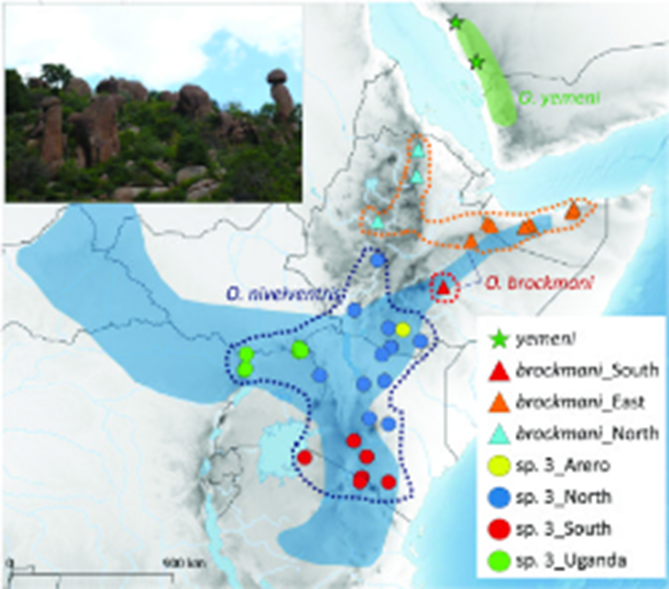
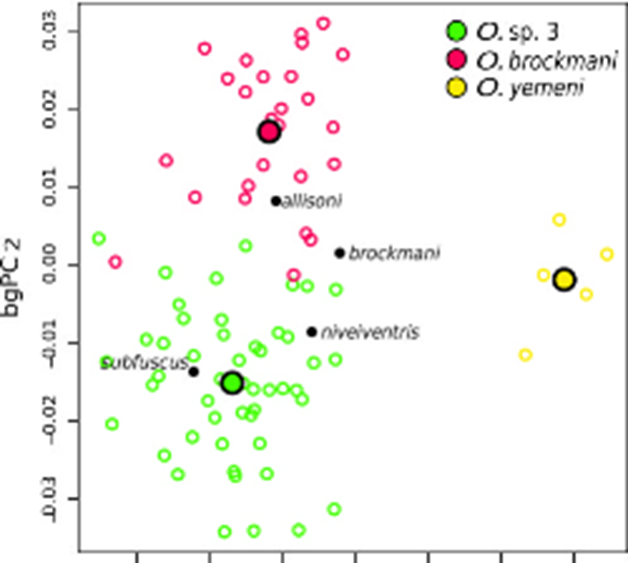
2. Using a combination of genomic and morphological data, a taxonomic revision was carried out of the recently described genus of white-bellied rock rats Ochromyscus, one of the few rodent genera with an Afro-Arabian distribution. Three species are recognized within this genus: two in East Africa (O. brockmani и O. niveiventris) and one in southern Arabia (O. yemeni), and their distribution, genetic structure, and reconstructed evolutionary history are described in detail. It was found that, despite a considerable degree of morphological similarity, the divergence of these three species occurred in pre-Pleistocene times, and the level of genetic divergence between them is comparable to that between related genera of murine rodents.
Опубликовано: Meheretu Y., Mikula O., Frynta D., Frýdlová P., Mulualem G., Lavrenchenko L.A., Kostin D.S., Elmi H. Sh. A., Šumbera R., Bryja J., 2024. Phylogeny, biogeography, and integrative taxonomic revision of the Afro-Arabian rodent genus Ochromyscus (Muridae: Murinae: Praomyini). Zoological Journal of the Linnean Society, 202(1): zlad158.
3. Using a combination of molecular-phylogenetic analyses and geometric morphometric methods, the genetic and morphological variability of three white-toothed shrew species (Crocidura thalia, C. glassi и C. afeworkbekelei) that replace one another in adjacent altitudinal belts of the Bale Mountains massif was studied. A high degree of genetic similarity among the three studied species was shown, along with significant differences in skull size and shape between them. The results obtained are consistent with the predictions of the model of ecological speciation. This is the first case confirming this mode of speciation simultaneously for three mammalian forms inhabiting three adjacent altitudinal belts of a single mountain massif.
Опубликовано: ZemlemerovaE.D., Martynov A.A., Sycheva V.B., Lavrenchenko L.A., 2024. The usage of historical DNA and geometric morphometric approach for detecting the ecological diversification along a remarkable altitudinal gradient. Mammalian Biology, 104(5): 529–538.
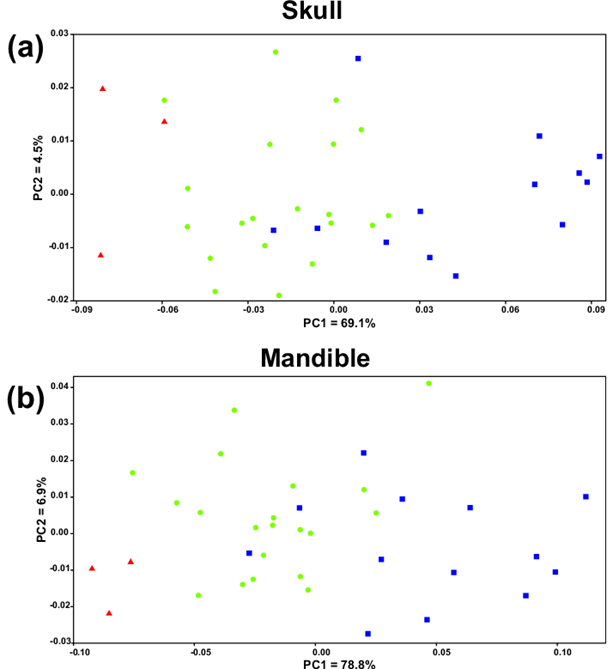
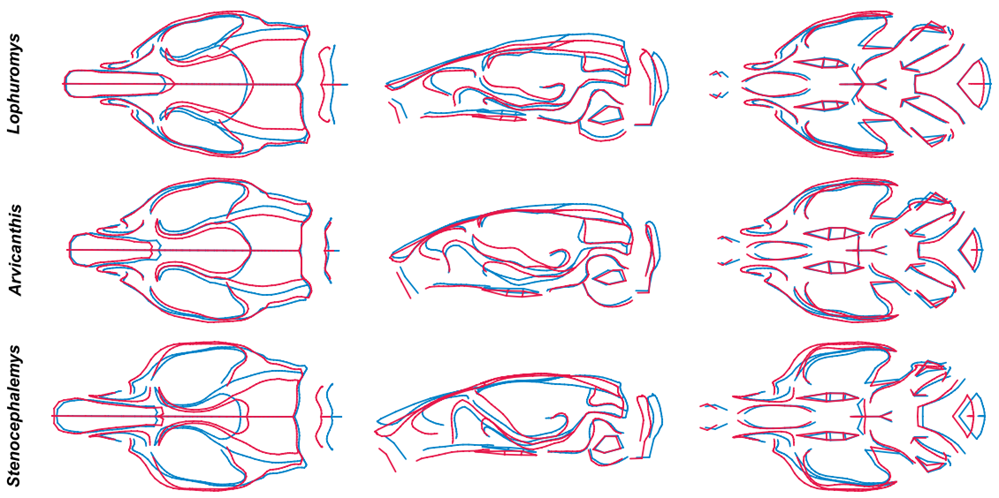
4. For the first time, a comparative study of skull shape was conducted in closely related rodent species specialized for life in different belts of a single altitudinal gradient. The application of computed tomography, three-dimensional virtual models, and geometric morphometry showed that altitude-related differentiation is a characteristic feature of changes in skull and mandible shape in all three genera studied (Lophuromys, Arvicanthis, Stenocephalemys) inhabiting the Ethiopian Highlands. It was shown that the eye orbits and the attachment sites of the masticatory muscles undergo the greatest transformation, reflecting adaptive changes in the peripheral part of the visual analyzer as well as specialization to different diets.
Опубликовано: Mizerovská D., Špoutil F., Claude J., Lavrenchenko L.A., Procházka J., Bryja J., Mikula O., 2023. Parallel evolution of skull form in three rodent genera inhabiting steep elevational gradients of Ethiopian highlands. Evolutionary Biology, 50(3): 332–349.
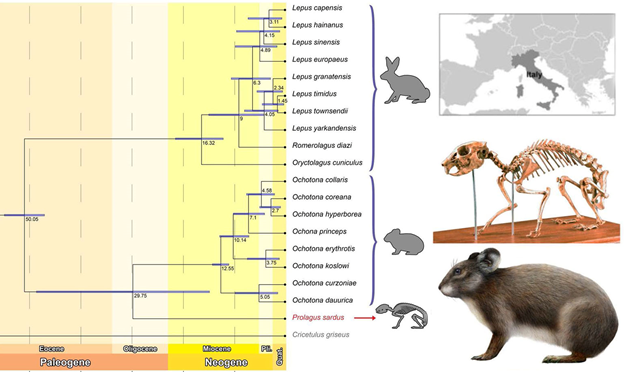
5. An analysis of the mitochondrial genome of the Sardinian pika Prolagus sardus was carried out to assess the phylogenetic position of the extinct group of lagomorph mammals, the prolagids. The results of the analysis confirmed the correctness of the unpopular view of Russian paleontologists regarding the rank of the prolagids as an independent family, Prolagidae. Thus, the prolagids have become a "new" family of mammals. The phylogenetic examination of a new family is an extremely rare event in mammalian science in recent years.
Опубликовано: Utzeri V.J., Cilli E., Fontani F., Zoboli D., Orsini M., Ribani A., Latorre A., Lissovsky A.A., Pillola G.L., Bovo S., Gruppioni G., Luiselli D., Fontanesi L., 2023. Ancient DNA re-opens the question of the phylogenetic position of the Sardinian pika Prolagus sardus (Wagner, 1829), an extinct lagomorph. Scientific Reports, 13(1): 13635.