
Заголовок
Standing Complex Radioecological Expedition
About the Expedition
In June 1986, scientists of the A.N. Severtsov Institute of Evolutionary Morphology and Ecology of Animals RAS began work on aquatic and terrestrial radioecology in the 30-km zone around the Chernobyl NPP. In the course of studying the Chernobyl disaster, the need arose to create a special section — "Ecology." By government decision, work on this section was entrusted to the USSR Academy of Sciences. The ecological section was subsequently transformed into an independent Complex Program, "The Impact of Radioactive Contamination on Flora and Fauna," planned for implementation in 1986-1990. The scientific director of this program was appointed to be Academician-Secretary of the Department of General Biology of the USSR Academy of Sciences and director of the A.N. Severtsov Institute of Evolutionary Morphology and Ecology of Animals RAS — Academician V.E. Sokolov.
In May 1987, on the basis of the Institute's Chernobyl Expedition, the Complex Radioecological Expedition of the USSR Academy of Sciences was established by order of the Presidium of the USSR Academy of Sciences; it continues to carry out radioecological and genetic research, albeit on a reduced scale, in Russia, Belarus, and Ukraine to this day. I.N. Ryabov was appointed head of the expedition. To accommodate staff and conduct field and laboratory research, expedition bases were organized in Chernobyl, on the shore of the Kyiv Reservoir in the village of Strakholesye, on the border of the 30-km zone around the Chernobyl NPP near the village of Oranoye in the Ivankiv District of Kyiv Region, and in the Zlynka District of Bryansk Region. Teams from 28 institutes of the USSR Academy of Sciences and a number of other agencies worked as part of the Complex Expedition at various times. Particular mention should be made of the great dedication of staff from Moscow research institutes such as the Institute of General Genetics — headed by V.A. Shevchenko, the Laboratory of Forest Science — headed by Yu.D. Abaturov, the Laboratory of Helminthology — headed by A.A. Pelgunov, the Institute of Chemical Physics — headed by I.I. Pelevina, the Institute of Physical Chemistry — headed by B.F. Gulev, as well as teams from institutions belonging to other agencies: MEPhI — headed by V.N. Lystsov, the Faculty of Soil Science of Moscow State University — headed by F.A. Tikhomirov, the Faculty of Biology of Moscow State University — headed by N.V. Belova, Yu.B. Kudryashov, A.S. Severtsov, and the All-Union Research Institute of Forest Chemistry (VNIIKhLes) — headed by V.P. Sidorov. In addition to Muscovites, expedition teams from many cities of our country took part — the Institute of Biology (Syktyvkar) — headed by A.N. Taskaev; the Institute of Biology of Leningrad State University — headed by Yu.N. Gorodilov; the Zoological Institute (ZIN) — headed by V.V. Khlebovich; and the Institute of Inland Water Biology "Borok" — headed by G.G. Shcherbina. The expedition also included groups of specialists from Ukrainian academic institutes of biological profile, among them the I.I. Schmalhausen Institute of Zoology (Kyiv) — headed by L.I. Frantsevich, and the Institute of Biology of the Southern Seas of the USSR Academy of Sciences (Sevastopol) — headed by G.G. Polikarpov. In Belarus, staff of the Institute of Zoology and Parasitology of the Belarusian Academy of Sciences — headed by M.M. Pikulik, the Institute of Radiobiology — directed by E.F. Konoplya, and the Faculty of Chemistry of Belarusian State University — headed by E.P. Petryaev and G.A. Sokolik, were actively involved. An important role in organizing experimental work on the Chernobyl NPP cooling pond in 1987-1990 was played by the team of the Ukrainian design, survey, and research institute "UkrGiprovodkhoz" (which was part of the Complex Expedition of the USSR Academy of Sciences in its early years) under the leadership of L.I. Filchagov.
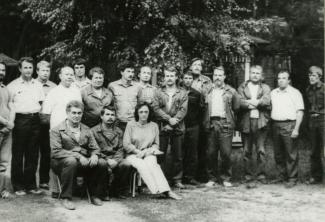
Участники Комплексной радиоэкологической экспедиции 1987 г.
Vladimir Evgenyevich Sokolov was one of the first ecologists to arrive at the site of the accident. He worked in the Chernobyl expedition on many occasions. On the tenth anniversary of this largest nuclear disaster of the 20th century, Vladimir Evgenyevich was awarded the Order of Courage — the first Russian order received by staff of our Institute.
In addition to obtaining scientific data, it was necessary, especially in the first years after the accident, to organize the exchange of the knowledge gained. To this end, it was decided in 1990 to hold the First International Conference on the Radioecological and Biological Consequences of the Chernobyl Accident. This conference gave impetus to international cooperation in radioecology and radiation genetics. In subsequent years, expedition staff were able to take part in many international projects, such as CIS/EEC, INCO-COPERNICUS, INTAS, TACIS, and others, carried out under the Agreement between the Republic of Belarus, Ukraine, Russia, and the Commission of the European Community. Over the years, more than 300 researchers, drivers, technicians, and workers took part in the expedition. At the Institute of Ecology and Evolution alone, 52 staff members became Chernobyl liquidators in 1986-1990. After the collapse of the USSR, the Expedition became based at a field station in the Novozybkov District of Bryansk Region. The data obtained have been presented in numerous Russian journals and conference proceedings.
Monitoring of radionuclide accumulation by various biota in the Bryansk Region of Russia is continuing at present.