

Key Results of the Laboratory 2023-2024
1. Extreme weather events such as extreme heat, droughts, floods, and frosts are becoming increasingly common due to global warming; understanding how soil microbes, which are crucial to ecosystem functioning, respond to them was the aim of this study. Microorganisms play a key role in natural processes such as the carbon cycle, which helps determine how much carbon is stored in the soil and how much is released into the atmosphere as carbon dioxide, a major driver of global warming. Soil samples from 30 grasslands in 10 European countries were subjected to simulated extreme weather events under controlled laboratory conditions to determine how the microbes would respond. It was shown that microbial communities in soils from different parts of Europe responded differently to extreme events. For example, soils from cooler, wetter climates were particularly vulnerable to heat waves and droughts, while soils from arid regions were more affected by floods. Microbes can "pause" their activity and enter a dormant state — essentially waiting out difficult conditions — under any of these weather events.
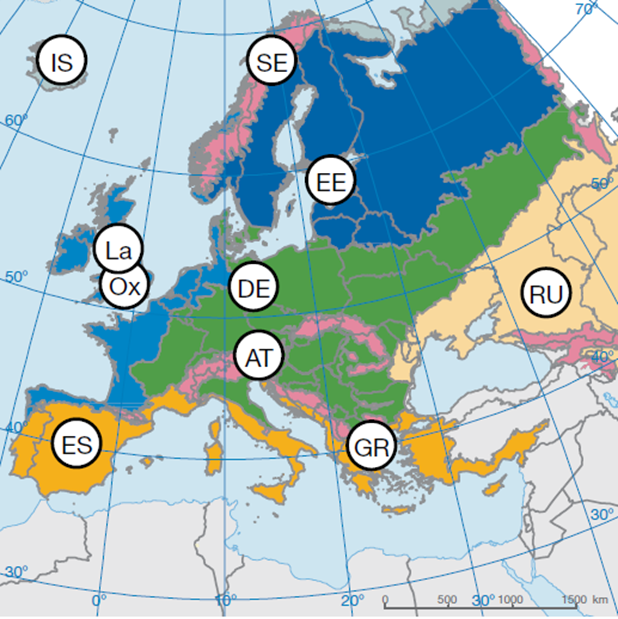
Knight, C.G., Nicolitch, O., Griffiths, R.I., Goodall, T., Jones, B., Weser, C., Langridge, H., Davison, J., Dellavalle, A., Eisenhauer, N., Gongalsky, K.B., Hector, A., Jardine, E., Kardol, P., Maestre, F.T., Schädler, M., Semchenko, M., Stevens, C., Tsiafouli, M.Α., Vilhelmsson, O., Wanek, W., De Vries, F.T., 2024. Soil microbiomes show consistent and predictable responses to extreme events // Nature. 2024. – V. 636. – P. 690–696. https://www.nature.com/articles/s41586-024-08185-3
2. An analysis of long-term trends in 923 terrestrial insect communities, monitored across 106 publications, showed that over time the abundance of initially common species declined, while the number of rare species did not. At the population level, it was found that species that were most abundant at the start of the time series showed the strongest average decline. The abundance of rare species also declined on average, but this was offset by increases in the abundance of other species. The results show that the observed decline in overall insect abundance can largely be explained by the widespread decline of formerly abundant species. This contradicts the common view that biodiversity loss is mainly characterized by the decline of rare species. Although the results show that fundamental changes are occurring in insect communities, it is important to recognize that they reflect only trends from sites for which sufficient long-term data are available. Nevertheless, given the importance of formerly common species in ecosystems, their overall decline is likely to have serious consequences for food webs and ecosystem functioning.
Опубликовано: van Klink R., Bowler D.E., Gongalsky K.B., Shen M., Swengel A.B., Chase J.M. 2024. Disproportionate declines of formerly abundant species underlie insect loss // Nature. Vol. 628. P. 359-364. https://www.nature.com/articles/s41586-023-06861-4
3. The problem of ensuring the sustainability of terrestrial ecosystems under increasing intensity of agricultural use is highly relevant in the modern world. A study of the composition and functioning of biota at the level of individual organisms, species, and whole communities established that, with intensifying agricultural use of grassland ecosystems, species and individuals characterized by small body size and accelerated functional processes acquire increasing functional importance in the communities of terrestrial and belowground organisms that inhabit them. This was demonstrated quantitatively for plants, bats, birds, flying insects, and various terrestrial and soil invertebrates, based on measurements of various morphological and functional parameters (traits). In disturbed ecosystems, by contrast, small, fast-moving, fecund species with intense physiological processes predominate (referred to as "fast" traits). Accordingly, ecosystems in lightly exploited meadows and pastures are "slow," accumulating a large biomass stock and characterized by relatively slow processes, whereas under intensive use they become "fast," with reduced biomass but accelerated functioning and response to stimuli. As a result, intensively used meadows and pastures can effectively resist complete degradation, since they recover faster after additional disturbance. The revealed mechanisms of ensuring the sustainability of meadows and pastures under intensifying human use, through accelerated functioning and a shift in community functional structure toward "fast" traits, demonstrate the possibility of a systemic solution to fundamental problems of enhancing the functioning of terrestrial ecosystems. In the applied domain, this discovery points to new approaches and prospects for developing a green economy based on the further introduction of nature-like technologies, which will increase agricultural efficiency while reducing the chemical burden on agrocenoses.
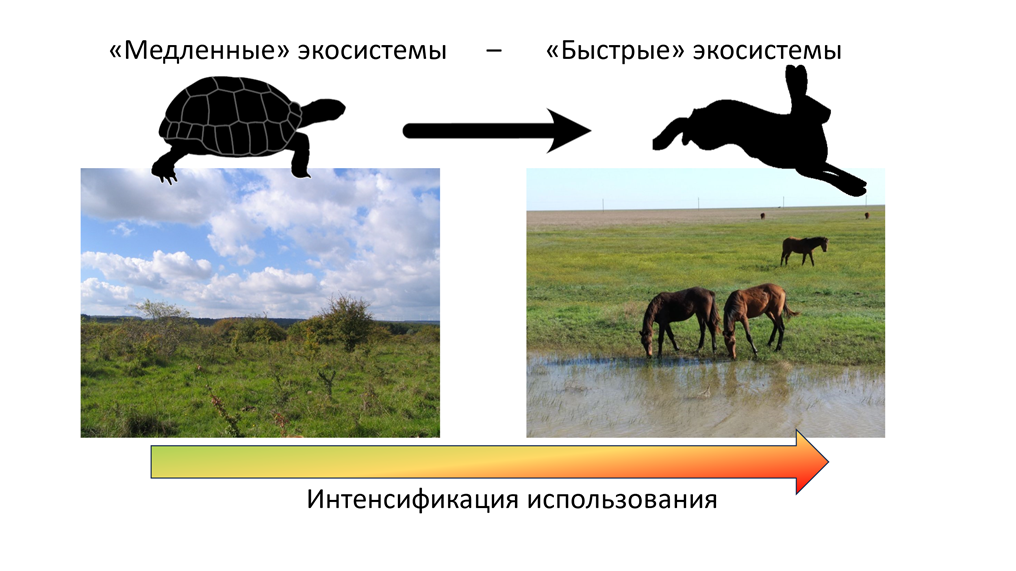
Опубликовано: Neyret M., Le Provost G., Boesing A.L., Schneider F.D., Baulechner D., Bergmann J., de Vries F.T., Fiore-Donno A.M., Geisen S., Goldmann K., Merges A., Saifutdinov R.A., Simons N.K., Tobias J.A., Zaitsev A.S., Gossner M.M., Jung K., Kandeler E., Krauss J., Penone C., Schloter M., Schulz S., Staab M., Wolters V., Apostolakis A., Birkhofer K., Boch S., Boeddinghaus R.S., Bolliger R., Bonkowski M., Buscot F., Dumack K., Fischer M., Gan H.Y., Heinze J., Hölzel N., John K., Klaus V.H., Kleinebecker T., Marhan S., Müller J., Renner S.C., Rillig M.C., Schenk N.V., Schöning I., Schrumpf M., Seibold S., Socher S.A., Solly E.F., Teuscher M., van Kleunen M., Wubet T., Manning P. // Nature Communications. – 2024. V. 15. – Paper 1251. https://doi.org/10.1038/s41467-024-45113-5
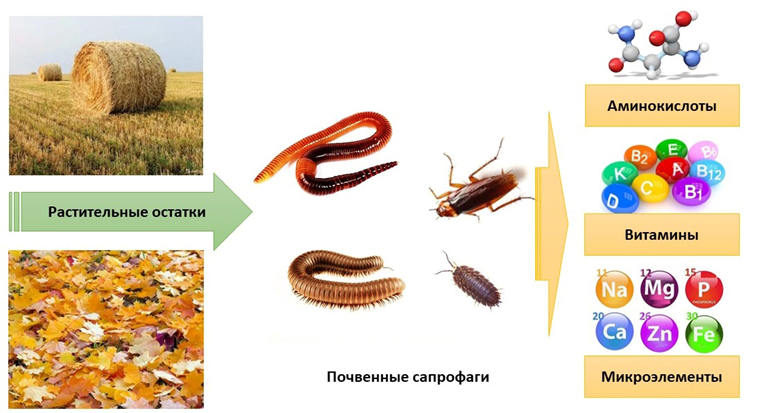
4. Animals that decompose plant litter (saprophages) constitute a major share of Earth's zoomass, but are little used by humans as a potential source of trace elements. To assess nutritional value in terms of trace elements, 30 invertebrate species obtained from natural ecosystems of European Russia were selected, together with a number of widely cultivated species from tropical regions: cockroaches (Blattodea), beetle larvae and adults (Coleoptera), springtails (Collembola), millipedes (Diplopoda), fly larvae including the black soldier fly (Diptera), earthworms (Haplotaxida), woodlice (Isopoda), and crickets (Orthoptera). Their amino acid, trace element, and vitamin composition was assessed, taxonomic differences in the composition and ratio of trace elements were determined, and specific taxa naturally enriched in micronutrients were identified for further consideration as potential feed additives. The most promising species were found to be the earthworms Lumbricus terrestris, Octolasion lacteum, и жук-носорог Oryctes nasicornis. (Head of the laboratory: K.B. Gongalsky, Dr. Sci. (Biol.), Professor of the Russian Academy of Sciences)
Опубликовано: Gongalsky K.B., Korobushkin D.I., Baratova L.A., Bastrakov A.I., Degtyarev M.I., Gorbunova A.Yu., Ksenofontov A.L., Lapa S.A., Lebedev I.M., Zaitsev A.S., 2023. Soil saprophages as an emerging global source of micronutrients // Journal of Insects as Food and Feed. V. 9. P. 1606-1613. (Q1, IF = 5.1).
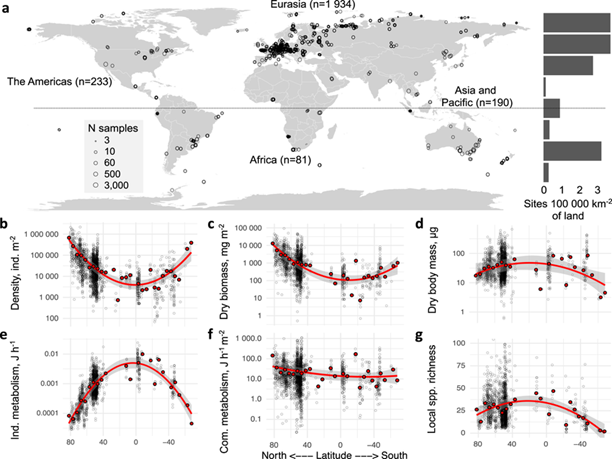
5. Unique data have been published on the global ecological role of springtails (Collembola) in regulating soil fertility and energy processes in terrestrial ecosystems. According to a global analysis based on data from 2470 sites, it was established that the biomass of springtails is equivalent to 27.5 megatonnes of carbon, three times greater than the biomass of terrestrial wild vertebrates. Notably, despite a 20-fold difference in biomass between the tundra and the tropics, springtails show a constant rate of energy use along latitudinal gradients, mainly influenced by temperature changes. These results indicate the potential impact of climate warming on fundamental indicators of soil biodiversity, which will have consequences for the restructuring of terrestrial food webs and soil functioning. A.M. Potapov, R.A. Saifutdinov, A.B. Babenko — different laboratories).
Опубликовано: Potapov A.M., Guerra C.A., van den Hoogen J., Babenko A., Bellini B.C., Berg M.P., Chown S.L., Deharveng L., Kováč L., Kuznetsova N.A., Ponge J.-F., Potapov M.B., Russell D.J., Alexandre D., Saifutdinov R.A., et al.. Globally invariant metabolism but density-diversity mismatch in springtails // Nature Communications. 2023.– V. 14. – Article 674.
6. A laboratory microcosm experiment was conducted to assess the possibility of using a mixture of littoral enchytraeids (Clitellata: Enchytraeidae) and Eisenia fetida earthworms to accelerate the decomposition of dominant algal taxa from the White Sea (Fucus spp.) and the Black Sea (Cystoseira spp.), while simultaneously reducing carbon dioxide emissions. It was found that adding a mixture of enchytraeids and earthworms significantly accelerates the decomposition of Cystoseira spp. algae. It was established that earthworm castings represent an important reservoir for concentrating marine carbon; at the same time, selective bacterial grazing by littoral enchytraeids on the algal surface can increase the efficiency of soil carbon accumulation by significantly reducing its loss as carbon dioxide. The results of the study are presented in the publication.
Опубликовано: Korobushkin D.I., Zaitsev A.S., Degtyarev M.I., Danilova M.A., Filimonova Zh. V., Guseva P.A., Pelgunova L.A., Pronina N.A., Tsurikov S.M., Vecherskii M.V., Volkova E.M., Zuev A.G., Saifutdinov R.A.,2023. Littoral enchytraeids and Eisenia fetida earthworms facilitate utilization of marine macroalgae as biofertilizers // Applied Soil Ecology. V. 188. P. 104882.
The following study guides have been published:
Малхазова С.М., Гонгальский К.Б. Современная экология: Учебное пособие по курсу «Экология с основами биогеографии». М.: Леналенд. 2023. 200 с. ISBN 978-5-9710-9913-0
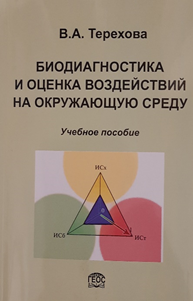
Терехова В. А. Биодиагностика и оценка воздействий на окружающую среду: учебное пособие. ГЕОС: Москва, 2023. – 102 с.
Рахлеева А.А., Терехова В.А., Гладкова М.М., Вавилова В.М., Кулачкова С.А., Розанова М.С., Батаков А.Д., Данилова М.А., Тригуб А.Г. Научная библиотека МГУ имени М.В. Ломоносова Москва, 2024. 21 с.
Terekhovа V.A., Kovaleva E.I., Kulachkova S.A., Rakhleeva A.A., Gorlenko M.V., Derevenets E.N., Sergeeva Yu D., Batakov А.D., Yakimenko O.S., Kozlov I.A. Principles of Biodiagnostics of Waste Hazards and Soil Health (Methodological Guide) ГЕОС Москва, ISBN 978-5-89118-889-1, 2024/ 64 с