
History
The Laboratory of Arid Territory Ecology was organized in 1993 on the initiative of P.D. Gunin. A major contribution to developing the unit's program was made by Hero of Socialist Labor of the USSR, USSR State Prize laureate, and Academician of the Turkmen Academy of Sciences N.T. Nechaeva.
Since 1988 to the present, the laboratory staff has carried out scientific and organizational work on expeditionary research for the Joint Russian-Mongolian Complex Biological Expedition of RAS and MAS (JRMCBE RAS and MAS).
The JRMCBE RAS and MAS was created in 1970, continuing research previously conducted by the Russian Geographical Society, expeditions of the USSR Academy of Sciences, and the Science Committee of Mongolia. Its scientific directors at various times were Academicians of the USSR Academy of Sciences E.M. Lavrenko and V.E. Sokolov, Corresponding Member of RAS R.V. Kamelin, as well as Academicians of the Mongolian Academy of Sciences B. Shirendev, N. Ulziikhutag, and O. Shagdarsuren, and Ts. Zhanchiv. Scientific leadership is currently provided by Academician of RAS D.S. Pavlov and Academician of MAS Ch. Dugarzhav. The heads of the Russian part of the expedition were Cand. Sci. (Biol.) P.B. Vipper, Dr. Sci. (Biol.) E.V. Rothschild, Dr. Sci. (Biol.) L.N. Medvedev, and, since 1988 to the present, P.D. Gunin. The deputy head for science is Dr. Sci. (Biol.) N.A. Dorofeyuk, the deputy head for logistics is A.D. Gunin, and the scientific secretary is Dr. Sci. (Biol.) S.D. Syrtypova. The head of the Mongolian part of the Expedition is Dr. Sci. (Biol.) Ya. Adyaa, director of the IGEB MAS, a student of Academician V.E. Sokolov.
The JRMCBE RAS and MAS operates in accordance with the agreements between the two countries on scientific and cultural cooperation (1947, 1971), decrees of the Presidiums of the academies of sciences of the two countries (1969, 2011), and the Agreement on Scientific Cooperation between RAS and MAS (2011).
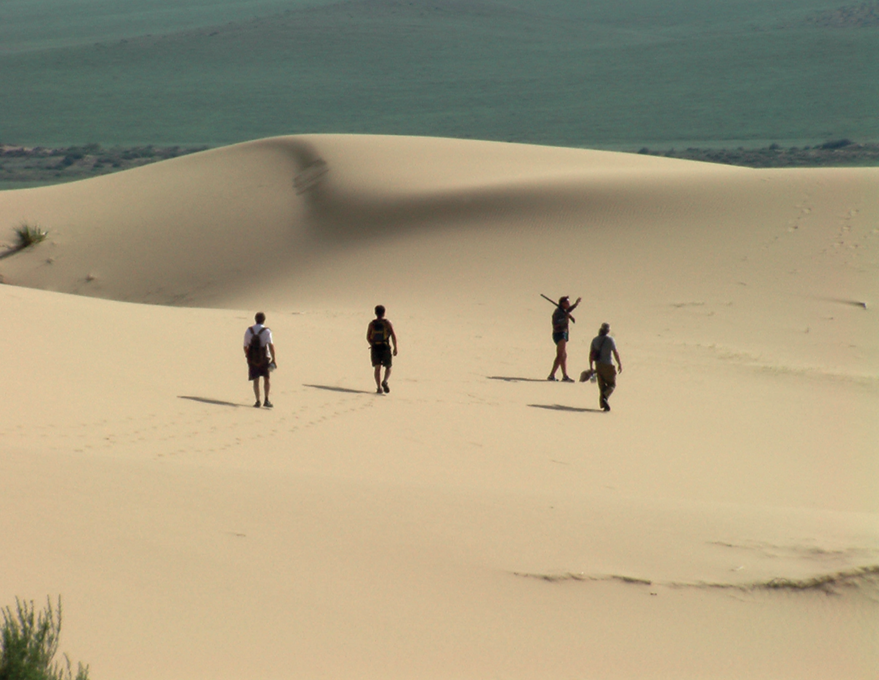
Mongolia lies at the junction of three major climatic systems and has the most rapid spatial transition of contrasting ecosystems in the world ― from alpine tundra to extremely arid deserts. The major botanical-geographical, edaphic, floristic, and faunistic boundaries pass through its territory, as does the watershed between the basins of the Arctic and Pacific Oceans and the closed drainage area of Asia. Studying the ecological conditions and ecosystems of Mongolia is of great importance for preserving ecological balance at the boundary of Siberia and the deserts of Asia, and especially for the UNESCO World Natural Heritage Site of Lake Baikal, 51% of whose basin lies within Mongolia's territory. The JRMCBE RAS and MAS has studied the properties of Mongolia's ecotonal territory for several decades under a comprehensive program combining route-based and stationary studies in botany, zoology, soil science, geomorphology, climatology, hydrology and permafrost studies, glaciology, landscape science and paleogeography, and cultural geography and social anthropology. The Expedition remains the largest permanently operating land expedition in the world. Up to 250-300 people from various research centers and universities of the USSR and Mongolia participated in its work at different times. In addition, scientists from many countries of the world (Israel, Germany, the USA, the United Kingdom, Japan, Iran, and others) worked within it on a temporary basis during certain periods.
Since the late 1990s, research has begun on the ecological assessment of the state of Mongolia's ecosystems, determining the degree of their anthropogenic disturbance, identifying diagnostic indicators of ecosystem degradation and desertification, and mapping them.
2025 will mark the 55th anniversary of the expedition's founding.