
Research Directions
The laboratory's priority research areas are:
- Developing a methodology for the ecological assessment of the biological component of landscapes and ecosystems of the arid, semi-arid, and subhumid zones functioning under extreme hydrothermal conditions.
- Creating cartographic models (landscape-ecological maps) of the region under study.
- Monitoring and studying the succession of pastoral, agricultural, and forestry ecosystems.
- Determining the causes of degradation and the degree of anthropogenic impact on ecosystems under climatic aridization.
- Developing recommendations and a system of measures to prevent further degradation of arid-zone ecosystems, and forecasting ecological situations to prevent environmental disasters.
Methodology:
- A comprehensive, ecosystem-based, and interdisciplinary approach, involving specialists from different fields with different perspectives, to study all the main components of the problem of ecological-balance disruption.
- Applying remote-sensing data (satellite imagery "Resurs," "Landsat TM," "Landsat ETM," NDVI data, etc.) as diagnostic and indicator signs of degradation and desertification processes of the main ecosystem types of the Baikal basin and adjacent territories.
- Identifying the role of "island" ecosystems (oases, wetlands, exposure forest stands, traditional sacred sites, etc.) in preserving the floristic-phytocoenological and ecosystem diversity of mosaic landscapes, and developing measures for their conservation and optimizing use regimes.
The main object of assessing anthropogenic ecosystem disturbance is the soil and vegetation cover, affected by pastoral, agricultural, forestry, and mining use of natural resources.
Great importance is attached to determining the diagnostic signs and the degree of development and manifestation of various desertification processes (sandification, gammadization, argillization, desiccation, dehumification, alkalization, and secondary salinization).
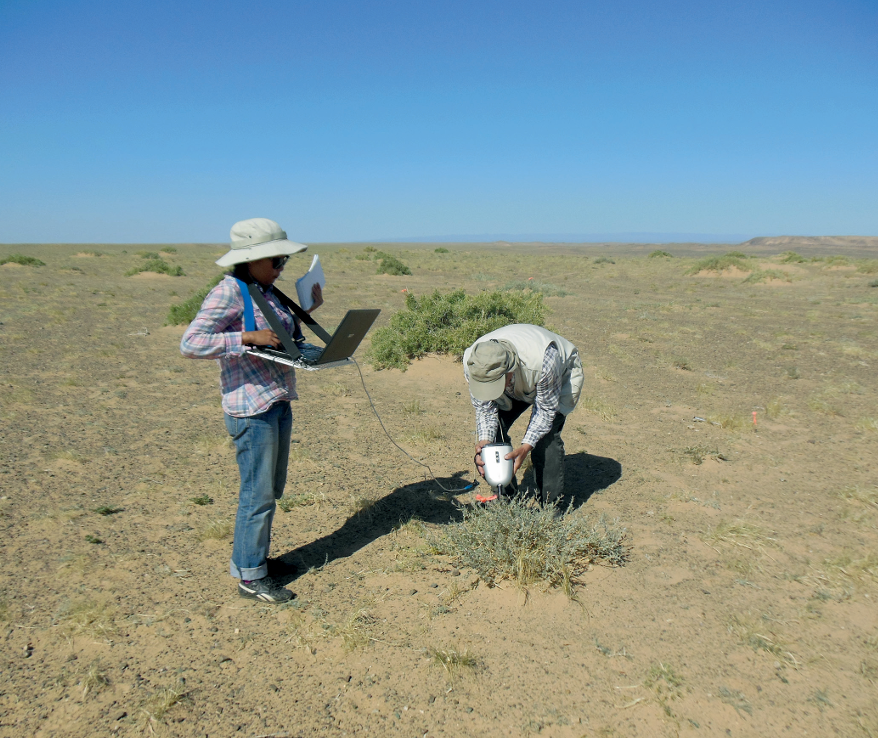
In recent years, laboratory staff have studied two important issues of international significance within individual projects and grants:
A) The processes of transboundary interaction between natural and anthropogenically disturbed ecosystems in the ecotonal zone of the mountain forests of Southern Siberia and the deserts of Central Asia. The most productive studies, both functionally and practically, concerned the dynamics of the expansion of invasive species — representatives of desert-steppe flora with a high degree of adaptation to climate aridization and alkaloid toxicity — in the forest-steppe and taiga landscapes of northern Mongolia. The conditions for the formation of monodominant communities of alkaloid-containing species were determined, and their biological features were discovered (drought tolerance, high seed productivity, a powerful surface root system), which give them a competitive advantage over native species of dry-steppe and forest-steppe ecosystems. This gives grounds to classify the phenomenon as a dangerous process of biological desertification of pastoral ecosystems.
B) Problems of analyzing ecosystem biodiversity and landscape degradation in the Baikal region (project 04/2015/RGS-RFBR), and the anthropogenic transformation of terrestrial ecosystems in the Baikal basin (topic 51.0, No. 01201356024) and (topic 52).