

A methodology for preparing orphaned tiger cubs, developed specifically for their release into the wild, has been published
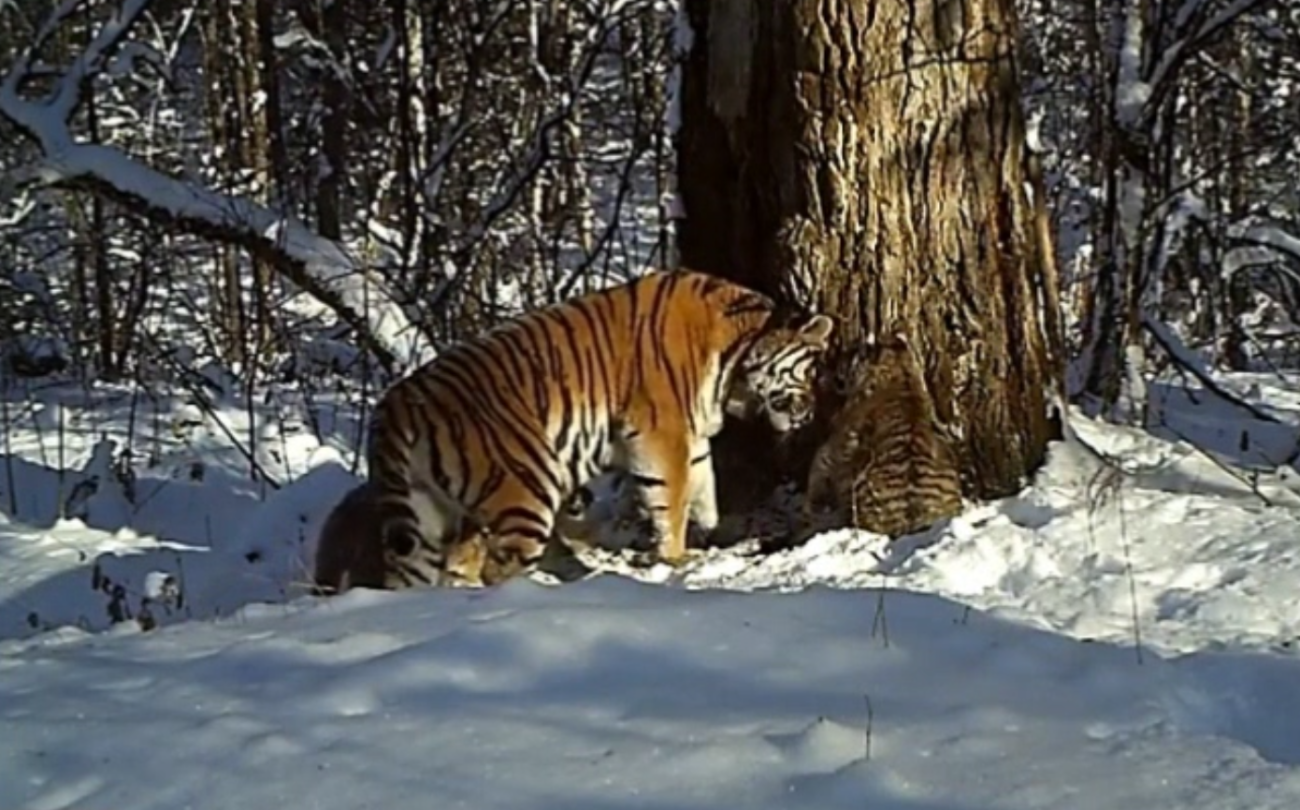
The article has been published in the journal *Izvestiya RAN* (Bulletin of the Russian Academy of Sciences: Biology) summarizing over a decade of work by scientists at the A.N. Severtsov Institute of Ecology and Evolution (RAS) on the rehabilitation and release of orphaned Amur tiger cubs into the wild. This initiative, launched between 2012 and 2014, laid the groundwork for restoring the tiger population in the northwestern part of its range, an area where the species had not been recorded since the 1970s.
In 2008, researchers from the A.N. Severtsov Institute of Ecology and Evolution of the Russian Academy of Sciences launched a program to study the Amur tiger in the Russian Far East. The program encompassed research into the species' spatial ecology, population-genetic variability, hormonal status, reproductive characteristics, and susceptibility to various infectious diseases. This work necessitated capturing and immobilizing these large predators, as well as employing both instrumental and non-invasive research methods. During the course of the study, the idea emerged to rescue orphaned tiger cubs - which frequently appeared in the taiga only to perish there - and to use them to restore tiger populations in areas where the species had previously been exterminated by humans.
To implement this concept, IEE RAS built an experimental Amur tiger rehabilitation and reintroduction center in Primorsky Krai between 2013 and 2014. Six tiger cubs - three males and three females - underwent training there after being removed from the wild at the age of 4-6 months following the deaths of their mothers. The process was designed to completely eliminate direct contact between the animals and humans, a measure essential for preserving their natural instinct to avoid people. However, successfully executing the plan required developing a specific methodology for the work.
It took over a decade of patient effort to go from the initial idea to the final result. In fact, the development of the methodology began long before the actual releases took place. Researchers began formulating ideas on how to instill appropriate behavior in captive-reared predators as early as 2007-2011, drawing on concepts and work pioneered by Ya.K. Badridze and V.S. Pazhetnov. Insights into key aspects of tiger biology were also incorporated based on V.G. Yudin’s unique experience in keeping tigers in captivity. Yet, working with animals as large and complex as tigers demands exceptional patience and time.
"It took years to realize that our efforts had succeeded. It was not until 2015 that it became known that the tigress Zolushka - successfully prepared for life in the wild and released in 2013 - had produced her first offspring with a wild male in the Bastak Nature Reserve," notes Vyacheslav Rozhnov, an Academician of the Russian Academy of Sciences. This was a pivotal moment: it confirmed that rehabilitated animals not only survive but are also capable of reproducing - meaning they can form family groups, thereby making the restoration of the population a real possibility. Researchers also needed time to verify their hypotheses regarding sensitive periods of behavioral development using groups of animals kept in captivity.
Working with large predators presents certain challenges. Preparing tigers for life in the wild is a lengthy process that requires a deep understanding of the animal's biology. Some crucial behavioral nuances can only be grasped by observing animals in captivity, while other aspects are revealed solely through monitoring tigers in the wild - both truly wild individuals and those that have been released.
The methodology is based on three conceptual approaches: (i) the concept of sensitive periods - there are specific age-related "windows" during which tiger cubs are most receptive to the formation of certain behaviors and, subsequently, the skills needed for survival in their natural habitat; (ii) the concept of species-typical behavior - it is essential that the animals develop the natural behavioral responses characteristic of tigers in the wild; and (iii) the concept of an integrated ontogenetic scale - all developmental changes in the cub are systematized on a timeline, providing a ready-reference guide for the timely introduction of necessary stimuli.
Key aspects of the training program included fostering natural hunting behaviors - such as capturing wild prey (roe deer, red deer, and wild boar) - while simultaneously maintaining and reinforcing an avoidance response toward humans. Particular emphasis was placed on developing appropriate social interactions with other tigers. Video cameras and camera traps were used for monitoring, allowing the process to be observed remotely without interfering with the animals' lives.
The project's success has been proven over time: the released tigers not only survived and hunted successfully but also formed families and produced offspring. A self-sustaining population comprising at least 25 breeding individuals has now become established in the northwestern part of the tiger's range (see Rozhnov et al., 2021, DOI: 10.31857/S0044513421010074 and DOI: 10.1134/S1062359021080239).
"This work has a long history. What we have now presented in a publication is the result of over a decade of observations, analysis, and an understanding of how to properly prepare predators for their return to the wild," summarizes Anna Yachmennikova.