

Laboratory Results 2023-2024
1. The area of Caucasus glaciers has shrunk by 23% over the past 20 years, which may soon lead to the extinction of cold-adapted species and to major shifts in their habitat range. For the first time in Russia, invertebrate successions over the past 150-170 years were studied on well-dated surfaces (IG RAS) that emerged after the retreat of Central Caucasus glaciers (Tsey, Bezengi, Kashkatash). It was established that the pioneer species complex is largely similar to the supraglacial community existing on the surface of the glacier itself. The taxonomic diversity of most groups increases progressively over time, but community succession follows a replacement (rather than an additive) model, in which the animal community is fundamentally transformed at each stage of vegetation-type change (heath — meadow — shrubland — forest). At the same time, the pace of succession slows during the forest phase (Fig. 1). Of the 438 species found, 30 proved new to science, and Caucasus endemics were numerous at all succession stages. The classical principles of primary succession — the "predator first paradox principle" (Hodkinson et al. 2001, 2002) and the "Collembola first principle" (Hågvar et al. 2020; Hågvar and Gobbi 2022) — were challenged, since a number of major taxa and trophic groups appear on young surfaces almost simultaneously and very rapidly.
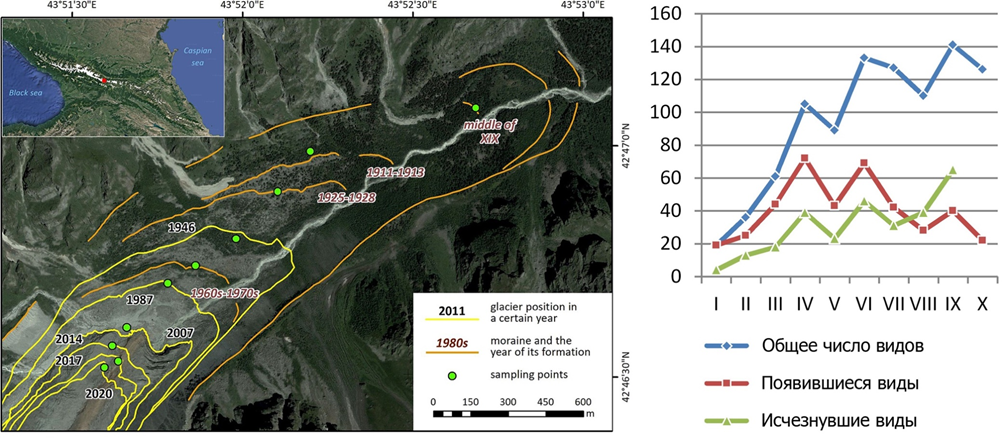
Publications: Makarova O.L., Antipova M.D., Babenko A.B., Bushueva I.S., Chulei A.D., Golovatch S.I., Doroshina G.Ya., Kolesnikov V.B., Mazei Yu.A., Makarov K.V., Palatov D., Ponomarev A.V., Popov K.P., Rapoport I.B., Semionenkov O.S., Snegovaya N.Y., Sheftel B.I., Tsyganov A.N., Turbanov I.S., Zuev R.V. 2024. Successions of terrestrial invertebrate communities during the Tsey Glacier retreat, Central Caucasus // Caucasiana. No 3. P. 41–87. DOI: 10.3897/caucasiana.3.e117332 [РИНЦ]
Marin I.N., Palatov D.M. 2024. The diversity of freshwater stygobiotic crustaceans in the republic of North Ossetia–Alania provides new evidence for the existence of an ancient glacial refugium in the North Caucasus region // Water. Vol. 16, no. 9. P. 1212–1212. https://doi.org/10.3390/w16091212 [Q1, Scopus]
Makarchenko E.A., Semenchenko A.A., Palatov D.M. 2024. Smittia solominae sp. nov. (Diptera: Chironomidae: Orthocladiinae), living on ice of high mountain glaciers of the Elbrus region (North Caucasus) // Zootaxa. Vol. 5415, no. 4. P. 561–569. https://doi.org/10.11646/zootaxa.5415.4.5 [Q2, Scopus]
Shveenkova Y.B., Antipova M.D., Babenko A.B. 2024. Nine new species of the genus Oligaphorura Bagnall 1949 (Collembola, Onychiuridae) from Russia // Зоологический журнал. Т. 103. №. 1. С. 8–32. doi: 10.31857/S0044513424010029 [Q4, Scopus]
Striuchkova A.V., Antipova M.D., Potapov M.B., Semenova D.A., Kuznetsova N.A. 2024. Distribution of genetic lineages of Parisotoma notabilis sensu lato (Collembola) in Eastern Europe and the Caucasus: new lineages and morphological differences // Soil Organisms. Vol. 96, no 1. P. 23–36. doi: 10.25674/356
Makarchenko E. A., Palatov D.M. 2024. Redescription of the caucasian endemic Diamesa tskhomelidzei Kownacki et Kownacka (Diptera: Chironomidae: Diamesinae) // Zootaxa. Vol. 5419, no. 3. P. 446–450. https://doi.org/10.11646/zootaxa.5419.3.9 [Q2, Scopus]
Teslenko V.A., Palatov D.M., Semenchenko A.A. 2024. Overview of the caucasian Perla Geoffroy, 1762 (Plecoptera: Perlidae) based on morphological and molecular data with description of two new species // Zootaxa. Vol. 5507, no. 1. P. 1–56. https://doi.org/10.11646/zootaxa.5507.1.1 [Q2, Scopus]
Makarchenko E.A., Semenchenko A.A., Palatov D.M. 2024. Morphological description and DNA barcoding of Diamesa achipseensis sp. nov. (Diptera: Chironomidae: Diamesinae) from southwestern Caucasus // Zootaxa. Vol. 5481, no. 4. P. 477–482. https://doi.org/10.11646/zootaxa.5481.4.6 [Q2, Scopus]
2. Contrary to expectations, the taxonomic diversity of Caspian littoral mites (the most diverse group of animals on sea shores) proved to be sharply impoverished, consisting only of common Holarctic or European species represented by the most ordinary haplotypes. At the same time, endemism of the Caspian marine fauna reaches 60-80% in some groups, and the soil and stygobiotic invertebrate complexes of marine terraces contain numerous new, endemic, and relict species. It is suggested that the constant instability of the Caspian coastline — even now receding by 25-30 cm per year, with no true intertidal zone — has historically also hindered the emergence of new and the persistence of rare littoral fauna taxa.
Publications: Makarova O.L., Kazemi S. 2024. A new species of Antennoseius from the Caspian region and the species composition of the oudemansi-group (Acari, Mesostigmata, Ascidae) // Systematic & Applied Acarology. Vol. 29, no 7. P. 811–830. [Q1, Scopus]
Andrianov B.V., Makarova O.L., Goryacheva I.I. 2024. Genetic variability of abundant littoral species of mesostigmatic mites (Acari, Mesostigmata) with different distributions from the seashores of Eurasia // Acarologia. Vol. 64, no 4. P. 1191–1212. [Q2, Scopus]
Makarchenko E.A., Semenchenko A.A., Palatov D.M., Lisanovskaya E.A. 2024. Morphological description and DNA barcoding of Thalassomya paraskevae sp.nov. (Diptera: Chironomidae: Telmatogetoninae) from coast of the Black Sea // Zootaxa. Vol. 5481, no. 4. P. 477–482. https://doi.org/10.11646/zootaxa.5501.4.2 [Q2, Scopus]
Kolesnikov V.B., Klimov P.B., Khaustov A.A., Makarova O.L. 2024. A new arenicolous species of the genus Thyreophagus (Acari: Acaridae) from the Caspian Sea coast: Taxonomy and ecological insights. Zootaxa. In press. [Q2, Scopus]
3. In total, 39 species of soil, freshwater, and amphibiotic invertebrates new to science were described: 1 Clitellata, 3 Gastropoda, 12 Collembola, 13 Crustacea, 5 Arachnida, 5 Insecta. Pre-glacial refugia of stygobiotic fauna were discovered in the Caucasus and the Volga region. Regional taxonomic revisions of three arthropod genera were carried out, and the faunogenetic processes of Eastern European freshwater sponges and Beringian pond snails were analyzed.
Teslenko V.A., Palatov D.M., Semenchenko A.A. 2024. Overview of the caucasian Perla Geoffroy, 1762 (Plecoptera: Perlidae) based on morphological and molecular data with description of two new species //Zootaxa. Vol. 5507, no 1. P. 1-56. https://doi.org/10.11646/zootaxa.5507.1.1[Q2, Scopus]
Sokolova A.M., Palatov D.M., Itskovich V.B. 2024. Latitudinal distribution of freshwater sponge species across European Russia // Zoologischer Anzeiger. Vol. 311. P. 88-96. https://doi.org/10.1016/j.jcz.2024.06.004[Q1, Scopus]
Palatov D.M., Chertoprud E.M. 2024. A new stygobiotic species of the genus Proasellus Dudich, 1925 (Crustacea: Isopoda: Asellidae) from the Black sea coast of the Caucasus // Invertebrate Zoology. Vol. 21, no 3. P. 369-383. https://doi.org/10.15298/ invertzool.21.3.09 [Q1, Scopus]
Novikov A.A., Sharafutdinova D.N., Mayor T.Y., Chertoprud E.S. 2024. A New Species of Diacyclops (Copepoda, Cyclopoida) from the D. crassicaudis (Sars, 1863) Species Group with Critical Taxonomy Remarks //Diversity. Vol. 16, no 4. P. 208. https://doi.org/10.3390/d16040208 [Q1, Scopus]
Fefilova E. B., Novikov A. A., Chertoprud E.S. 2024. A new species of the genus Moraria T. Scott et A. Scott, 1893 (Copepoda: Harpacticoida) from Russian Arctic // Artropoda Selecta. Vol. 33, no 1. P. 53-64. https://doi.org/ 10.15298/arthsel.33.1.05 [Q2, Scopus]
Nekhaeva A.A., Kim L.V., Yeszhanov A.B. 2024. New data on the spider fauna (Arachnida, Aranei) of the East Kyzylkum Desert, Kazakhstan // Arthropoda Selecta. Vol. 33, no 3. P. 391–405. https://doi.org/ 10.15298/arthsel.33.3.08 [Q2, Scopus]
Aksenova O.V., Vinarski M.V., Itagaki T., Ohari Y., Oshida T., Kim S.K., Lee J.H., Kondakov A.V., Khrebtova I.S., Soboleva A.A., Travina O.V., Sokolova S.E., Palatov D.M., Bespalaya Y.V., Vikhrev I.V., Gofarov M.Yu., Bolotov I.N. 2024. Taxonomy and trans-beringian biogeography of the pond snails (Gastropoda: Lymnaeidae) of East Asia: an integrative view // Zoological Journal of the Linnean Society. Vol. 201, no 4. zlae083. https://doi.org/ 10.1093/zoolinnean/zlae083 [Q1, Scopus]
Dózsa-Farkas K., Makarova O. 2024. A new species of the enchytraeid genus Mesenchytraeus Eisen, 1878 (Clitellata, Enchytraeidae) from the eastern Chukot Peninsula, Russian Far East, as further evidence of former trans-Beringian faunal connections // Zootaxa. In press. [Q2, Scopus]
4. It has been established that the periglacial surfaces of circumpolar land in both hemispheres, as well as new territories formed after the retreat of mountain glaciers, are inhabited predominantly by the same arthropod groups, among which the most common are thin-cuticled representatives of the families Nanorchestidae, Eupodidae, Brachychthoniidae (Acari), Isotomidae (Collembola), and Chironomidae (Insecta). Thus, the youngest biome on Earth — the polar desert — and the pioneer surfaces of former glacier beds are inhabited by the most ancient animal groups, tracing their origin to the Devonian (microarthropods) or Triassic (non-biting midges), whose diet relies heavily on biofilms forming on mineral particles. Evidence was obtained for the leading role of aeroplankton in the colonization of these cold pioneer substrates by these groups.
Исполнители: О.Л. Макарова, Д.М. Палатов, А.Б. Бабенко, М.Д. Антипова, Зав. лаб. – О.Л. Макарова
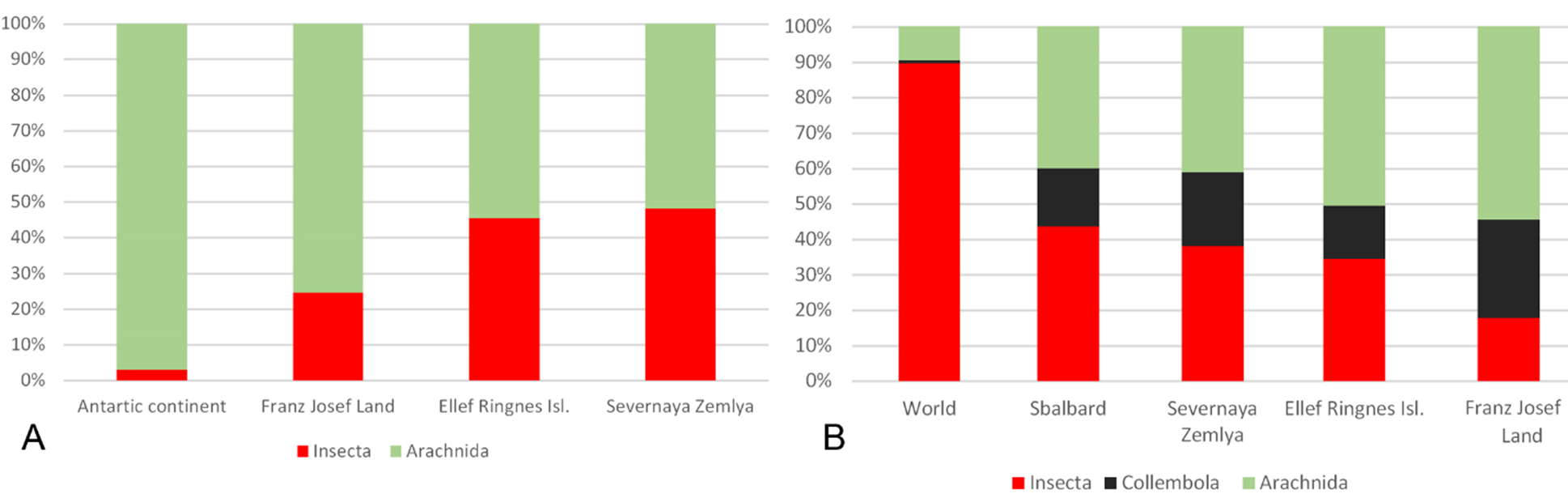
Makarova O.L. 2023. Free-living mites (Acari) of the Franz Josef Land Archipelago, the coldest Old World territory: diversity, geographic distributions, assemblages // Acarologia. V. 63. № 4. P. 1163–1186. https://doi.org/10.24349/p6wb-pcni
Антипова М. Д., Бабенко А.Б., 2023. Формирование сообществ коллембол (Hexapoda, Collembola) при отступании Цейского ледника (Северная Осетия-Алания) // Зоологический журнал. Т. 102, № 12, с. 1–19. https://doi.org/10.31857/S0044513423120036
Makarchenko E.A., Semenchenko A.A., Palatov D.M. 2023. Fauna and taxonomy of Diamesinae (Diptera, Chironomidae) from the Caucasus, with a morphological description and DNA barcoding of new taxa and a discussion of diagnostic problems for Diamesa Meigen and Pseudodiamesa Goetghebuer // Zootaxa. V. 5271. № 2. P. 313–328.
5. The succession of dominant-species complexes in communities of different ecological groups of organisms during the development of a thermokarst tundra water body is described. It is shown that the sequential change of community types constitutes primary succession. For testate amoebae and microcrustaceans with short life cycles, environmental factors varying on timescales of months to years proved significant. For macroinvertebrates with prolonged development, key environmental factors varied on a scale of a year or more. It is suggested that the first ecosystem changes driven by global climate change will appear in zooplankton, micro-, and meiobenthos communities, as these are more sensitive to short-term environmental changes.
Опубликовано: Chertoprud E.S., Novichkova A.A., Tsyganov A.N., Vorobjeva L.V., Esaulov A.S., Krylenko S.V., Mazei Y.A. 2023. Species Diversity and Driving Factors of Benthic and Zooplanktonic Assemblages at Different Stages of Thermokarst Lake Development: A Case Study in the Lena River Delta (Middle Siberia) // Diversity. V. 15. №4. P. 511. https://doi.org/10.3390/d15040511
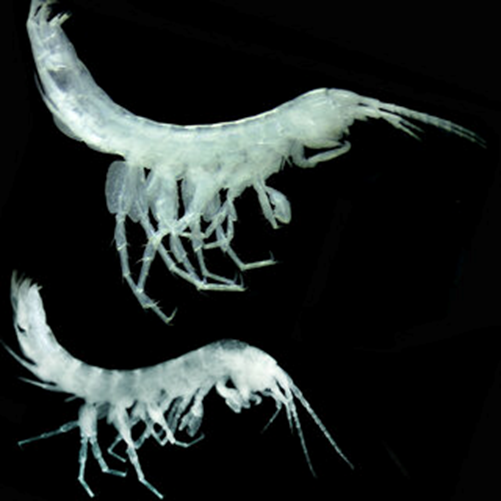
6. A unique refugium of pre-glacial ancient-freshwater fauna has been discovered in the lower reaches and estuarine zone of the Don River. The amphipod crustaceans inhabiting this area have been studied and described. New, locally distributed species within the endemic Caucasian genera Diasynurella and Pontonyx, as well as within the pan-European genera Niphargus and Cryptorchestia, were found in springs and groundwater of the Kizitirinka River basin, which flows through the city of Rostov-on-Don. In total, four species new to science were described. Molecular data confirm their long-term isolation dating back at least to the Pliocene. This is the first clearly delineated lowland freshwater fauna refugium discovered and described in the Ciscaucasia and Sea of Azov region. It was previously thought that the ancient fauna of these areas had gone extinct during glacial periods and was subsequently replaced by widespread pan-European species. Our data indicate that this unique fauna has survived fragmentarily and locally.
Palatov D.M., Marin I.N. 2023. Diversity of the caucasian genus Diasynurella Behning, 1940 (Amphipoda: Crangonyctidae) with description of four new species // Arthropoda Selecta. V.32. № 1. P. 23–55. doi: 10.15298/arthsel.32.1.03
Marin I.N., Palatov D.M. 2023. A new semi-terrestrial Cryptorchestia Lowry et Fanini, 2013 (Amphipoda: Talitridae) from the southwestern Caucasus and the Ciscaucasian plain // Arthropoda Selecta. V. 32. № 3. P. 281–292. doi:10.15298/arthsel.32.3.05
Marin I.N., Palatov D.M. 2023. A revision of the genus Pontonyx Palatov et Marin, 2021 (Amphipoda: Crangonyctidae), with an overview of crangonyctid diversity in the Palaearctic // Arthropoda Selecta, V.32. № 2. P. 173–196. doi: 10.15298/arthsel.32.2.04
Marin I.N. Palatov D.M. 2023. Insights on the existence of ancient glacial refugee in the northern Black/Azov sea lowland, with the description of the first stygobiotic microcrustacean species of the genus Niphargus Schiödte, 1849 from the mouth of the Don River // Diversity. V. 15. № 5. 682. doi:10.3390/d15050682
7. Principles for compiling Red Data Books as a tool for conserving a region's successional system have been formulated:
а) система объектов животного и растительного мира, занесённых в ту или иную Красную книгу, должна соответствовать сукцессионной системе, актуальной в регионе действия данной Красной книги;
б) места обитания занесённых в Красную книгу видов животных и растений должны охватывать сообщества организмов разного ранга, функциональные блоки и уязвимые комплексы региональной сукцессионной системы;
в) промежуточные стадии сукцессии целесообразно поддерживать не консервационно, искусственным торможением сукцессии, а ротационно, когда завершение той или иной стадии сукцессии на одном участке сопровождается достижением той же стадии сукцессии на топологически близком участке;
г) фрагментация природного покрова и уменьшение характерного размера местообитаний снижает хорологический класс вида, при котором возникает риск потери жизнеспособности его популяций.
Using insects listed in the Red Data Book of the Moscow Region as an example, it is shown that, taken together, their habitats significantly (though not completely) cover the diversity of natural ecosystems in the region. One obstacle is the insufficiently studied dynamics of plant communities and their not-yet-fully-developed classification.
Published: Sobolev N.A., Волкова Л.Б. Красная книга как инструмент защиты экосистем в эпоху антропоцена // Использование и охрана природных ресурсов в России. 2023. №2. С. 13-18. https://istina.msu.ru/publications/article/612726634/