

Key Results of the Laboratory 2023-2024
1. Alien species pose a potential threat to local ecosystems and economies. The mosquitofish Gambusia holbrooki is a dangerous invasive species, but despite this it continues to be used on the Black Sea coast of the Caucasus for the biological control of mosquito larvae. Flexible behavior allows the mosquitofish to easily integrate into food webs. Among the helminths of the mosquitofish, we found the nematode Pseudocapillariatomentosa and the cestode Schyzocotyle acheilognathi. The nematode P. tomentosa is recorded for the first time in fish of the genus Gambusia. The cestode S. acheilognathi is the most successful invasive parasite species in the planet's freshwater bodies. It is extremely dangerous for natural ecosystems and aquaculture, being the causative agent of bothriocephalosis, which causes mass mortality of juvenile fish. The use of the mosquitofish as a biological control agent needs to be restricted.
Опубликовано: Lebedeva D.I., Petrovskiy A.B., Reshetnikov A.N., 2024. Potential role of the Eastern mosquitofish (Gambusia holbrooki) in the spread of the harmful fish parasite, Asian tapeworm Schyzocotyle (Bothriocephalus) acheilognathi. // Parasitologia 2024, 4, 358–368. https://doi.org/10.3390/parasitologia4040031
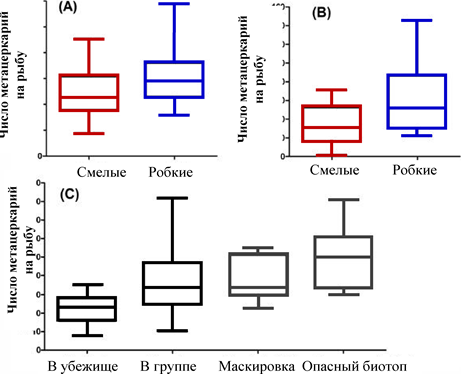
2. The traditional concept of the unconditionally positive role of refuges in shaping population size in environments with high densities of parasites and predators has been revisited. Using a mathematical model, it was shown that when refuges are insufficient, total population mortality increases sharply. This effect results from the interaction between emerging dynamic behavioral structuring and strong intraspecific competition for refuges. Non-plastic behavioral structuring (a stable division into "bold" and "shy" individuals) reduces the negative effects. The mathematical modeling was supplemented by experimental results on the infection of rainbow trout (Oncorhynchus mykiss) by the trematode Diplostomum pseudospathaceum, which is capable of manipulating host behavior.
Опубликовано: Sandhu, S., Mikheev, V., Pasternak, A., Taskinen, J., Morozov, A., 2024. Revisiting the role of behavior-mediated structuring in the survival of populations in hostile environments. Communications Biology, Vol. 7(1), p.93. Q1, IF=6,3
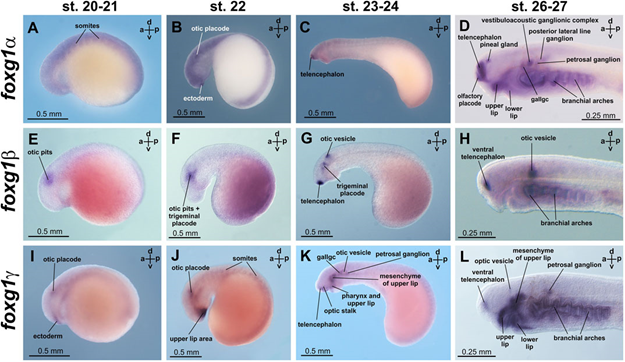
3. Three foxg1 genes — key regulators of early forebrain and sense-organ development — have been described in lampreys, along with their expression in the river lamprey Lampetra fluviatilis and the sterlet Acipenser ruthenus. It was shown that these genes share a common origin in lampreys and other vertebrates, and arose as a result of two rounds of genome duplication early in evolution. Based on phylogenetic data, linked loci, and expression patterns, it is difficult to precisely establish the pairwise correspondence of homologous foxg1 genes between lampreys and sterlet. The emergence of three foxg1 homologs in jawless and jawed vertebrates could have resulted either from two rounds of genome duplication in the common vertebrate ancestor (the classical model), or from a first shared round followed by independent polyploidization in the two evolutionary lineages (the modern independent-duplication hypothesis). Thus, a common origin of the foxg1 genes was found across all vertebrates, which is important for understanding the evolution of spatial orientation in vertebrates.
Опубликовано: Ermakova GV, Kucheryavyy AV, Mugue NS, Mischenko AV, Zaraisky AG, Bayramov AV., 2024. Three foxg1 paralogues in lampreys and gnathostomes - brothers or cousins? Frontiers in Cell and Developmental Biology 11:1321317. doi: 10.3389/fcell.2023.1321317
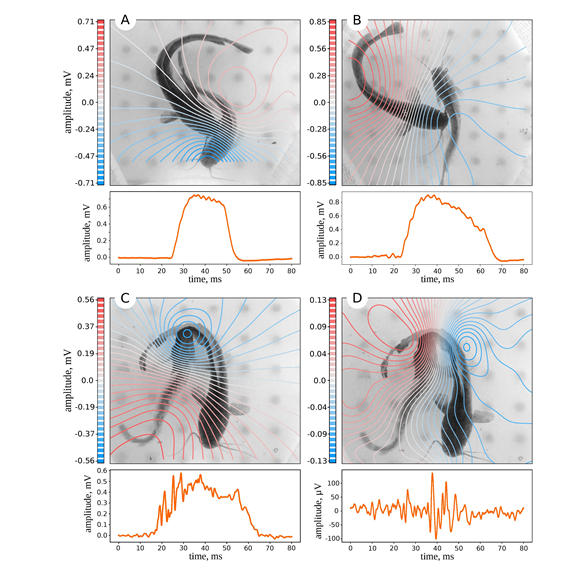
4. A technology for visualizing the electric fields of fish has been developed for the first time. It allows identification of the source fish, localization of electrogenic structures, display of discharge patterns and the spatial distribution of potentials for simultaneously occurring electrical events, quantitative assessment of the effects of one fish on another at any relative position, and visualization of electric-field distortions caused by various objects. The technology will help expand our understanding of electrocommunication, electrogenesis, and the role of electric fields in the ecology and evolution of aquatic animals. It will make it possible to develop tools for non-invasive monitoring of the condition of aquatic organisms, environmental biomonitoring, and toxicity assessment of synthetic substances, including nanomaterials.
Опубликовано: Zlenko D.V. , Olshanskiy V.M., Orlov A.A., Kasumyan A.O., MacMahon E., Xue W., Moller P. Visualization of Electric Fields and Associated Behavior in Fish and other Aquatic Animals // Behavior Research Methods, 2023, doi 10.3758/s13428-023-02175-5; Ольшанский В. М., Барон В. Д., МакМагон Е., Зленко Д. В. Электрические рыбы как объект фундаментальных исследований // Известия вузов. ПНД. 2023. T. 31, № 6. С. 674–709. DOI: 10.18500/0869-6632- 003075
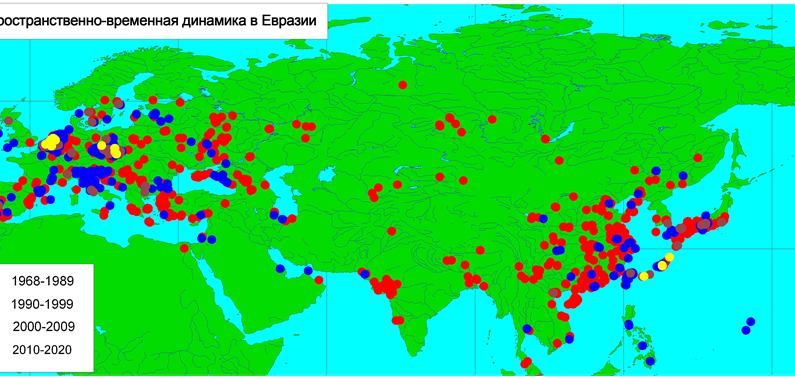
5. A unique database on the ecology of the North American freshwater red-eared slider turtle Trachemys scripta elegans in Eurasia has been developed with the participation of co-authors from 51 research organizations in 19 countries. A GIS analysis of 50 years of data revealed the regions of earliest introduction and the dynamics of spread, covering 68 countries. Data were obtained for the first time for eight countries. Trends in abundance, habitat association, and breeding success of the turtle in different parts of Eurasia have been established. An extensive geographic region of successful overwintering (without reproduction) has been identified, in which the growth in the number of colonized water bodies and pseudopopulation abundance is driven by amateur releases of new individuals. A new type of biological invasion has been described — a conditional invasion, occurring without the formation of self-sustaining populations.
Опубликовано: Reshetnikov A.N., Zibrova M.G., … Petrovskiy A.B., … Petrosyan V.G. 2023. Rarely naturalized, but widespread and even invasive: the paradox of a popular pet terrapin expansion in Eurasia // NeoBiota. V. 81. P. 91–127. DOI: 10.3897/neobiota.81.90473
6. Previously, population-dynamics modeling was mostly concerned with long-term ecosystem studies; transient regimes were neglected. However, the role of transient regimes in population dynamics is now being fundamentally reconsidered. This theoretical study (based on discrete-time population models) demonstrates the importance of transient, non-equilibrium processes for predicting ecosystem resilience and species persistence. In particular, it is shown that sudden ecosystem collapse and species extinction can occur without any influence of external factors. This occurs because a long-lasting transient quasi-stationary regime is mistakenly perceived as final, whereas, once this regime ends, the ecosystem abruptly shifts to a different regime without any external influence. The possibilities for modeling such scenarios in ecology are discussed.
Morozov, A. Y., Almutairi, D., Petrovskii, S. V., Lai, Y. C., 2023. Long transients in discontinuous time-discrete models of population dynamics. // Chaos, Solitons and Fractals. V. 174. P. 113707.