Key Results of the Laboratory 2023-2024
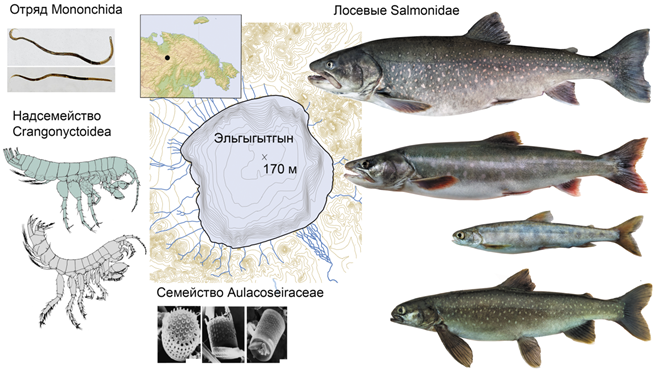
1. Lake El'gygytgyn is the only ancient lake in the Arctic (located on the Anadyr Plateau) that escaped Pleistocene ice-sheet glaciation. Over 2 million years of continuous existence, the lake has become a refuge for ancient species that have disappeared elsewhere in their range; a center of origin for new species; and a site of ongoing adaptive evolution of postglacial colonizers. Our work has described a uniquely high level of faunal endemism in Lake El'gygytgyn. The lake is home to giant nematodes of the order Mononchida and eyeless, depigmented amphipods of the superfamily Crangonyctoidea, which serve as food for the relict salmonid fish, the long-finned char, capable of living more than 30 years. Other salmonid lake fish — deep-water predatory char, descendants of a later colonization wave — underwent secondary adaptive divergence, giving rise to a new coastal-form species amid ongoing modern warming. The flesh of the new species is distinguished by an exceptionally high concentration of essential omega-3 fatty acids.
Publications - Esin, E. V., Shkil, F. N., Zlenko, D. V., Medvedev, D. A., Korostelev, N. B., & Markevich, G. N. Quaternary history and radiation of Salvelinus fish in the ancient Arctic Lake El'gygytgyn. Hydrobiologia. - 2024. - Vol. 851. - P. 2389–2404. DOI: 10.1007/s10750-023-05464-4; Copilaş-Ciocianu, D., Prokin, A., Esin, E., Shkil, F., Zlenko, D., Markevich, G., Sidorov, D. The subarctic ancient Lake El'gygytgyn harbours the world's northernmost 'limnostygon community' and reshuffles crangonyctoid systematics (Crustacea, Amphipoda). Invertebrate Systematics. - 2024. - Vol. 38. DOI: 10.1071/IS24001
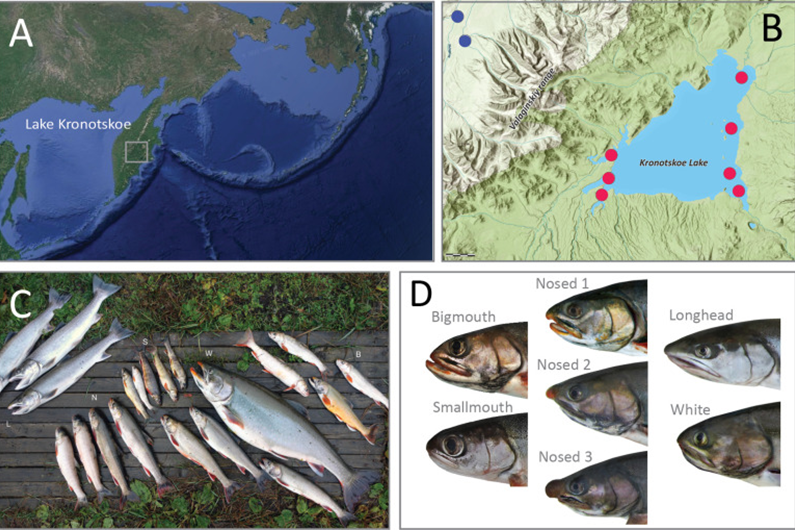
2. The molecular-physiological mechanisms triggering the divergence of adaptive phenotypes in early individual development have been studied. Lake fish at the initial stages of evolutionary diversification were chosen as the study model. Genomic data analysis revealed key mutations affecting a small number of regulatory genes with pleiotropic effects, including genes related to hormonal signaling and regulators of connective tissue development. Quantitative exome analysis showed that divergent morphogenesis is driven by differential expression of genome regions responsible for key processes of growth and differentiation of cartilage and muscle tissue, neural and intercellular signal conduction, and energy metabolism. Adaptation to habitat occurs through changes in energy metabolism.
Publication: Woronowicz, K. C., Esin, E. V., Markevich, G. N., Martinez, C. S., McMenamin, S. K., Daane, J. M., Harris, M. P., & Shkil, F. N. Plylogenomic analysis of the Lake Kronotskoe species flock of Dolly Varden charr reveals genetic and developmental signatures of sympatric radiation // Development (Cambridge). - 2024. - Vol. 150(20). - dev.203002. DOI: 10.1242/dev.203002
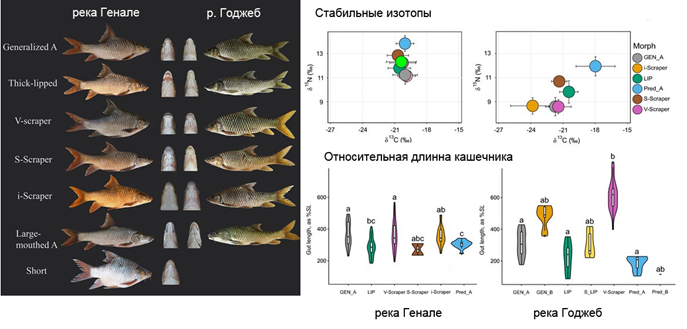
3. As a result of many years of research on the rivers of the Abyssinian Plateau in Africa, A.S. Golubtsov, together with colleagues from other organizations, discovered so-called "swarms of forms" of polyploid cyprinid fish of the genus Labeobarbus [Levin et al., 2023]. Each swarm consists of 4–6 sympatric morphotypes. A number of independently originated swarms show a uniform pattern of divergence in mouth-apparatus phenotypes, which can be linked to dietary specialization. Using stable isotope analysis and gut-content analysis, the degree of trophic specialization and the effectiveness of niche partitioning within each swarm were assessed. It was found that the forms within the swarms are at different stages of trophic-ecological differentiation, regardless of the degree of phenotypic difference (Figure 1). Cases of ecologically non-functional polymorphism of the oral cavity are a striking example of "Liem's paradox" and support a plasticity-based concept of evolution. Diversification may be based on pre-existing genomic templates inherited from ancestors. Pre-adaptive polymorphism of the oral cavity can be regarded as a key innovation of this fish group that facilitates its rapid and effective trophic diversification.
Published: Levin, B. A., Komarova, A. S., Tiunov, A. V., & Golubtsov, A. S. Liem's paradox in parallel trophic diversifications of polyploid fish: from preadaptive polymorphism to trophic specialization // Hydrobiologia. - 2024. - Vol. 851. - P. 5137–5138. DOI: 10.1007/s10750-024-05689-x
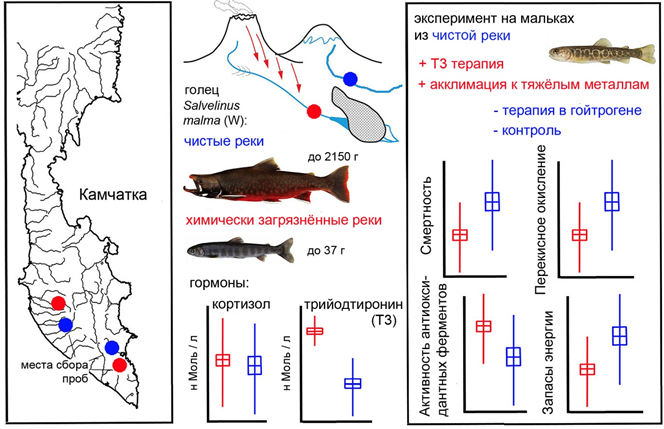
4. The role of hormonal mechanisms in the adaptation of salmonid fish to living in chemically polluted streams on volcano slopes has been established. Results of field and experimental studies on the physiological basis of adaptation to heavy-metal pollution in Dolly Varden char (Salvelinus malma) are presented. Populations from volcanic streams have a physiological phenotype that distinguishes them from populations inhabiting clean waters. They are characterized by a hyperthyroid status accompanied by an increased metabolic rate, elevated antioxidant enzyme activity, reduced tissue ionic conductivity, and reduced energy reserves. Experimental data show that hyperthyroidism is an adaptive trait that increases resistance to chemical pollution and drives the direction of the fish's evolutionary specialization.
Published: Esin E.V., Shulgina E.V., Shkil F.N., 2023. Rapid hyperthyroidism-induced adaptation of salmonid fish in response to environmental pollution // Journal of Evolutionary Biology. V. 36. P. 1471‑1483. doi: 10.1111/JEB.14220; Esin E.V., Shulgina E.V., Pavlova N.S., Zlenko D.V., 2023. The role of thyroid hormones in the adaptation of Salvelinus charr (Salmonidae) to volcanic habitat pollution // Journal of Ichthyology. V. 63. № 6. P. 731–739. doi: 10.31857/S0042875223060036