

History
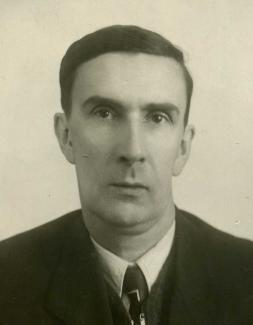
Г.В Никольский, 1950-е годы.
In 1956, the eminent Russian ichthyologist Georgy Vasilyevich Nikolsky (Professor and Head of the Department of Ichthyology at the Faculty of Biology, Lomonosov Moscow State University, since 1941; Corresponding Member of the USSR Academy of Sciences since 1953) organized the Laboratory of Ichthyology within the Institute of Animal Morphology of the USSR Academy of Sciences (now the A.N. Severtsov Institute of Ecology and Evolution RAS). The breadth of G.V. Nikolsky's scientific interests determined the diversity of the laboratory's research directions: population dynamics; the adaptive significance of variability; recruitment formation — fecundity, quality of sex products and their relationship to the quality of the parent stock; food availability, growth patterns, and fat balance; natural and fishing mortality, the predator-prey problem; and patterns of fish behavior and distribution. Individual research areas in the laboratory were led by such authoritative researchers as Boris Petrovich Manteifel, Georgy Dmitrievich Polyakov, Evgeny Vasilyevich Borutsky, Nina Ivanovna Chugunova, and Katerina Romanovna Fortunatova.
The Laboratory of Ichthyology comprised two groups — fish ecology (headed by G.V. Nikolsky) and fish behavior (headed by Prof. B.P. Manteifel). In 1967, these groups were separated into independent laboratories — the Laboratory of Ecology of Lower Vertebrates and the Laboratory of Behavior of Lower Vertebrates — which remain part of the Institute to this day. G.V. Nikolsky headed the first laboratory until 1977, and B.P. Manteifel headed the second until 1986.
From 1977 to 2014, the Laboratory of Ecology of Lower Vertebrates was headed by Prof. Mikhail Ilyich Shatunovsky. Alongside the previously established research directions, this period saw the wide development of work employing genetic and karyological methods as well as mathematical modeling. It should be noted that modeling and karyological research had already been initiated by G.V. Nikolsky. M.I. Shatunovsky's research made a major contribution to the development of fish ecological physiology and bioenergetics. The study of fish biodiversity in Russia and a number of regions of Europe, Asia, the Americas, and Africa occupied a significant place in the laboratory's activities. The staff's work on the ecology, evolution, and systematics of such fish groups as sturgeons, whitefishes, spined loaches, African barbs, and gobies has received wide international recognition.
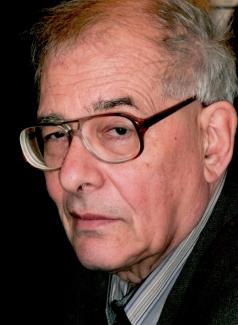
М.И. Шатуновский, 2014 г.
Even before G.V. Nikolsky founded the Laboratory of Ichthyology, fundamental research on ichthyological topics was already being conducted at the Institute of Animal Morphology. The most important results on the ecology of reproduction and early developmental stages of fish were obtained in laboratories concerned mainly with morphogenesis, embryology, and phylogeny, headed by students of Academician Alexei Nikolaevich Severtsov — Prof. Vladimir Viktorovich Vasnetsov, Prof. Sergei Grigoryevich Kryzhanovsky, and Prof. Boris Stepanovich Matveev. In the 1950s–70s these research teams were headed by Dr. Sci. (Biol.) Elena Fedorovna Eremeeva, Dr. Sci. (Biol.) Nikolai Nikolaevich Disler, and Dr. Sci. (Biol.) Sergei Vladimirovich Emelyanov. The scientific staff and research themes of these teams were largely inherited by the Laboratory of Fish Ontogeny Ecology and Morphology, headed from 1977 to 1992 by Dr. Sci. (Biol.) Boris Viktorovich Koshelev. After B.V. Koshelev's death in 1992, the Laboratory of Fish Ontogeny Ecology and Morphology joined the Laboratory of Ecology of Lower Vertebrates as a group headed by Cand. Sci. (Biol.) Georgy Igorevich Ruban. Later, in 2000, it was separated into an independent group under the Institute's Directorate and remained in that status until 2006, when it was again incorporated into the Laboratory of Ecology of Lower Vertebrates.
The work of the Laboratory of Fish Ontogeny Ecology and Morphology was focused mainly on studying embryogenesis, gameto- and gonadogenesis, as well as the patterns of reproductive cyclicity, spawning, and developmental abnormalities in marine and freshwater fish. In order to reflect on the Institute's website the activities of the Laboratory of Fish Ontogeny Ecology and Morphology and its predecessors (the laboratories of V.V. Vasnetsov, S.G. Kryzhanovsky, and N.N. Disler, which worked on ichthyological subjects), we considered it necessary to present the research staff, main achievements, and publications of these teams as supplements to the corresponding sections on the activities of the Laboratory of Ecology of Lower Vertebrates.
Research at the Laboratory of Ecology of Lower Vertebrates is carried out in close collaboration with other departments of the Institute working on ichthyological topics (the Laboratories of Problems of Evolutionary Morphology, Behavior of Lower Vertebrates, Ecology of Aquatic Communities and Invasions, and Ecological Monitoring of Nuclear Power Plant Regions and Bioindication). The laboratory's collaboration with Russian and foreign scientific organizations spans a broad geography.
Staff of the Laboratory of Ecology of Lower Vertebrates, in addition to collecting material and conducting field research in many freshwater basins and marine waters of the Soviet Union and the Russian Federation, actively participated in the work of the Complex Radioecological Expedition of the USSR Academy of Sciences, the Joint Soviet-Mongolian Complex Biological Expedition, the Tropical Center in Vietnam, the Joint Russian-(Soviet-)Ethiopian Biological Expedition, the Peruvian Biological Station of the USSR Academy of Sciences, and the Soviet-Cuban cooperation program in oceanology. Laboratory staff have taken part in international programs including Cypriniformes Tree of Life (NSF, USA), All Catfish Species Inventory (NSF, USA), and Long-term Ecological Effects of a Biological Invasion (The Arctic University of Norway, Tromsø, Norway).
The staff's work has been recognized with scientific prizes and awards: the First Prize of the Moscow Society of Naturalists for 1987 (V.P. Vasilyev for the monograph "Evolutionary Karyology of Fish"), the title of laureate of the Foundation for Assistance to Domestic Science under the "Candidates and Doctors of Sciences of the RAS" program in 2005-2006 (E.B. Lebedeva and A.S. Golubtsov), the Prize of the Academician V.E. Sokolov Charitable Foundation for the Support of Science (A.S. Golubtsov in 2011, M.I. Shatunovsky in 2014, G.I. Ruban in 2018), and the title of Distinguished Nature Conservationist for services to nature conservation in the Republic of Sakha (Yakutia) (Yu.S. Reshetnikov in 2017). It should also be noted that N.N. Disler was awarded the A.O. Kovalevsky Prize in 1976 for a series of works on "Ecological and morphological patterns in the development of the lateral line sensory organs of fish."
Over the years, the following people worked at and made significant contributions to the Laboratory of Ecology of Lower Vertebrates: Liliya Evgenyevna Anokhina, Ada Vasilyevna Assman, Tatyana Nikolaevna Belyanina, Yury Yulianovich Dgebuadze (now Academician RAS), Vyacheslav Yakovlevich Ermokhin, Nona Konstantinovna Kanevskaya, Evgeny Arkadyevich Kriksunov (now Corresponding Member RAS), Evgeny Yuryevich Krysanov, Yury Emelyanovich Lapin, Natalya Nikolaevna Lapina, Elena Borisovna Lebedeva, Nina Pavlovna Makarova, Igor Aleksandrovich Paraketsov, Viktor Aleksandrovich Pegasov, Olga Aleksandrovna Popova, Galina Yuryevna Provorova, Dmitry Vladimirovich Serov, Mikhail Anatolyevich Snetkov, Irina Evgenyevna Starostina, Lyudmila Nikitichna Tryapitsyna, Yudif Ilyinichna Cheprakova, Aleksandr Vladimirovich Shaikin, and Margarita Aleksandrovna Sharkova (a photographic history of the laboratory — link to Reshetnikov's album); in the Laboratory (later — Group) of Fish Ontogeny Ecology and Morphology — Nina Vasilyevna Akimova, Nikolai Nikolaevich Disler, Mark Viktorovich Gulidov, Elena Nikolaevna Dmitrieva, Nikolai Ivanovich Dragomirov, Irina Nikolaevna Ziborova, Mikhail Igorevich Molyukov, Klara Ivanovna Moskalkova, Sergei Petrovich Muntyan, Marina Prokhorovna Nikolskaya, Klara Sergeevna Popova, Pavel Nikolaevich Reznichenko, Igor Nikolaevich Ryabov, Sergei Aleksandrovich Smirnov, and Diana Mikhailovna Tsypanova. Photo history
From 2015 to 2025, Dr. Sci. (Biol.) Aleksandr Serafimovich Golubtsov served as acting head of the Laboratory of Ecology of Lower Vertebrates. Since 2025, the laboratory has been headed by Evgeny Vladislavovich Esin.
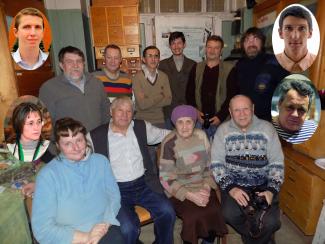
The laboratory staff in December 2018 — front row (left to right): Evgenia Alekseevna Chikurnova, Ekaterina Leonidovna Sokolova, Viktor Pavlovich Vasilyev, Olga Aleksandrovna Popova, Yury Stepanovich Reshetnikov, Georgy Igorevich Ruban; back row — Denis Vladimirovich Prazdnikov, Sergei Sergeevich Alekseev, Aleksey Markovich Orlov, Maksim Olegovich Skomorokhov, Dmitry Aleksandrovich Medvedev, Aleksandr Serafimovich Golubtsov, Aleksandr Evgenyevich Bobyrev, and Evgeny Vladislavovich Esin.
Supplement: History and key staff of the Institute's laboratories that worked on ichthyological subjects and arose earlier than, or existed in parallel with, G.V. Nikolsky's Laboratory of Ichthyology (later the Laboratory of Ecology of Lower Vertebrates).