

Key Results of the Laboratory 2023-2024
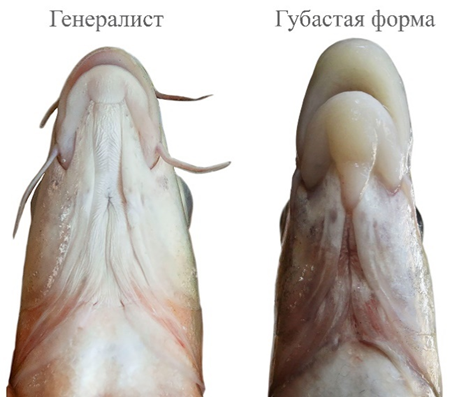
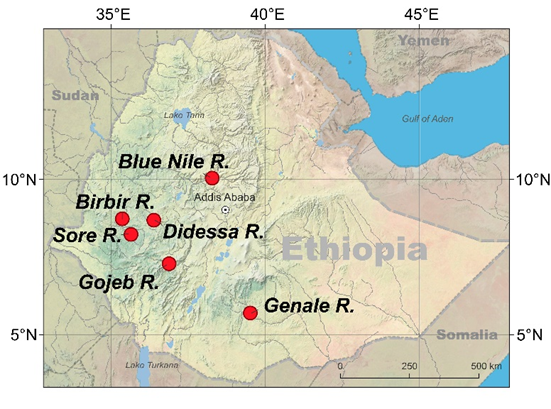
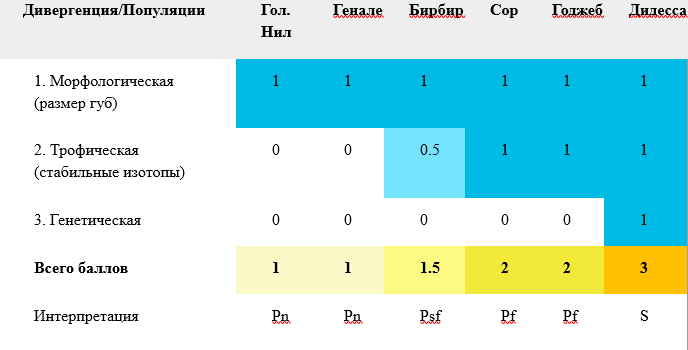
1. In studying adaptive radiations in fish, a continuum of speciation was discovered during the emergence and fixation of an adaptive trait — enlarged, or "rubber," lips used for a novel feeding mode: sucking benthic prey hidden between rocks — using African barbs of the genus Labeobarbus as an example. This adaptation arises independently in different barb populations inhabiting isolated water bodies of the Ethiopian Highlands. Analysis of a series of cases at different stages of the process, using methods of morphology, ecology, and genomics, made it possible to trace the stages of speciation associated with the partitioning of trophic resources among co-occurring (sympatric) populations. It was found that a phenotypic innovation arises first, followed by its ecological functionalization, with genetic divergence — i.e. speciation — occurring at a later stage.
Publication: B. Levin, A. Komarova, E. Simonov, A. Tiunov, M. Levina, A. Golubtsov, F. Kondrashov, A. Meyer «Speciation and repeated origins of hypertrophied lips in parallel adaptive radiations of cyprinid fish from East Africa». 2023. Ecology and Evolution, V. 13, Is. 9. https://onlinelibrary.wiley.com/doi/10.1002/ece3.10523, (lab head A.Yu. Krysanov).
2. Karyotype differentiation was studied in a group of African short-lived (annual) fish species of Nothobranchius ugandensis, comprising 12 valid species. The originality of the study lay in the fact that, in addition to cytogenetic data for each of the 12 species, a complete set of phylogenetic and biogeographic data was also analyzed. All members of the group are characterized by a conserved diploid chromosome number of 2n = 36, but a variable number of chromosome arms, NF = 46–64, suggesting a significant role for pericentric inversions and/or other types of centromere repositioning in the evolution of this group's genomes. The cytogenetic characteristics showed no relationship either with phylogenetic relationships or with the peculiarities of range distribution.
Publication: Krysanov E.Yu., Nagy B., Watters B.R., Sember A., Simanovsky S.A. (2023) Karyotype differentiation in the Nothobranchius ugandensis species group (Teleostei, Cyprinodontiformes), seasonal fishes from the east African inland plateau, in the context of phylogeny and biogeography. Comparative Cytogenetics 7(1): 13–29. https://doi.org/10.3897/compcytogen.v7.i1.97165