
Results
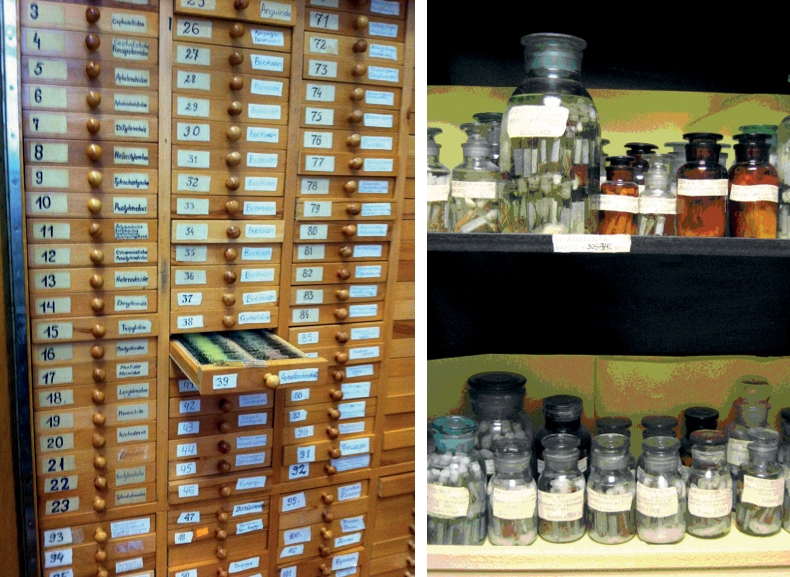
At present, the museum's helminth collection includes more than 4,000 identified species and a large number of forms identified only to genus or higher taxonomic level (over 300,000 storage units), from 6 classes (cestodes, trematodes, acanthocephalans, nematodes, monogeneans, protozoa). The materials have been entered into the Database and published in a 4-volume catalog.
The collection's core asset is its type material (new, previously unknown parasite species), represented by 762 species from 6 classes of parasitic organisms, as well as voucher specimens (more than 10,000 storage units), which can be used in karyological, biochemical and molecular-phylogenetic studies to confirm the systematic affiliation of the organisms and their phylogeny and evolution. Analysis of the collection material has yielded new information on the biodiversity of parasites, their hosts, the geography of their distribution, and the factors shaping helminth complexes in the host.
For the first time, studies of voucher collection specimens of helminths, analyzed by molecular-genetic methods, have yielded new data on the phylogeny of parasites and led to revisions in their species-level and higher-level taxonomy. The extensive collection material has served as the basis for a number of research studies. Below are the results of some of the work carried out by researchers using the collection over the past three years.
During the processing of zooplankton samples stored at the CP IEE RAS museum, collected from the coastal waters off Iturup Island (VNIRO), data were obtained for the first time on the second intermediate hosts of Brachyphallus crenatus in the North Pacific. Metacercariae of this trematode species were found in the copepods Pseudocalanus newmani and Acartia longiremis.
Based on analysis of collection material from Turkmenistan (1976), the structure and dynamics of the helminth community of sandpipers (genus Calidris) — migratory birds with different migration routes — were studied (341 birds dissected). Fifty-three helminth species of various taxonomic groups were found (36 nematode species, 17 cestode species). Data on the specificity of the helminth fauna for each bird group associated with particular migration routes were obtained for the first time.
A revision was carried out of the collection material of cestodes of the subgenus Leuckartcohn acanthus (genus Microsomacanthus) from waterfowl of various regions of Siberia and the Far East. The taxonomic status of some representatives of the subgenus Leuckartcohn acanthus was clarified.
Material on two trematode species from the CP IEE RAS museum collection — Gonocerca muraenolepisi and Proctophantastes gillissi — from the Antarctic fish Muraenolepis marmorata (Gadiformes), collected in various years and deposited by VNIRO staff, was processed. These species were redescribed and their phylogenetic relationships established. The phylogenetic relationships of G. muraenolepisi within the superfamily Hemiuroidea were studied based on an analysis of nucleotide sequences of a region of 28S rDNA. Molecular analysis of the voucher helminth specimens showed that the molecular data do not support the view that the genus Gonocerca, and the subfamily Gonocercinae based on it, belong within the family Derogenidae. The molecular data likewise did not support the inclusion of the genus Hemipera within the subfamily Gonocercinae. The taxonomic status and composition of Gonocercinae require clarification. Work with the collection material also established that the genera Proctophantastes and Deretrema belong to a single subfamily of the family Zoogonidae, independent of the three other subfamilies (Cephaloporinae, Lepidophyllinae and Zoogoninae) recognized within the family Zoogonidae.
Acanthocephalans Prosthenorchis cf. elegans were found in collection material from lemurs at Moscow Zoo. Analysis of ITS1 rDNA and the mtDNA COI gene of Prosthenorchis cf. elegans indicated a phylogenetic relationship of these acanthocephalans with several representatives of the class Archiacanthocephala. The molecular-genetic data obtained did not confirm the monophyly of the family Oligacanthorhynchidae or the order Oligacanthorhynchida.
The trematode Amurotrema dombrowskajae was found in material from grass carp. Phylogenetic analysis using molecular-genetic methods established this species' position within a common clade with representatives of the family Cladorchiidae — Megalodiscus temperatus and Indosolenorchis hirudinaceus — consistent with the traditional view of this parasite's family affiliation.
A revision of nematodes of the order Telotylenchida (Nematoda, Tylenchida) in European Russia was carried out. Analysis of material obtained from soil sampling (more than 600 samples) from various regions of European Russia, together with published data, identified 25 valid species. In the plant-nematode collection of the CP IEE RAS, this suborder is represented by 20 species, 6 of which, from material collected in 2010–2016, were added to the general collection in 2017.
Based on a synthesis of published data, study of the collection material of the Helminthological Museum of the CP IEE RAS, and new soil sampling at various sites in European Russia, a revision of nematodes of the orders Tylenchida and Mononchida was carried out.
An inventory of the collection of permanent preparations of plant nematodes of the order Mononchida and nematodes of the family Criconematidae was carried out. In the surveyed area, 26 species of mononchids from 3 families — Mononchidae, Mylonchulidae and Anatonchidae — and 16 species of criconematids were found. The Helminthological Museum's collection holds permanent preparations of 20 nematode species of the order Mononchida and 8 nematode species of the family Criconematidae.
In 2014–2016, more than 700 permanent preparations of soil-dwelling nematodes of the orders Dorylaimida, Rhabditida, Plectida and Tylenchida from a meadow biocenosis in Yaroslavl Region were prepared and deposited in the collection. More than 115 type preparations of soil-dwelling and freshwater nematodes from various regions of Russia, Mongolia and Vietnam have been accepted for storage in the collection.
The unified database of the collection of parasitic worms, maintained within the local information retrieval system Helminthsys and covering material on animal and plant helminths, has now been updated. The database is based on an integrated information system operating over the internet using client-server technology with an INTERBASE SQL server. The main principle underlying the system was the creation of convenient web interfaces for various specialists to work on creating and updating the databases. Software tools were developed, and the first version of the website and information portal for the helminth collections was created. A certificate of state registration for computer programs No. 2016610125 (registered on 11 January 2016), «Analysis of the Helminthological Collections Holdings — Helminthsys», was obtained. The program comprises 16 modules with a total size of 12,496.2 KB. The information portal and database are hosted on the IEE RAS information servers and are available at: www.sevin.ru/Helminths.
Checklists of nematodes of the orders Tylenchida, Mononchida and the family Criconematidae in the IEE RAS collection have been extracted from the database for open internet access and are presented on the collection's website: www.sevin.ru/Helminths.