

New research reveals the secrets of the life of a coral-symbiont crab
Coral reefs around the world are being destroyed by global warming and human activity. To restore them, corals are grown in nurseries and then transplanted onto damaged areas. However, success depends not only on the corals themselves but also on their "roommates" - small animals that live on the corals and help them survive.
One such roommate is the Trapezia septata crab. It lives exclusively on corals of the genus Pocillopora, protecting them from predators and keeping them free of sediment, fungal infections, and bacterial growth. Until now, however, scientists knew almost nothing about the lifespan or growth rate of these crabs. Without this information, it is difficult to effectively plan reef restoration efforts.
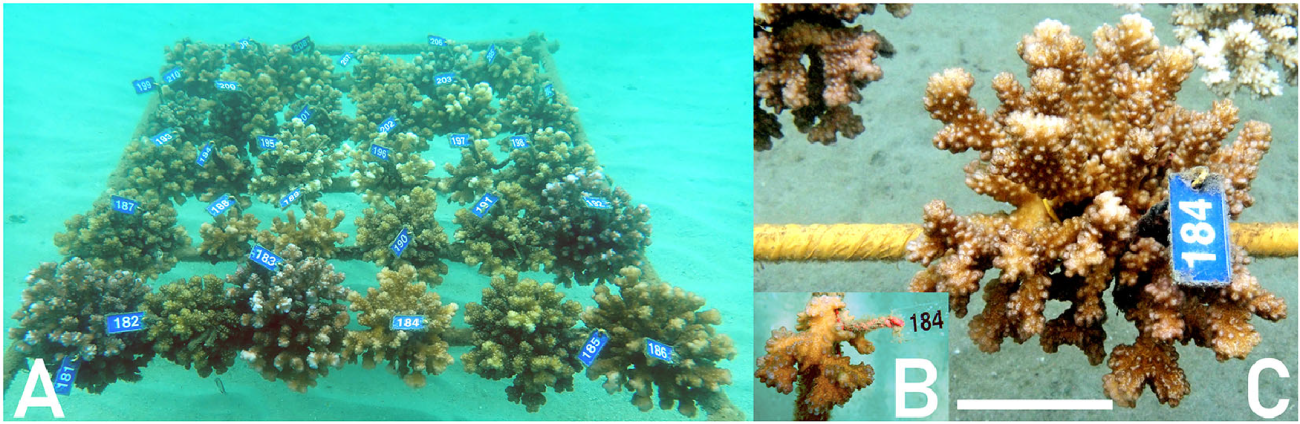
Scientists from Russia and Vietnam spent nearly three years (from April 2022 to December 2024) observing crabs in Nha Trang Bay, Vietnam. They utilized experimental coral nurseries containing fragments of the coral Pocillopora verrucosa. At monthly or quarterly intervals, the researchers examined the corals, collected the crabs inhabiting them, measured their carapace width, and determined their sex and age. To characterize their growth, they employed the von Bertalanffy model, which establishes a relationship between an animal's age and its size.
The study revealed that the crabs grow very rapidly during their first few months. Within the first month of settling on a coral, they reach a carapace width of approximately 4 mm. On average, during the first 9 months of life, a crab grows by about 1.8 mm per month. By three months, the carapace reaches approximately 9 mm; by six months, 13 mm; and by nine months, 16 mm. Thereafter, the growth rate slows down.
The largest crab reached a carapace width of 19.8 mm. Calculations indicate that this corresponds to an age of approximately 15 months. Consequently, the maximum lifespan of Trapezia septata is at least 15-16 months.
The researchers identified 13 groups of crabs that appeared successively over different months. Each group remained on their coral colony for a period ranging from 5 to 15 months. During the first six months following the coral transplantation, the number of crabs was very low. However, in the spring of 2023, there was a sharp recruitment peak, with a large number of young crabs settling on the corals. Subsequently, the population size stabilized.
It was previously hypothesized that these crabs consist of "migrants" - young individuals responsible for dispersal - and "residents" - large, adult crabs that live in pairs and defend their host coral (Britayev et al. 2025). This new study confirms that hypothesis.
"Why is this important? It takes time - from several months to a year - for beneficial crabs to appear on transplanted corals. The likelihood of colonization is higher in the spring. Therefore, it's best to plan coral replanting to coincide with the natural peak of crab settlement. Furthermore, it's important to care not only for the corals but also for their symbionts. Reef restoration projects should aim not only to plant corals but also to ensure that beneficial cohabitants settle and thrive on them," explained Temir Britaev, Doctor of Biological Sciences and Head of the Laboratory of Marine Invertebrate Morphology and Ecology at IEE RAS.
The developed method for analyzing crab size and age can be applied to other small coral inhabitants. This will help better understand the structure of the reef as a whole and improve its restoration.
The study is the first to provide a detailed description of the growth and lifespan of the Trapezia septata crab. These crabs live for approximately 15 months, grow rapidly in their first year, and colonize corals unevenly, with a pronounced peak in spring. The data obtained help plan reef restoration, taking into account not only the corals but also their beneficial cohabitants. This is a step toward restoring not just individual corals but entire living ecosystems.
The study was supported by the Russian Science Foundation (grant RSF 24-14-00288) and the Russian-Vietnamese Tropical Center.