

Soil invertebrates alter their feeding habits depending on the quality of plant litter
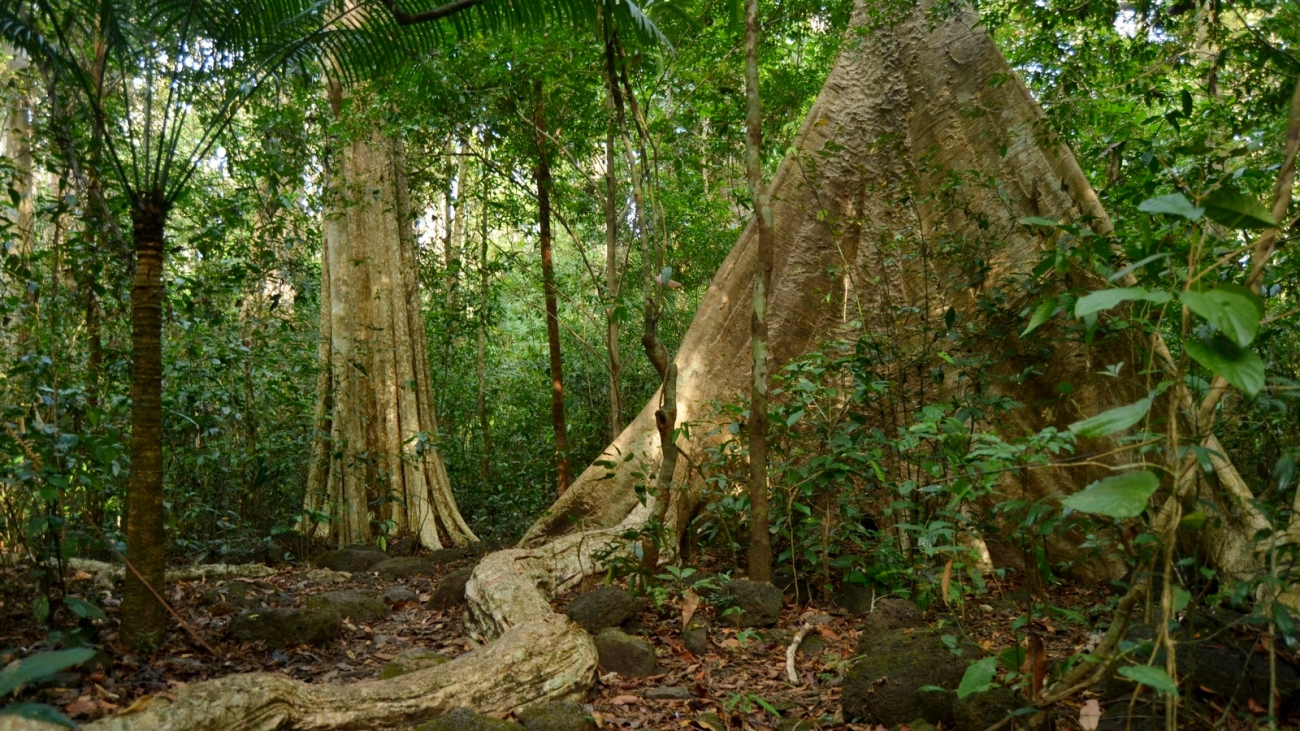
Researchers from the A.N. Severtsov Institute of Ecology and Evolution of the Russian Academy of Sciences (IEE RAS), in collaboration with international colleagues, have conducted a large-scale study on the diet of soil invertebrates in forest ecosystems.
Soil invertebrates play a crucial role in the decomposition of plant residues and the transformation of organic matter within the soil. They can feed either directly on dead plant material or on the microorganisms such as bacteria and fungi that decompose this material. Until now, however, it remained unclear how the balance between these different feeding strategies varies across different forest biomes.
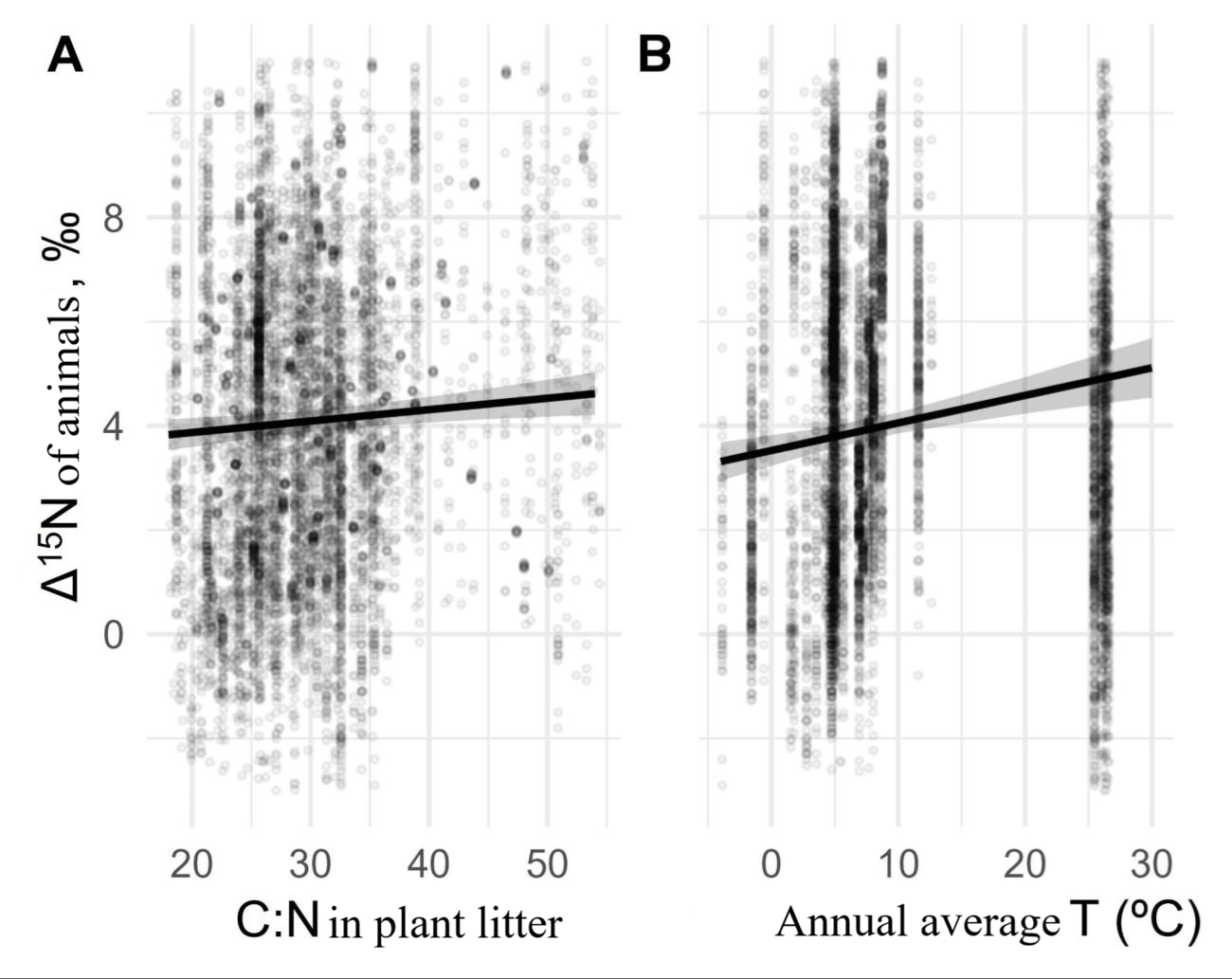
As litter quality decreases (A) and mean annual temperature increases (B), the Δ15N value - an isotopic indicator of trophic position - increases in soil invertebrates, reflecting a greater role for microorganisms in their diet. Points represent individual measurements; lines represent model estimates with 95% confidence intervals.
Researchers analyzed the carbon and nitrogen isotopic composition of 7,408 soil invertebrate specimens collected from 228 forest sites, ranging from boreal to tropical forests. Isotopic data make it possible to assess the position of invertebrates within food webs and determine which food sources they utilize. A key indicator of plant litter quality is the carbon-to-nitrogen (C:N) ratio; a higher ratio signifies lower quality, as such material is nitrogen-poor and more difficult to digest. The analysis revealed that as the C:N ratio increases, soil invertebrates occupy a higher position in the food web (Figure 1). This indicates a shift from feeding directly on plant detritus to relying on microorganisms as a food resource.
“In other words, when plant litter becomes ‘less edible,’ soil invertebrates increasingly feed not on the plant material itself, but on the bacteria and fungi that are more efficient at decomposing it,” explained Sergey Tsurikov, Candidate of Biological Sciences and a researcher at IEE RAS.
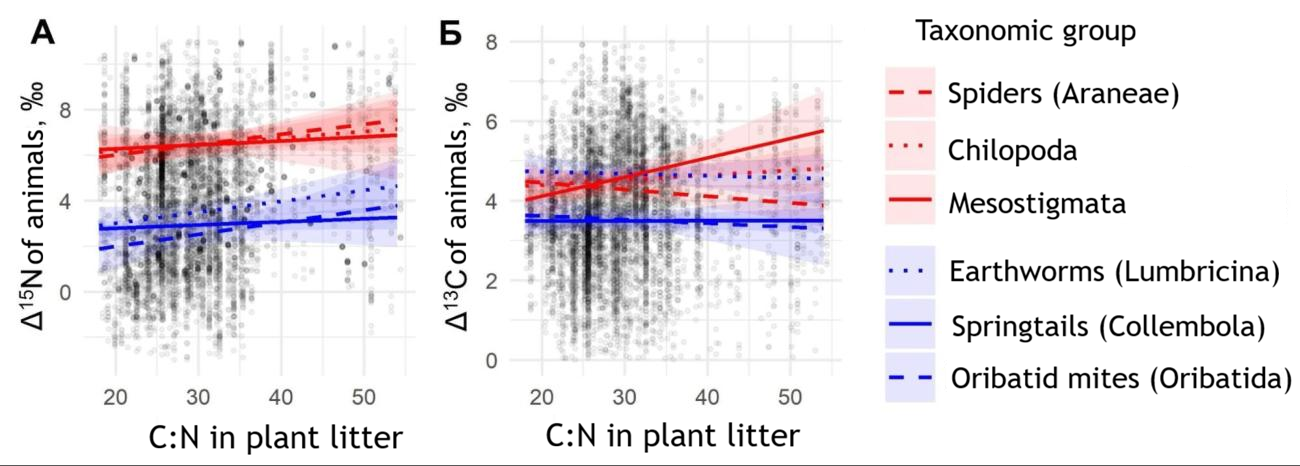
The figure illustrates how the carbon-to-nitrogen ratio in litter relates to the nitrogen (δ¹⁵N, A) and carbon (δ¹³C, B) isotopic composition across major taxonomic groups of soil invertebrates. Data points represent individual measurements, while the lines show estimates from a statistical model, including 95% confidence intervals.
This effect was observed across various groups of soil invertebrates (Figure 2). Unexpectedly, it was found that mean annual temperature is also linked to a higher trophic position among soil invertebrates. This suggests that, under warmer conditions, microbial processes may further enhance the role of microorganisms within soil food webs.
These findings indicate that the quality of plant litter is a key factor in determining the structure of soil food webs. This provides greater insight into how shifts in climate and plant communities can influence the decomposition of organic matter and the carbon cycle in terrestrial ecosystems.
The article was published in the journal Ecology Letters.