

Eukaryotic cells typically contain two genomes: the mitochondrial genome and the nuclear genome. Both play a role in determining an organism's traits and serve as vital sources of information for establishing evolutionary relationships and classifying liv
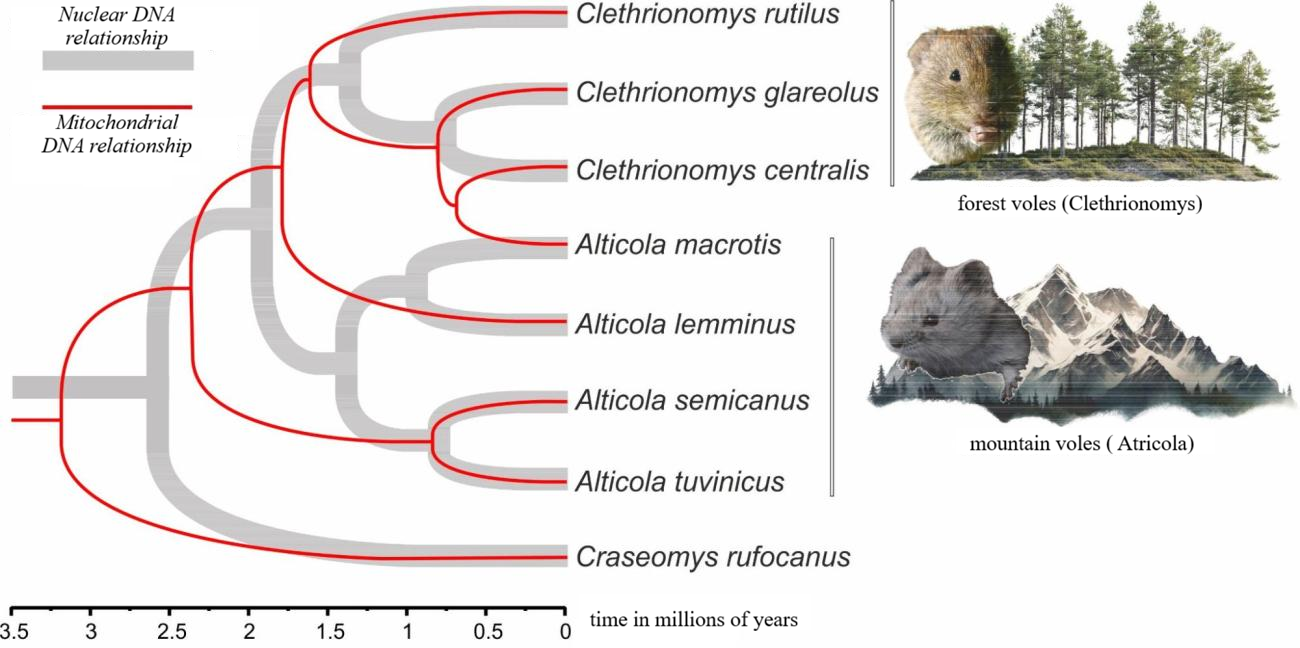
As recently as a decade ago, zoologists relied on mitochondrial genes for the vast majority of phylogenetic studies, primarily because their sequences are relatively easy to read. However, this often revealed discrepancies between mitochondrial-based phylogenies and findings from morphological research, prompting a re-evaluation of the taxonomy of many groups. With the advancement of sequencing technologies, researchers have increasingly turned to nuclear genomic data to reconstruct evolutionary relationships. This has uncovered further contradictions, leading to yet another revision of the taxonomy for a number of taxa.
A striking example of this phenomenon can be found in the phylogeny of mountain voles and forest voles. One group of mountain voles - the subgenus Aschizomys - carries a mitochondrial genome acquired from members of a sister genus, the forest voles (Clethrionomys); in other words, an introgression of the mitochondrial genome has occurred. These two genera are clearly distinct in terms of morphology and ecology, and their respective habitats hardly ever overlap. It is therefore all the more intriguing that the mitochondrial genome of Aschizomys is most closely related to that of C. centralis - the only species of forest vole that inhabits high-altitude, isolated forests in the Tien Shan mountains.
In a recent study, researchers from the A. N. Severtsov Institute of Ecology and Evolution (IEE RAS) and the Zoological Institute (ZIN RAS) set out to identify segments of the forest vole genome within the nuclear genome of Aschizomys. The scientists aimed to detect traces of nuclear genomic introgression similar to those observed in the mitochondrial genome and, consequently, to explore the potential adaptive role of this introgression in the evolution of this group. The study was conducted using RNA-seq and RAD-seq data.
"For about 10 years, I’ve been troubled by a question: how can a typical mountain vole possess the mitochondrial genome of a forest vole - why does it have it, and how did this come to be?" notes Semyon Bodrov, a specialist in mountain voles of the genus Alticola.
The study’s results reveal a clear distinction between forest and mountain voles based on nuclear genetic data; no evidence of nuclear gene introgression in the recent past was found. The researchers propose a "neutral" scenario for the acquisition of the mitochondrial genome by mountain voles. Under this model, the foreign mitochondrial genome could have become established within the population through demographic processes, without conferring any adaptive advantage upon its carriers. These findings do not necessitate a revision of the taxonomy for either genus.
This research further illustrates the limitations of relying solely on mitochondrial phylogeny for taxonomic classification. It also underscores the fact that the role of introgression in evolution - and its connection to adaptation - remains insufficiently understood.
An article detailing these findings has been published in the journal Molecular Phylogenetics and Evolution.