
Congratulations to Nina Shamilyevna Bulatova on her 80th birthday!
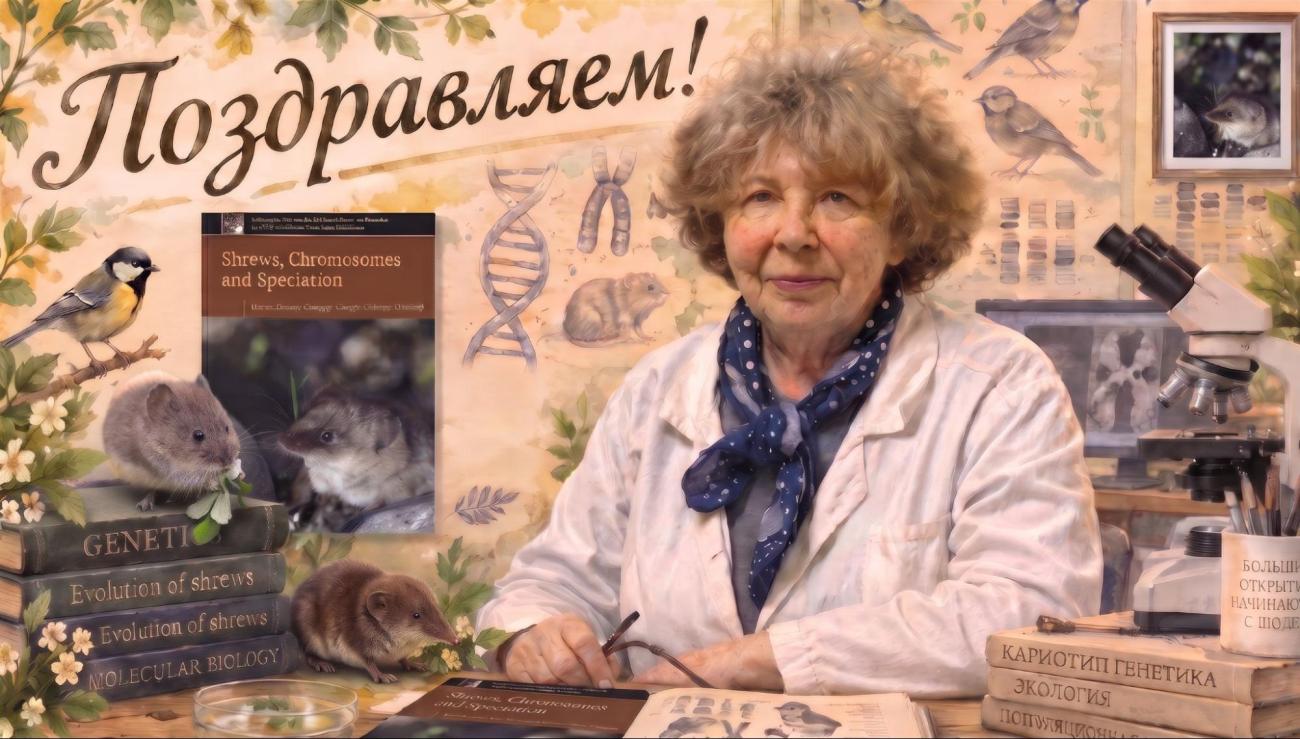
October 26, 2026, marks the anniversary of Nina Shamilevna Bulatova, Associate Professor, PhD, Senior Researcher (now Lead Engineer) at the Mammalian Microevolution Laboratory at the Institute of Ecology and Evolution of the Russian Academy of Sciences.
Nina Shamilevna is a recognized expert in the field of mammalian cytogenetics and evolution, enjoying well-deserved respect among her colleagues. However, her first research subjects belonged to a different class of vertebrates - birds.
In 1969, Nina Shamilevna graduated from the Faculty of Biology at Novosibirsk State University. It was during this period of her studies that Novosibirsk University emerged as the center of Russian genetics, including cytogenetics. Therefore, Nina Shamilevna became familiar with the practice of cytogenetic research well before her graduation.
From 1969 onwards, she navigated every stage in the development of comparative chromosome analysis methods, working under the guidance of and in collaboration with distinguished scientists who were instrumental in establishing the field of cytogenetics in our country and, more specifically, in fostering the flourishing of mammalian comparative cytogenetics. Nina Shamilievna spent 10 years as a staff member at the Institute of Cytology and Genetics of the Russian Academy of Sciences (RAS) before joining our Institute in 1979.
Although she defended her Candidate of Sciences dissertation titled "Comparative Karyology of Birds: Cytotaxonomic and Evolutionary Aspects" (Novosibirsk, Institute of Cytology and Genetics, 1975) prior to her arrival at IEE RAS, the most productive phase of her scientific career has unfolded within the walls of our Institute. She herself considers her most fruitful years to have been those spent among a substantial team of cytogeneticists focused on the cytogenetics of various mammalian species at the Institute of Evolutionary Morphology and Ecology of Animals (USSR Academy of Sciences) / later A.N. Severtsov Institute of Ecology and Evolution (RAS), a success made possible by the dedicated leadership of the laboratory head, Professor V. N. Orlov (Doctor of Biological Sciences).
Over the course of many years of work at IEE RAS, as a staff member in the Mammalian Microevolution Laboratory, Nina Shamilevna made a number of scientific discoveries. For example, she discovered new races of the common shrew and studied their interactions and hybridization. She and colleagues from other institutions were the first to identify the northern section of the hybrid zone between two forms of Microtus arvalis s. l., and, using fine chromosomal markers, they clarified the geographic distribution, status, and phylogenetic relationships of several rodent species in Russia, as well as in Ethiopia and Vietnam.
The results of Nina Shamilevna Bulatova's research and generalizations during her years at the IPEE RAS are reflected in three monographs, of which she is a co-author: "Karyosystematics of Mammals." Moscow, 1983; "Field Genomics Practice. Sample Collection Guide." Moscow, 2009; "Shrews. Chromosomes and Speciation," 2019; and in more than 100 articles published in high-ranking journals, many of which have the highest citation indexes (Q1), in particular, PLOS ONE, Evolution, J. of Evolutionary Biology, Biogeographia, Biol. J. of Linn. Soc., Mol. Phylogenetics and Evolution and many, many others.
Some of Nina Shamilievna’s publications boast an exceptionally high citation count, and her h-index (23) is a testament to the international recognition of her work. Nina Shamilievna has established her own academic school, comprising the followers she has mentored including candidates for advanced degrees and numerous students working on their theses. Two of her mentees, N. Bystrakova and S. Pavlova, successfully defended their Candidate of Sciences dissertations under her guidance and are now thriving in the interdisciplinary field where cytogenetics meets molecular analysis.
Nina Shamilievna remains highly active today: she shares her wealth of experience with colleagues, participates in conferences and forums, and continues to author compelling research papers.
Let us wish our honoree continued success!
The IEE RAS team