

In the great Asian nightjar, the daily rhythm of vocal activity varies by season
It is generally believed that many bird species in the tropics maintain permanent, year-round territories. However, conducting detailed studies on the territorial behavior of tropical species is challenging. Many birds use vocal signals both to establish and defend their territories and as part of their mating behavior. Consequently, passive acoustic monitoring (PAM) which utilizes autonomous acoustic recorders offers a promising method for data collection. Since 2020, researchers from the A.N. Severtsov Institute of Ecology and Evolution of the Russian Academy of Sciences have employed this method to study and continuously monitor the tropical forest in Cat Tien National Park (Dong Nai Province, Vietnam). The study area features a monsoon climate, characterized by distinct wet (from April/May to November) and dry (from November to April/May) seasons. In this study, the researchers examined the daily and seasonal dynamics of the vocal activity of the great eared nightjar (Lyncornis macrotis). The analysis draws on data collected between August 2020 and June 2024, obtained from two Song Meter SM4 recorders positioned 3 km apart. In total, 87,918 five-minute recordings were collected.
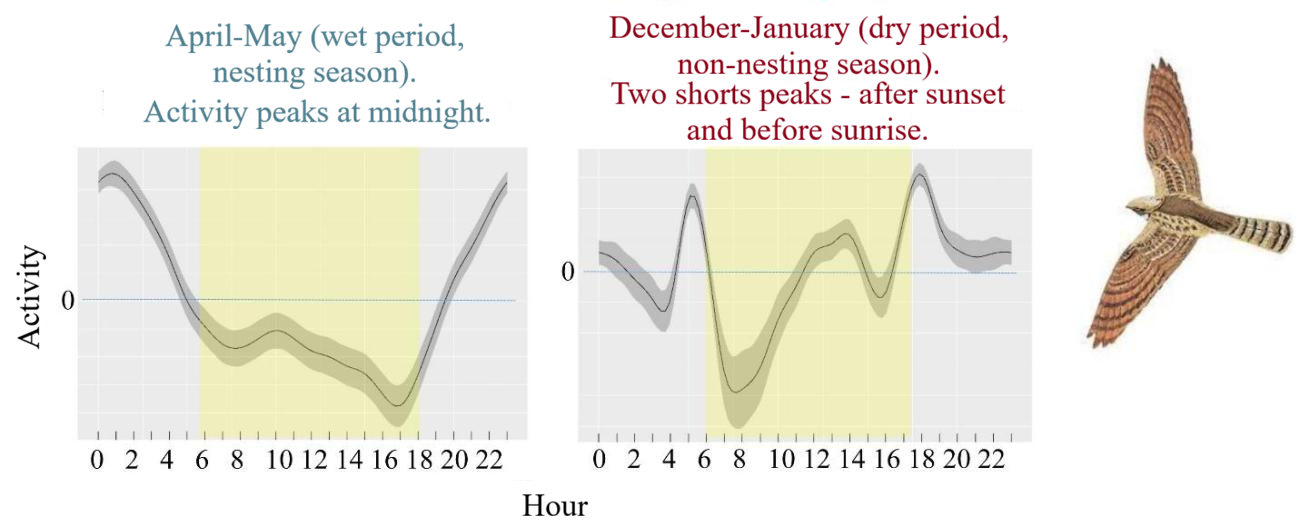
The vocalizations of the great eared nightjar are simple. The only regularly heard territorial call is a loud, two-note "pee-oo" sound, delivered in series. The birds, most likely males, vocalize both while in flight (during display flights) and while perched in the upper canopy. BirdNET-Analyser algorithms detected nightjar calls in 13.4% of the recordings. Vocalizations were recorded exclusively after dark. While the birds can be heard throughout the year, there is a distinct peak in activity from April to June (the end of the dry season and the beginning of the wet season) which likely corresponds to the breeding period. During this time, the nightjars vocalize all night long, with activity peaking around midnight. In other seasons, when vocal activity is lower, the daily pattern of calling changes: from approximately July to March, there are two short (30-60 minute) bursts of activity, one shortly after sunset and another just before dawn, while for the remainder of the night the birds remain silent.
“Thus, we have identified annual variability in the daily patterns of vocal activity in the great eared nightjar. This variability likely has a functional explanation, a conclusion supported by census data and field observations. During the breeding season (April-June), individual territories are clearly defined. In this period, the birds vocalize actively to signal that a territory is occupied and/or to attract mates. Outside the breeding season (July-March), the birds often call while in flight; during this time, the ‘display territories’ of different individuals may overlap, leading to vocal interactions. We hypothesize that the brief spikes in acoustic activity observed during this period serve to maintain or establish contact between neighbors, which is ultimately essential for preserving the territorial structure,” explained Alexey Opaev, Doctor of Biological Sciences and a leading researcher at the A.N. Severtsov Institute of Ecology and Evolution of the Russian Academy of Sciences (IEE RAS).