

Gravid females of viviparous lizards form consistent social groups
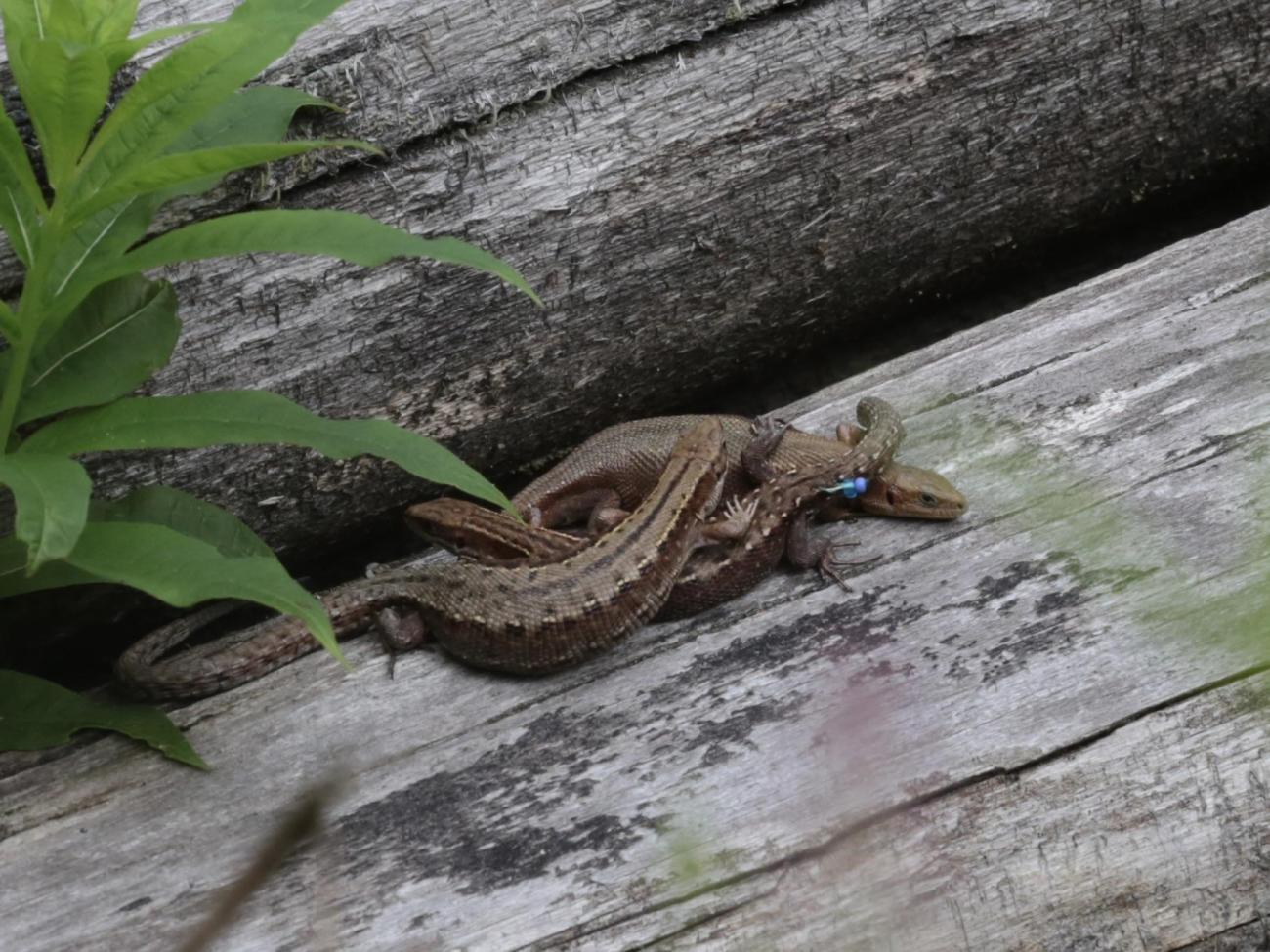
Figure 1. A group of three individually marked females in physical contact. The lizard closest to the observer has clear and black beads attached to its sacral region (individual No. 72), while the middle one has blue and violet beads (individual No. 99). The beads allow the observer to distinguish between the females. The farthest female bears no marks, since her coloration made her sufficiently distinct. Photo by Natalia Sopilko.
The viviparous lizard Zootoca vivipara (Lichtenstein, 1823) is a widely distributed reptile species found across Eurasia. In the mountainous regions of Western Europe, these lizards lay eggs, whereas throughout the rest of their range, they are ovoviviparous.
Over a three-year period (2020–2022), scientists from the A.N. Severtsov Institute of Ecology and Evolution of the Russian Academy of Sciences (IEE RAS) studied the social behavior of individually marked viviparous lizards near the village of Chistoye in the Toropetsky District of the Tver Region. During their observations, the researchers noted that females - which lead solitary lives in the spring - began regularly gathering in groups of two to four individuals on logs during the summer of 2020. Gravid females spent long periods together, often clustering in tight groups (Figure 1). Even when the females moved apart, they would subsequently return to their preferred spots. Interactions within the groups were non-aggressive; the lizards frequently crawled over one another and lay together on the surface of the logs. However, after giving birth, the females left the gathering sites and ceased to be part of the groups. Such behavior in this species had not been previously described.
Aggregations of gravid females have been documented in reptiles. Clark and colleagues previously observed female timber rattlesnakes (Crotalus horridus) clustering together to bask in the sun (Clark et al., 2012). The authors demonstrated that females of this species prefer to group with related individuals; the level of genetic relatedness within groups was higher than the population average. They hypothesized that this selectivity in choosing basking partners suggests the presence of kin selection within groups, promoting the survival of closely related individuals. This aligns well with Hamilton’s theory of kin selection (Hamilton, 1964), developed within the sociobiological paradigm. By cooperating, females enhance not only their own individual fitness but also that of their female relatives who share the same genes. Clustering is advantageous for females because developing embryos have specific temperature requirements (Sun et al., 2015), and heat absorption is more efficient in such groups. Furthermore, a group of animals can detect predators more quickly - a crucial factor for slow-moving gravid females (Pulliam, 1973).
The ability to recognize genetically related individuals is a prerequisite for the effective operation of kin selection. It has been demonstrated that certain reptiles, including the viviparous lizard, can distinguish close relatives based on olfactory cues. We hypothesized that, given their capacity for such complex behavior, the groups we observed might - like those of rattlesnakes - be formed on the basis of kinship.
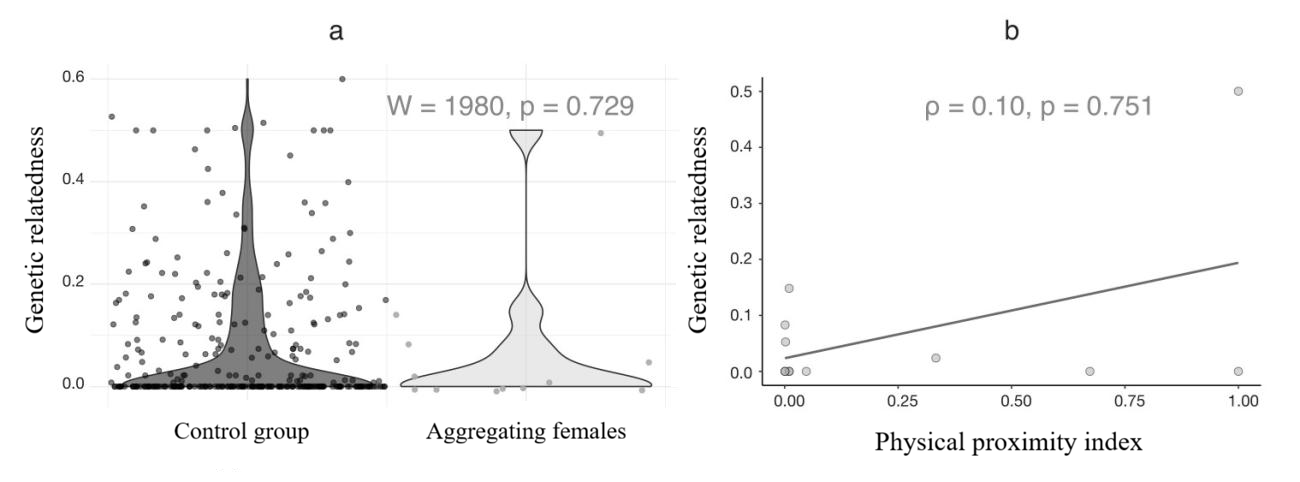
The composition of the female groups remained stable throughout the summer of 2020, comprising the same individuals. However, an analysis of microsatellite loci, conducted in collaboration with colleagues from VNIRO, revealed that the pairwise genetic relatedness among the studied female viviparous lizards did not differ from the population average (Figure 2a). Our results indicate that the females did not base their group formation on the degree of relatedness. Furthermore, within the observed groups, the degree of relatedness did not correlate with the proximity index - calculated as the time a pair of individuals spent in physical contact divided by the total time that pair of lizards spent in close proximity within the group (Figure 2b).
It is particularly interesting that the behavior described was observed only in 2020; nothing of the sort was seen during the subsequent two years of monitoring individuals from the same colony. The emergence of aggregations specifically in the summer of 2020 can be attributed to the coincidence of two factors: low summer temperatures - which prompted females to group together for more efficient warming - and high population density. This is supported by data from other study seasons: the summer of 2021 was warmer (with an average daily temperature of 20.3°C in June and July), and no aggregations formed; while average daily summer temperatures in 2022 were similar to those in 2020 (17.9°C and 18.1°C, respectively), the population density had dropped sharply by that time, and again, no aggregations were observed.
Although the scientists did not directly measure lizard population density, the capture and marking of all lizards encountered at the study site over three years of observation allow for an indirect estimate of this metric. In 2020, 57 adults (42 females and 15 males) were marked; this figure dropped to 20 (10 females and 10 males) in 2021 and to 16 adults (10 females and 6 males) in 2022. The researchers also noted a low rate of recaptures. Of the individuals marked in 2020, only six females and six males were encountered again the following year, while only two females and one male from the 2020 cohort were recaptured in 2022. Notably, the number of observation days remained constant across seasons and did not correlate with the number of lizards captured (Rs = 0.60; p = 0.240). This may indicate a decline in population size during the study period.
Thus, it is most likely that aggregations form only under conditions of low daily temperatures during the first half of summer and high population density. Furthermore, the selection of partners for group formation is based on preferences other than kinship.
This work was supported by the Russian Science Foundation (Project No. N22-14-00227(P)).