

Does living fast mean taking risks? Scientists studied the pace-of-life syndrome in short-lived African fish
Evolutionary trade-offs in animal life histories lead to the formation of integrated complexes of behavioral and morphological traits. According to the "pace-of-life syndrome" hypothesis, these associations are particularly pronounced in short-lived species inhabiting extreme and unpredictable environments. Such species invest more resources in rapid reproduction; consequently, they are characterized by accelerated growth, early sexual maturation, and high metabolic rates. While risky behavior enables individuals to monopolize resources and access to mates, it also increases the organism's energy expenditure and leads to a higher risk of mortality due to predation and aggressive interactions. In addition to behavior, body size and conspicuous coloration are key components of the pace-of-life syndrome. These traits serve as indicators of rapid growth, aggression, and social dominance, yet simultaneously render the individual more visible to predators and rivals.
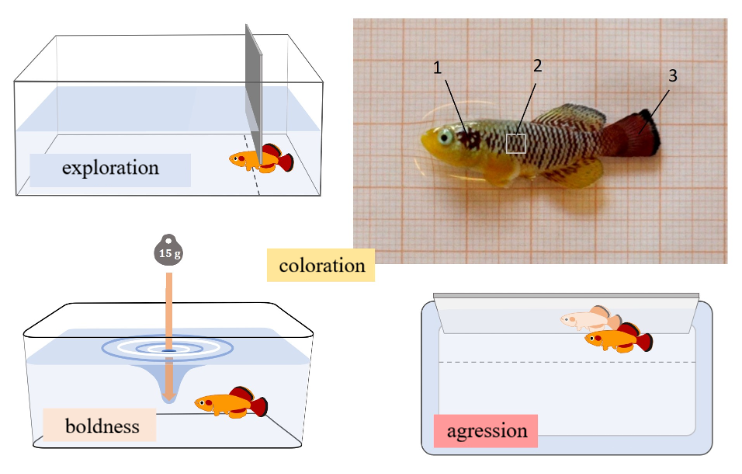
Scientists from the A.N. Severtsov Institute of Ecology and Evolution of the Russian Academy of Sciences (IEE RAS) tested the "pace-of-life" hypothesis using a model involving short-lived African fish of the genus Nothobranchius. These fish inhabit shallow savanna pools that dry up at the onset of the dry season, limiting the lifespan of adults to just a few months. Males are brightly colored, aggressively defend their territory, and fall prey to predators more frequently than females. The study aimed to determine whether a propensity for risky behavior correlates with larger body size and brighter coloration in males of the species Nothobranchius guentheri, in accordance with the pace-of-life syndrome hypothesis. Aggressiveness, boldness, and exploratory activity were assessed in the laboratory through a series of behavioral tests. Bayesian models were used to analyze the consistency of these behaviors and their correlations with one another and with morphological traits.
Aggressive behavior and boldness were statistically consistent across repeated tests and represented predictable personality traits in males, unlike exploratory activity. Male coloration intensity was linked to body size and aggressive behavior; larger males with more saturated, high-contrast coloration exhibited higher levels of ritualized aggression. However, no stable association was found between morphological traits and boldness. The correlation between aggression and conspicuous coloration in N. guentheri suggests a potential evolutionary trade-off: while more aggressive and brightly colored males hold a competitive advantage in contests for territory and access to females, they are also more conspicuous to predators and sustain injuries more frequently during interactions with rival males.
“The results show that even in species with short life cycles inhabiting extreme environments, the pace-of-life syndrome does not encompass all the characteristics proposed by the hypothesis. Aggressive behavior and body coloration formed a single complex, whereas exploratory activity fell outside this association, and boldness was linked to aggression only at the level of a trend,” said Tatyana Demidova, Candidate of Biological Sciences and Senior Researcher at IEE RAS.
Related materials: RAS: "Does living fast mean taking risks? 'Pace-of-life' syndrome studied in short-lived African fish"