

Mongolian gazelles produce a variety of sounds despite the complete loss of their vocal cords
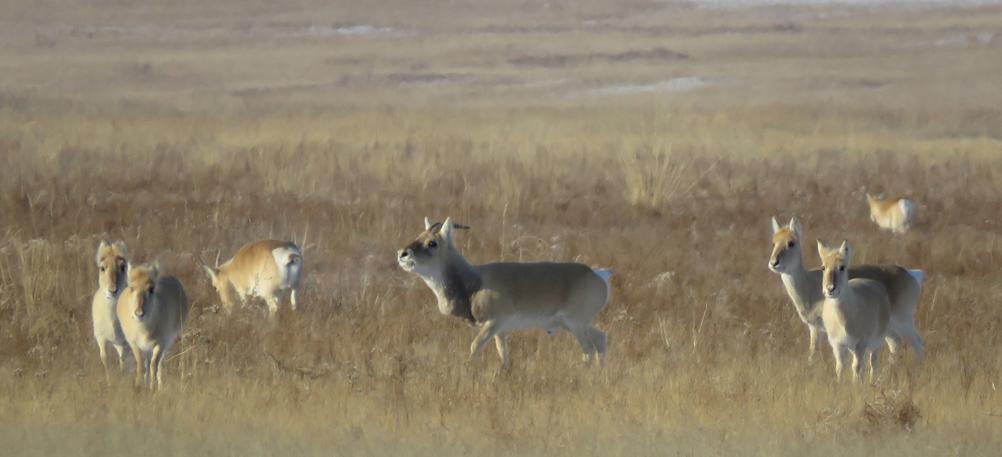
Photo 1: A male Mongolian gazelle in a harem of females during the rut in the Daurian steppe.
The Mongolian gazelle (Procapra gutturosa, also known as a dzeren) is a common ungulate species in Mongolia, whereas in Russia it is found only in the Zabaykalsky Krai, within a small area surrounding the Daursky Nature Reserve. Researchers from the A.N. Severtsov Institute of Ecology and Evolution (RAS), Lomonosov Moscow State University, the Institute of Natural Resources, Ecology and Cryology (Siberian Branch of the RAS), and the Leibniz Institute for Zoo and Wildlife Research (Germany) studied the behavior and vocalizations of male and female Mongolian gazelles during the rut, as well as the vocal anatomy of both sexes. The species is notable for the fact that the larynx of adult males is significantly larger and positioned much lower in the neck than that of females - a feature reminiscent of the sexual dimorphism of the vocal apparatus in humans. Additionally, males rapidly lower their larynx further during each vocalization.
“The dzeren rut takes place during the coldest time of the year - December - when air temperatures drop to between minus 30 and minus 45 degrees Celsius. Males strive to maintain harems of about ten females, while several rival males typically hover nearby. Dzerens are extremely wary and do not allow vehicles to approach closer than 200-300 meters. While this distance permitted video recording, it was too great for high-quality audio capture. Consequently, the vocalizations were recorded using automated sound traps placed in the steppe near the harems on ordinary kitchen stools,” explained Elena Volodina, Candidate of Biological Sciences and Senior Researcher at the A.N. Severtsov Institute of Ecology and Evolution (RAS).
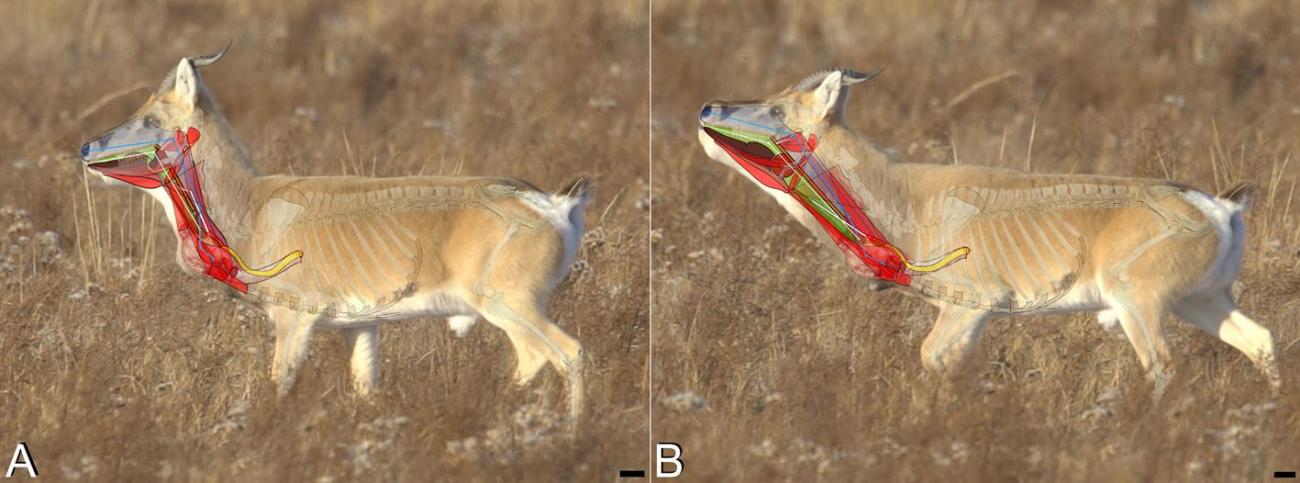
Photo 2: A male Mongolian gazelle pulls its larynx down the neck while calling. The vocal apparatus and the muscles controlling the position of the larynx are highlighted in color.
During the rut, both males and females vocalized constantly, day and night. Males produced long series of rutting barks - resembling the barking of dogs - while the females' varied contact calls sounded like the shrill cries of cats. When alarmed, individuals of both sexes emitted sharp nasal snorts. Neither mating behavior nor fights between males were accompanied by vocalizations. The animals could vocalize through either the mouth or the nose, a fact clearly visible from the puffs of vapor in the freezing air.
Both the males' barks and the females' contact calls were unusually high-pitched for such large animals, even without considering the males' hypertrophied larynxes. The fundamental frequency averaged 625 Hz for male barks and 733 Hz for female calls, whereas the expected fundamental frequency - based on the dimensions of the laryngeal sound-producing structures - was 43 Hz for males and 116 Hz for females. Moreover, an examination of vocal anatomy revealed no vocal folds (vocal cords) typical of mammals in either sex. Instead, the dzeren larynx contained one large vocal pad, the shape and structure of which did not allow for phonation. This is the only ungulate species in which vocal cords have been lost during the course of evolution.
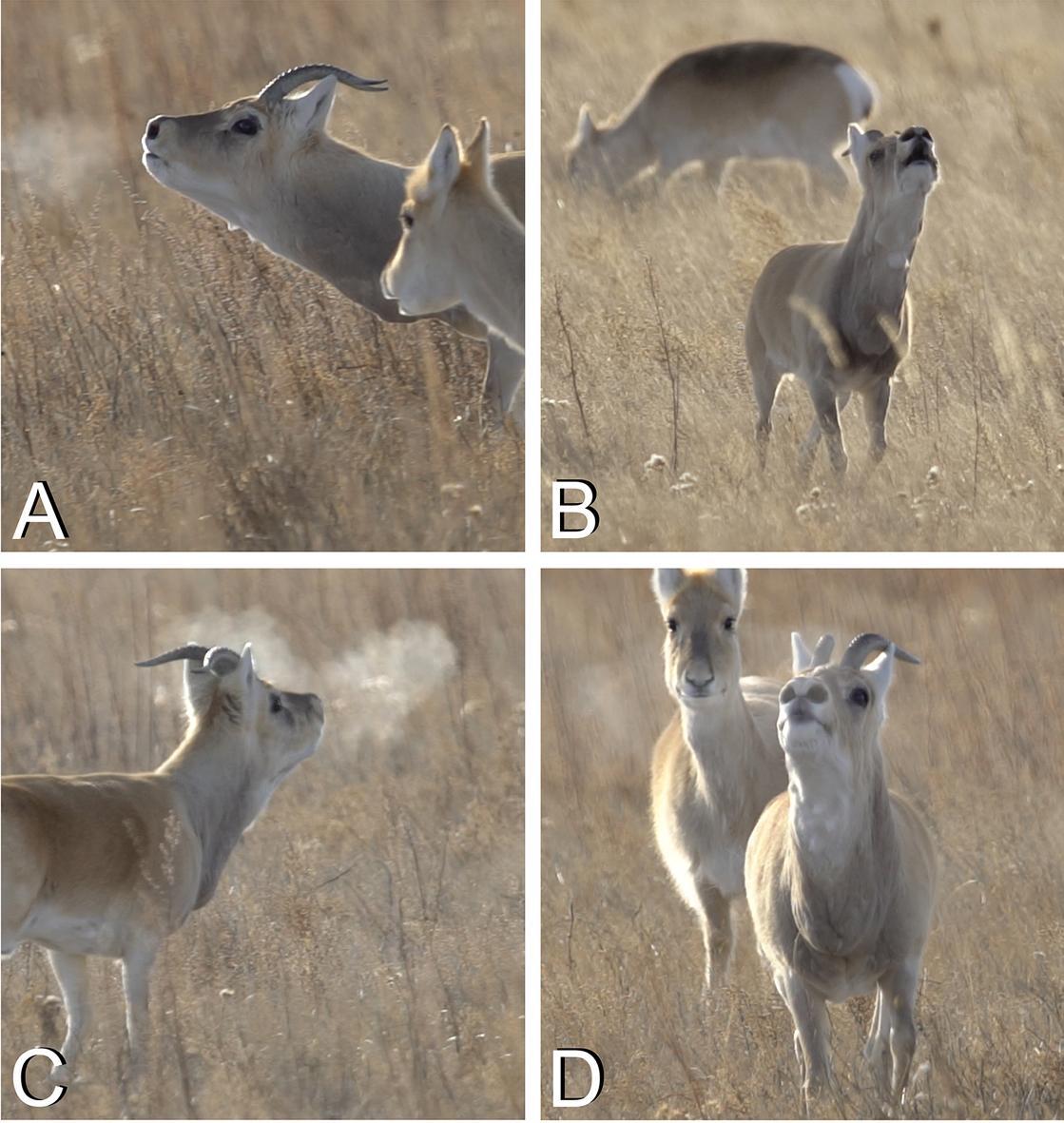
Photo 3: Oral (A, B) and nasal (C, D) rutting calls of a male Mongolian gazelle. Note the clouds of vapor and the opening of the mouth and nostrils.
It was hypothesized that Mongolian gazelles might produce their calls via a whistling mechanism, driven by turbulent air vortices as air passes through laryngeal constrictions. Experimental confirmation of this hypothesis emerged after the article was published. In domestic horses, it has been established that two frequencies are present simultaneously during neighing: the higher one is produced via a whistling mechanism, while the lower one is generated by the vocal pad.
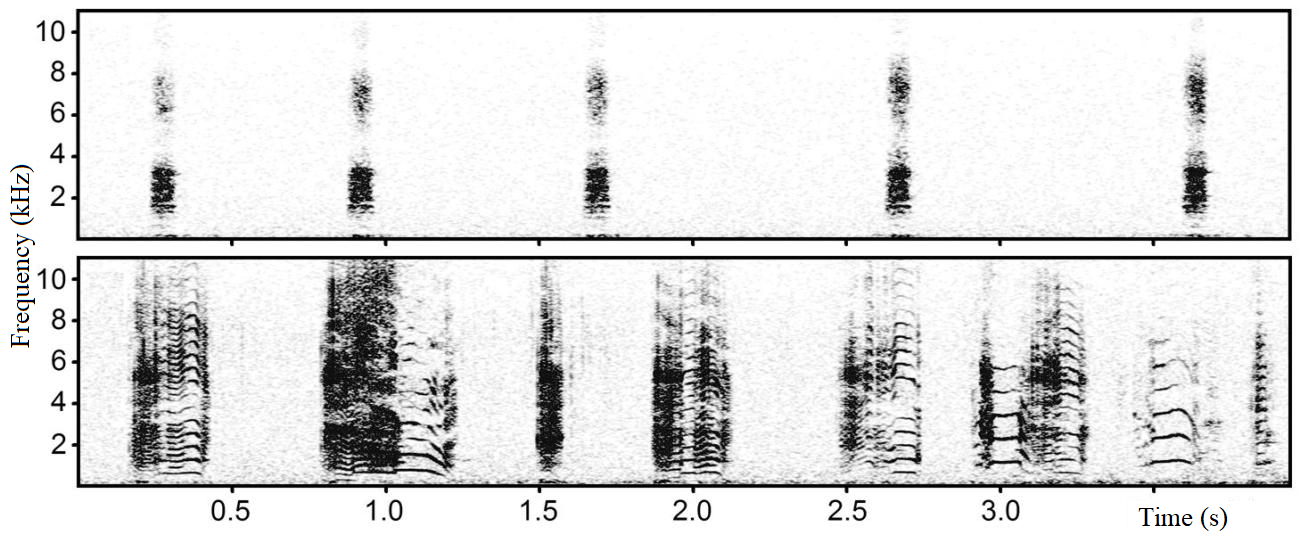
Photo 4: A series of rutting barks from a male Mongolian gazelle (top) and various contact calls from female Mongolian gazelles (bottom).
The study results have been published in the Q2 journal Science of Nature: Frey R., Volodin I.A., Kirilyuk V.E., Volodina E.V. Behaviour and vocalization of Mongolian gazelle (Procapra gutturosa) in rutting harems considering the sex-specific vocal anatomy. Science of Nature - Naturwissenschaften, 2026, v. 113, N 3, 48. https://doi.org/10.1007/s00114-026-02102-6