Results
A concept of a unified structural plan for the limbs of urodeles and anurans has been developed, which may support their monophyly. A hypothesis of an originally biserial structure of the archetypal state of the tetrapod limb has been proposed. A concept of paedomorphosis has been developed as a leading factor and mechanism in the formation not only of new morpho-functional traits but also of new taxa, from the species level up to new classes. Experimental methods have revealed the role of thyroid hormones in regulating the ontogeny of lower vertebrates (amphibians and teleost fish). The pathways and mechanisms of the origin and evolution of metamorphosis and direct development in amphibians have been identified. The evolution of ontogeny regulation mechanisms in lower vertebrates has been studied. The ontogenetic mechanisms of the explosive morphological divergence accompanying the formation of the species flock of large African barbs (Labeobarbus spp., Cyprinidae, Teleostei) of Lake Tana (Ethiopia) have been identified. A number of concepts of morpho-functional reorganizations in the course of evolution have been created, based on systemic studies of the biomechanical and ontogenetic reorganization of the jaw apparatus and the study of endocranial kinetism in amphibians and reptiles. A typology of the morphological elements of the head of sturgeons and paddlefishes has been developed, and an evolutionary scenario for the origin of the structural type of the acipenseriform skull has been proposed. Heterochronies have been identified in the development of several head structures of sturgeons, beluga, and the American paddlefish responsible for the formation of the jaw protrusion mechanism. A database has been created on the geography, ecology, and pollution effects for various amphibian species, covering more than 2000 localities.
The most interesting results obtained in 2023-2024:
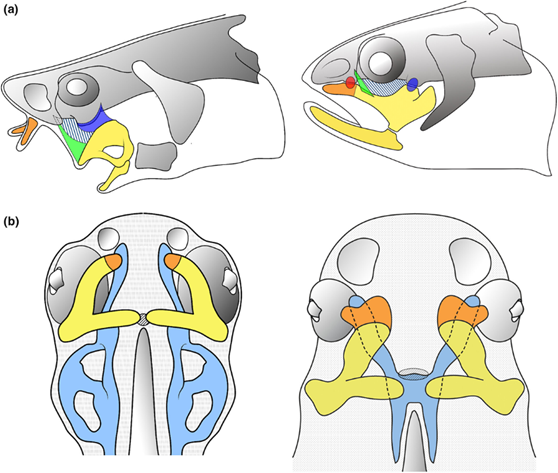
1. Ray-finned fish make up half of the species diversity of extant vertebrates. Sturgeons (Acipenseriformes) are a particularly important group for understanding fish evolution — a group at the base of the ray-finned fish phylogenetic tree, characterized by a very specific morphology of the mouth apparatus. Analysis of 3D reconstructions (Fig. 1) obtained from serial histological sections of the heads of developing sturgeons made it possible to formulate a testable hypothesis on the origin of the unique morphotype of these fish based on systemic paedomorphosis.
Published: Tsessarsky A. 2024. What is missing from the sturgeon jaw: Developmental morphology of the upper jaw in Acipenser // Journal of Anatomy, 00, P. 1–21. doi: https://doi.org/10.1111/joa.13953
2. An analysis of the conserved part of the genome of sympatric charr ecomorphs (Lake Kronotskoe, Kamchatka) was carried out, aimed at uncovering the basis of the observed morpho-ecological adaptations. The data obtained showed a monophyletic origin of this species flock, the existence of reproductively isolated lineages, and that the morphological and ecological diversification of the Kronotskoe charrs is linked to changes in genes and regulatory sequences responsible for the activity of neurohumoral axes (thyroid and leptin), skull bone ontogeny, and energy and ion metabolism. The results obtained made it possible to reconstruct the genetic scenario of the evolution of the Kronotskoe charrs and demonstrated the basic directions of genetic, physiological, and morphological diversification during the adaptive radiation of salmonid fish.
Publication: Katherine C. Woronowicz, Evgeny V. Esin, Grigorii N. Markevich, Crisvely Soto Martinez, Sarah K. McMenamin, Jacob M. Daane, Matthew P. Harris, Fedor N. Shkil; Phylogenomic analysis of the Lake Kronotskoe species flock of Dolly Varden charr reveals genetic and developmental signatures of sympatric radiation. Development, 2024; 151 (20): dev203002.
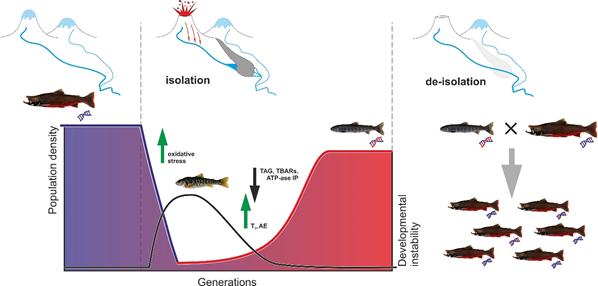
3. Watercourses draining volcanic landscapes are characterized by a complex of negative factors leading to the decline or death of aquatic organism populations. However, some populations undergo rapid adaptive changes that ensure their stable existence under extreme conditions. We were able to identify the mechanisms of adaptation to complex heavy-metal water pollution in populations of one salmonid species, Dolly Varden (Salvelinus malma), isolated in volcanic streams of Kamchatka. It was established that changes in thyroid activity underlie the adaptive changes in the physiology, morphology, behavior, and life cycle of Dolly Varden. These populations are an example of ultra-rapid (occurring in less than 30 years) endocrine adaptation to negative environmental factors, which can be regarded as a confirmed case of vertebrate "evolutionary rescue." Previously, this phenomenon had been described only for laboratory strains of bacteria, fungi, and some model invertebrates. The result obtained is of high importance for understanding the processes occurring in aquatic organism populations under conditions of ever-increasing anthropogenic pollution and climate change.
Published: Esin, E. V., Shulgina, E. V., & Shkil, F. N. (2023). Rapid hyperthyroidism-induced adaptation of salmonid fish in response to environmental pollution. Journal of Evolutionary Biology, 36, 1471–1483. https://doi.org/10.1111/jeb.14220
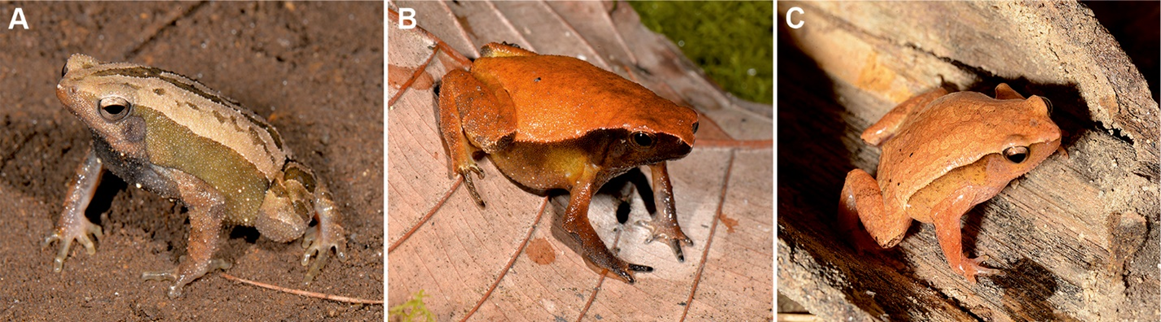
4. Comparative morphology methods were used to study the adaptations of tropical frog larvae to living in phytotelmata — arboreal micro-reservoirs. Using three closely related species of the genus Kalophrynus (family Microhylidae) inhabiting southern Vietnam as an example, it was shown that the transition to breeding in tree hollows and bamboo stems leads to a change in the tadpoles' feeding type (from microfiltration to oophagy), followed by a reorganization of the larval digestive tract, visceral skull, and hyobranchial apparatus.
Vassilieva A.B., Nguyen T.V. 2023. Restricting living space: Development and larval morphology in sticky frogs (Microhylidae: Kalophrynus) with different reproductive modes // Vertebrate Zoology. 73. P. 367-382. https://doi.org/10.3897/vz.73.e98618