

Заголовок
Chernogolovka Research and Experimental Station
About the laboratory
SCIENTIFIC DIRECTOR – V.V. ROZHNOV, ACADEMICIAN RAS
HEAD – G.V. TARASOVA
MAIN RESEARCH AREAS
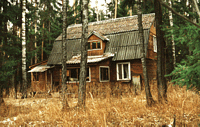
Один из корпусов НЭБ «Черноголовка»

Экспериментальный полигон для изучения социального поведения мелких хищных млекопитающих
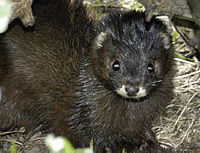
Для исследования причин исчезновения европейской норки и ее сохранения создан специальный центр
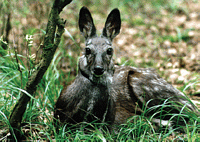
Кабарга – вид, для которого разработана технология прижизненного сбора мускуса
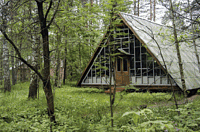
Экспериментальный полигон для изучения социального поведения полевок
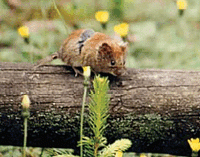
Красная полевка – один из объектов исследований социального поведения
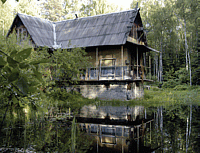
Комплекс для изучения поведения и репродуктивной биологиии русской выхохули
The Chernogolovka Research and Experimental Station is located in the Noginsk District of Moscow Region (60 km northeast of Moscow), on the territory of the Chernogolovka Scientific Center RAS, 4 km from the town of Chernogolovka, in a forest, on two plots with a total area of 40 hectares. The station was established in 1975 (Order of the Presidium of the USSR Academy of Sciences No. 125000-1018 of June 25, 1975) on the initiative of Academician V.E. Sokolov for the comparative study of behavior and chemical communication in wild mammals under conditions as close to natural as possible. Staff of the Laboratory of Behavior and Behavioral Ecology of Mammals, headed by the station's scientific director, Dr. Sci. (Biol.) V.V. Rozhnov, work at the station on an ongoing basis. Year-round experimental research is conducted here on the communicative and social behavior of terrestrial mammals and their reproductive biology; methods and technologies for keeping and breeding rare mammal species are developed.
The station holds a unique living collection of terrestrial mammals, totaling about 2,000 individuals. These include carnivores (mustelids — polecats, minks, sables; viverrids — palm civets, genets; lynxes, small felids), ungulates (musk deer), insectivores (hedgehogs, desmans), rodents (forest voles, grey voles, birch mice, gerbils, house mice, hamsters, guinea pigs), lagomorphs (rabbits), and bats.
Special enclosure and testing-ground complexes, mostly unique, have been built for different mammal species:
a complex of enclosures and experimental testing grounds for small carnivorous mammals (about fifteen enclosed pens of 3 to 30 m², two testing grounds of 40 m² and two of 120 m² each consisting of three reconfigurable compartments, a large enclosed "open field" apparatus, two large open-air enclosures, and two covered sheds with individual cages for 45 animals);
an enclosure complex for lynxes and small felids (enclosed cages for 28 animals of 4-8 m² each, six open enclosures of 74 m² each, two open enclosures of 0.5 ha each);
an enclosure complex for canids (one enclosure of 130 m², three of 300 m², one of 360 m², one of 420 m², one of 700 m², and one of 1,400 m²); an enclosure complex for musk deer (seven enclosures with a total area of about 5 ha);
a chiropterological facility (a large enclosed volume, a so-called hibernation "cave," and a complex of auxiliary buildings);
a vivarium-enclosure complex for insectivores (special cages for 20 animals, open enclosures of various sizes);
a complex of enclosures and pools for the Russian desman;
a complex of experimental testing grounds for rodents (a covered testing ground of 120 m² with three reconfigurable compartments for seasonal observations, an open testing ground of 240 m² with six reconfigurable compartments for seasonal observations, two enclosed testing grounds of 120 m² with two reconfigurable compartments each for year-round observations);
three laboratory-vivarium complexes for rodents (one for 1,000 animals with a set of laboratory equipment; a second for 500 animals with an open experimental testing ground of 100 m²; a third also for 500 animals);
a laboratory-vivarium complex for house mice (300 animals, enclosures);
a laboratory-vivarium complex for desert rodents (special cages for 200 animals, chambers of 1 m² each, two open enclosures of 200 and 400 m²).
The Chernogolovka Research and Experimental Station of IEE RAS has specialized laboratories equipped with scientific instrumentation:
a video laboratory for filming and analyzing mammal behavior (the "Observer" video-monitoring system with licensed software, digital video cameras, computers, video recorders, and monitors),
an acoustic laboratory for research on acoustic communication (recording equipment — a professional Tascam Teac Professional Division DA-P1 two-channel digital audio recorder with a recording frequency range of 20 Hz to 20 kHz, a Sennheiser K6 condenser microphone with a frequency range of 20 Hz to 20 kHz, a flat response of 500 Hz-20 kHz and a sensitivity at 1 kHz of 0 dB, a Sennheiser 416P 48U shotgun microphone with a frequency range of 40 Hz to 20 kHz and a pickup angle at 0 dB sensitivity at 1 kHz of 45°; a computer equipped with a professional DMX 6fire sound card for processing and storing an audio archive — a collection of mammal calls covering more than 100 species, subspecies, and populations; the licensed sound recording and analysis software Saslab Pro version 4.2),
a cytogenetics laboratory (microscopes, centrifuges, photographic equipment),
an ecological-physiological laboratory for determining hormone concentrations by enzyme immunoassay (a Multiscan EX variable-wavelength plate spectrophotometer with software for measuring optical density and concentrations, a StatFax-2600 automatic plate washer, an Elmi shaker-incubator for plates, an Ekros-6500 mixer, an Elmi centrifuge for Eppendorf tubes (up to 15,000 rpm), an Elmi shaker, a Heidolph magnetic stirrer, a Labsystem stepper, Ohaus electronic scales up to 200 g with 0.01 g precision, a portable Mettler-Toledo pH meter, variable-volume Gilson automatic pipettes, refrigerators and freezers for sample storage, a diluter, and a semen analyzer for monitoring sperm quality in breeding mammals),
a field-equipment laboratory for studying the behavioral ecology of mammals under natural conditions (Dedal-45 night-vision devices, equipment for radio-tracking mammals — Yaesu FT-817nd receivers with three-section YHA-63 antennas, Nikon Coolpix3200 digital cameras for photographing mammal tracks for subsequent individual identification by computer software, GPS navigation devices, and sensors for long-term measurement of temperature and humidity in mammal burrows).
The station's scientific and technical equipment allows for a much wider range of research than the study of mammal social and communicative behavior alone. In collaboration with specialists from other departments of the Institute, as well as colleagues from other research institutions in Russia and abroad, studies are conducted on the systematics, hybridization, ecological physiology, endocrinology, and integumentary morphology of terrestrial mammals.
To conserve rare mammal species, the station has established a "European Mink Conservation Center," a "Russian Desman Conservation Center," and a "Musk Deer Breeding Farm."
The use of the unique living mammal collection and modern scientific equipment by specialists from many research institutions has made it possible to establish a shared-use center — the "Chernogolovka Center for Ecological and Ethological Research (at the experimental station of the A.N. Severtsov IEE RAS)."
SCIENTIFIC CENTER
Since 1997, the Chernogolovka Research and Experimental Station of IEE RAS has hosted the Joint Educational and Scientific Biological Center of the A.N. Severtsov Institute of Ecology and Evolution RAS, Lomonosov Moscow State University, and Moscow Pedagogical State University (the Chernogolovka Educational-Scientific Center of IEE RAS) (bilateral agreements are in place); in addition, students from the following base universities of the region carry out coursework and thesis projects at the Chernogolovka Educational-Scientific Center of IEE RAS:
Lomonosov Moscow State University;
Moscow Pedagogical State University;
Russian State Agrarian University — Timiryazev Moscow Agricultural Academy;
K.I. Skryabin Moscow State Academy of Veterinary Medicine and Biotechnology;
Higher College of Rational Environmental Management of the D.I. Mendeleev Russian University of Chemical Technology;
L.N. Tolstoy Tula State Pedagogical University;
Samara State University;
Tver State University;
Novosibirsk State University.
In 2006, a base department — a branch of the Department of Zoology of the Russian State Agrarian University (Timiryazev Moscow Agricultural Academy) — was established at the Chernogolovka Research and Experimental Station of IEE RAS (a bilateral agreement is in place).
The station has a complex of facilities for housing personnel, visiting specialists, and students, as well as equipment and materials — 14 buildings with a total area of over 2,000 m². To support animal husbandry, there are storage facilities, refrigeration equipment, feed processing and preparation equipment, and production workshops. The station's operation is ensured by the head and production staff.
Open configuration settings