

«MALINKI» – IEE RAS BIOLOGICAL STATION
STATION CURATOR - A.V. TIUNOV
STATION HEAD - A.V. BESKOROVAINY
STATION HISTORY
The Malinki Biogeocenological Station was established in 1963 to carry out field research for the Laboratory of Biogeocenology of the Biological Institute of the USSR Academy of Sciences. On 28 July 1977, the station became part of IEE RAS (then the A.N. Severtsov Institute of Evolutionary Ecology and Animal Morphology of the USSR Academy of Sciences).
The station is located on the border of the Podolsk and Naro-Fominsk districts of Moscow Region (55°27' N, 37°13' E), 40 km from Moscow (10 km from the village of Krasnaya Pakhra). The station owns a 3.6-hectare plot with a laboratory building and a residential building, each 400 m² in area. Of the station's 2,500-hectare territory, about 80% is forest and 20% is fields, meadows, clear-cuts and wasteland. The forests around the station consist mainly of 50–130-year-old pine and spruce stands with an admixture of birch and aspen, birch and aspen stands, and secondary oak and lime stands. Conservation work began here in 1963 under the direction of Academician V.N. Sukachev, when economic activity was curtailed. The black alder stands along the streams led to the creation, in 1985, of the 14-hectare regional nature monument «Black Alder Forest».
The forests around the station are notable for having been renewed about 100 years ago. Local peasants leased the forests on the condition that for every tree felled, they would plant a young tree of the same species in its place. As a base for studying such forests, the eminent forest scientist Academician V.N. Sukachev chose plots of forest near the villages of Dybino and Polyany. V.N. Sukachev's student and follower, Professor V.N. Dylis, led and carried out the work of creating the experimental base, which was named «Malinki» after the logging enterprise whose land borders the station. The name stuck also because raspberries («malina» in Russian) are abundant around the station; the stress in the name therefore falls on the second syllable.
In the late 1980s, several new ecology-focused laboratories, as well as staff from university departments — Moscow State University (MSU), Moscow State Pedagogical University (MSPU), the Peoples' Friendship University of Russia (RUDN), and others — began conducting their own research at the station.
BIOGEOCENOSIS, ECOSYSTEM
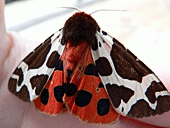
Рис.1
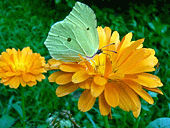
Рис.2
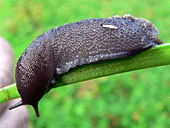
Рис.3
Following the traditions of Academician V.N. Sukachev, IEE RAS staff continue to study problems of biogeocenology. Under the long-time head of the station, N.V. Dylis, the vertical and horizontal structures of the phytocenosis were studied.
Work at the station is conducted at 50 permanent long-term monitoring plots in the broadleaf-spruce forest and meadow phytocenosis subzone. Based on this research, recommendations were developed for forestry in the Moscow Region and for organizing Moscow's forest-park zones. The results of fundamental research carried out at the Malinki Station have been used to substantiate nature conservation programs, including the creation of a network of biosphere reserves and the «Chronicle of Nature» (Letopis Prirody) program.
Scientists from IEE RAS, MSU, MSPU and other universities study invertebrates living in soils and in terrestrial ecosystems. Particular attention is paid to trends in the change of animal populations under the influence of anthropogenic factors. Animal adaptations to the soil environment, taxonomic composition and population structure are studied. This work develops Academician M.S. Ghilarov's ideas on the direct and feedback links between the composition of the soil animal population and the nature of the soil-forming process. Methods of zoological soil amelioration to increase its productivity are also studied.
An inventory of the biodiversity of the soil fauna and population is conducted. Questions concerning the formation of biosocial structures in economically important ant species are studied, taking into account their behavior under conditions of mass reproduction of harmful insects and other invertebrates. Methods of using ants as a means of forest protection against pests are being developed.
In 1964, a comprehensive Program of Biogeocenological Research on Forest Ecosystems, edited by N.V. Dylis, was prepared and published; it included a section on soil zoology compiled by M.S. Ghilarov. Subsequently, soil-zoological work at the Malinki field station was carried out in accordance with the main provisions of this Program. The Malinki field station, located in the central part of the Central Russian Upland, can serve as a regional center for organizing monitoring studies of the state of the biotic components of forest ecosystems, including plant, animal, and microbial communities typical of the coniferous-broadleaf forest zone of Central Russia.
Scientifically interesting invertebrate species are found on the station's territory (Figs. 1, 2, 3).
BIRDS, MAMMALS, FISH
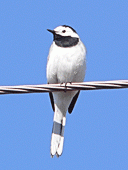
Рис.4
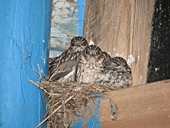
Рис.5
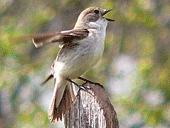
Рис.6
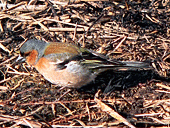
Рис.7
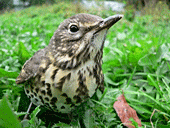
Рис.8
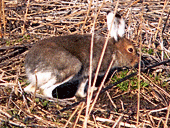
Рис.9
Ornithological observations at Malinki have been conducted since the 1960s. In total, about 140 bird species have been recorded here. Regionally rare species listed in the Red Data Book of Moscow Region nest here: the hen harrier, little owl, green and three-toed woodpeckers, spotted nutcracker, and barred warbler; the booted warbler is also thought to nest here. Species rare for the near Moscow Region that nest here include the black kite, European nightjar and mistle thrush (Zubakin, 2002; Konstantinov et al., 1998; Sharikov, 2006). The area around the station is included among the locally important key ornithological territories of Moscow Region.
The bird life is richly represented by many species, including some rare for the Moscow Region. Common inhabitants of the station include the great spotted woodpecker, and, much more rarely, the green and grey-headed woodpeckers. Both species are fairly rare in the Moscow Region. The black woodpecker also occurs. Closer to the Zhiletovka River, another rarity — the white-backed woodpecker — can be seen. An even greater rarity is the black stork soaring over the forest. The spotted nutcracker can be found, not every year but often, in the station's forests. Common buzzards and northern goshawks are common in the vicinity of the station, occurring alongside the smaller raptors — hobbies and sparrowhawks. Dense bird cherry thickets at the forest edge and along the Zhiletovka are home to nightingales and common rosefinches. Bird cherry berries attract hawfinches. The wren builds its nest under roots right at the water's edge. Treecreepers, willow tits, nuthatches and great tits often visit the forest edges and shrub thickets. Bullfinches and redpolls appear at the end of winter and in spring.
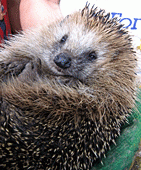
Рис.10
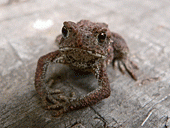
Рис.11
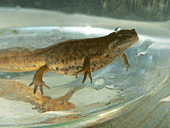
Рис.12
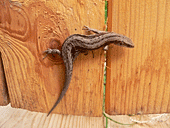
Рис.13
The white wagtail is a common resident of the station (Fig. 4). Barn swallows nest in the laboratory and residential buildings. A colony of house martins, unable to tolerate close proximity to people, abandoned its usual nesting site; their nests are now often occupied by spotted flycatchers (Fig. 5).
Pied flycatchers occupy the nest boxes put up around the territory (Fig. 6). One of the most common birds at the station is the chaffinch (Fig. 7). The European greenfinch is a fairly abundant species at the station. The redwing and fieldfare can very often be seen on the station's territory and in its surroundings. In spring, the whistled trills of the song thrush can be heard from the surrounding forests (Fig. 8). Goldfinches and siskins, familiar to us as cage birds, can be found on the station's territory. Ravens soaring in the sky serve as a kind of ornament to the station. Another corvid — the jay — is a regular visitor to the rubbish heap. Throughout the summer, until the first snow, another remarkable little bird, the European robin, can be found in the station's forests.
The mammals living in the station's forests are less conspicuous than the birds. They include elk and wild boar. Foxes and hares are more common. In spring and early summer, hares are frequent visitors to the station (Fig. 9). Stoats and weasels also occur, hunting the numerous mouse-like rodents. The latter include several species of mice and voles, whose numbers fluctuate strongly from year to year, sometimes accompanied by significant epizootics. Traces of muskrat can be seen on the duckweed of Dylis Pond, and, with luck, the animal itself, resembling a wet cat in the water.
Among the insectivorous mammals, hedgehogs (Fig. 10), moles and shrews are common on the station's territory.
Among the amphibians and reptiles at Malinki are the common frog and pool frog, the common toad (Fig. 11), the smooth newt (Fig. 12), and the viviparous lizard (Fig. 13).
MUSEUM OF NATURE OF CENTRAL RUSSIA
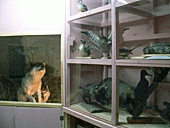
Рис.14
Under the auspices of the station, the Museum of Nature of Central Russia (MNCR) was established. It includes a collection of taxidermy specimens of birds and mammals, fungi, bird nests, botanical collections dating from the 1960s, osteological materials, and much more (Fig. 14).
The Museum appeared in February 2005, and not simply from a blank slate, but from a starting point that was, if anything, worse than empty. The room in question, a large one, was extremely cluttered. The wall cabinets were packed with 40-year-old chemical reagents, and chemical glassware, both usable and broken, was scattered everywhere. The floor had rotted through and collapsed — such was the legacy of the past. In twenty-degree frost, in an unheated room, two station staff members and one volunteer helper, led by the museum's future director, cleared out these Augean stables. Within a very short time the room was completely refurbished. The IEE RAS Directorate helped fund the tools and materials.
The collection of taxidermy specimens was donated to the Museum by V.A. Valuev, Cand. Sci. (Biol.), President of the Bashkir Ornithological Society; all the exhibits were made by him and his son. This treasure trove was transported from Ufa during that same freezing winter, with several transshipments along the way; the final stretch, through the forest, was covered by tractor. The exhibits were also set up by the station's own staff. Early in spring, materials were brought in by tractor; the exhibition design was developed by the donor of the taxidermy collection, who, together with a station worker, assembled everything. With the first warmth, work began on creating the interior setting of the exhibits, using exclusively natural materials. Photographs of the habitats were taken right in the vicinity of the station and enlarged to serve as backgrounds for the dioramas.
The task of the MNCR is to introduce visitors to the unique flora and fauna of the Malinki forest and other forests of the Moscow Region, as well as to the research carried out at the station by Academy of Sciences staff and university faculty. Students also take part in this work, and practical classes are organized for them here. Particularly valuable specimens are displayed as photographic images, allowing these species to be preserved undisturbed.
PRESERVING NATURE AND SPECIES DIVERSITY
The Malinki forest is subject to active anthropogenic impact. Trees are felled by poachers, and the ground cover is trampled by mushroom pickers and gatherers of berries, flowers and medicinal herbs. All of this disrupts the ecosystem and changes its appearance. We must protect the heritage we hold from further destruction. Ever-larger areas of meadows, fields and forest edges are being taken over by giant hogweed, displacing other plants and thereby negatively affecting biodiversity. In spring 2007, experimental research on the invasive weed Sosnowsky's hogweed began at the Malinki station, aimed at preventing its spread and preserving biodiversity.
A particular danger is posed by developers in the surrounding area, who are building ever more cottage communities. Their residents regularly visit the Malinki forest, leaving undesirable consequences behind them. In addition, these territories often become targets of hunting safaris, for both mammals and birds. All of this calls for urgent measures to grant protected status to the Malinki bio-complex, or the change to the ecosystem may become irreversible.
In order to preserve natural ecosystems and their components, as well as the sample plots established almost 40 years ago, and to ensure the continuity of observations, IEE RAS has repeatedly attempted to establish a state nature reserve (zakaznik) on the territory of the «Black Alder Forest» nature monument. A protected regime would make it possible to continue studying the dynamics of natural ecosystems and their components, and to expand biogeocenological research and biodiversity monitoring in this natural area under conditions of growing anthropogenic pressure near the megacity of Moscow.
LIST OF WORKS PREPARED BASED ON RESEARCH AT THE «MALINKI» STATION
Sukachev V.N., Dylis N.V. /Eds./ Osnovy lesnoy biogeotsenologii. M.: Nauka, 1964. 574 p.
Dylis N.V. /Ed./. Biogeotsenologicheskie issledovaniya v shirokolistvenno-elovykh lesakh. M.: Nauka, 1971. 333 p.
Dylis N.V. /Ed./. Programma i metodika biogeotsenologicheskikh issledovaniy. M.: Nauka, 1974. 403 p.
Dylis N.V. Uchenie o biogeotsenoze i ego problemy. M.: Znanie, 1975. 63 p.
Dylis N.V. Nosova L.M. Fitomassa lesnykh biogeotsenozov Podmoskovya. M.: Nauka, 1977. 143 p.
Dylis N.V. Osnovy biogeotsenologii. M.: MGU, 1978. 151 p.
Dylis N.V. et al. Sukhodolny lug kak biogeotsenoz. M.: Nauka, 1978. 83 p.
Dylis N.V. Listvennitsa. M.: Lesn. prom-st, 1981. 96 p.
Dylis N.V. (Ed.). Kompleksnye biogeotsenologicheskie issledovaniya v lesakh Podmoskovya. M.: Nauka, 1982. 242 p.
Puzachenko Yu.G., Skulkin V.S. Struktura lesnoy rastitelnosti. M.: Nauka, 1982. 320 p.
Burova L.G. Ekologiya gribov makromitsetov. M.: Nauka, 1986. 222 p.
Karpachevsky L.O. Lesa Yuzhnogo Podmoskovya. M.: MGU, 1986.
Ilyichev V.D., Butyev V.T., Konstantinov V.M. Ptitsy Moskvy i Podmoskovya. M.: Nauka, 1987. 272 p.
Burova L.G. Zagadochny mir gribov. M.: Nauka, 1991. 96 p.
Burova L.G. Griby Podmoskovya. M.: Nauka, 2000. 92 p.
Byazrov L.G. Lishayniki v ekologicheskom monitoringe. M.: Izd. "Nauchny mir", 2002. 336 p.
Kuznetsova N.A. Organizatsiya soobshchestv pochvoobitayushchikh kollembol. M.: GNO «Prometey» MPGU, 2005. 244 p.
Photos: O.L. Silaeva, V.D. Ilyichev, V.V. Reshetnikova