
Results of the scientific and educational series of lectures of the Institute of Ecology and Evolution of the Russian Academy of Sciences in the Chechen Republic: conservation of the leopard and the creation of a national photo-monitoring network
In May 2026, at the initiative of the A.N. Severtsov Institute of Ecology and Evolution of the Russian Academy of Sciences (IEE RAS), a series of lectures on current issues of biodiversity conservation, the restoration of key animal species, and the implementation of modern monitoring methods were held at higher education institutions in the Chechen Republic. The event marked an important milestone in the development of scientific and educational cooperation and the popularization of environmental topics among students and faculty in the region.
A total of seven lectures were given at the republic's two main universities: the A.A. Kadyrov Chechen State University (CSU) and the Chechen State Pedagogical University (CSPU). The lectures were delivered by leading researchers from the IEE RAS and the Dagestan Scientific Center of the Federal Research Center of the Russian Academy of Sciences (DSC FRC RAS). The lectures covered a wide range of topics, from the fundamental scientific foundations of ecosystem monitoring to specific practical steps for restoring populations of rare predators and ungulates in the Caucasus.
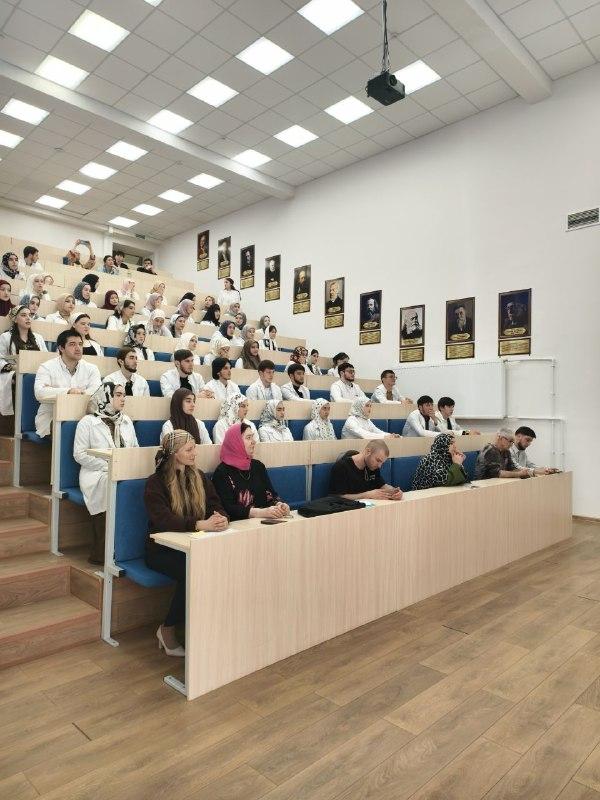
The lecture series opened on May 14 with two parallel presentations. At the Chechen State Pedagogical University, PhD in Biology A.A. Yachmennikova addressed students of the Faculty of Biology. Her lecture focused on the recovery of the Persian leopard, Russia's role in the International Project and the role of the Chechen Republic in this process, as well as the need for systematic monitoring of key animal species ecologically related to the leopard and the state of their habitats. Concurrently, PhD in Geography E.A. Aristarkhova delivered a lecture at the Chechen State University on "Biotopes of the Southern Part of the Chechen Republic: Modern Research Methods, Modeling, and Photomonitoring of Phenology." She discussed in detail the landscape prerequisites for the formation of stable populations of large mammals, the structure of floristic communities in the Chechen Republic, and the importance of ecological corridors. Both presentations sparked lively discussions. The audience was particularly interested in why the territory of the former Sovetsky Federal Nature Reserve in the Shatoi District is considered by scientists to be a key ecological bridge for the Persian leopard.
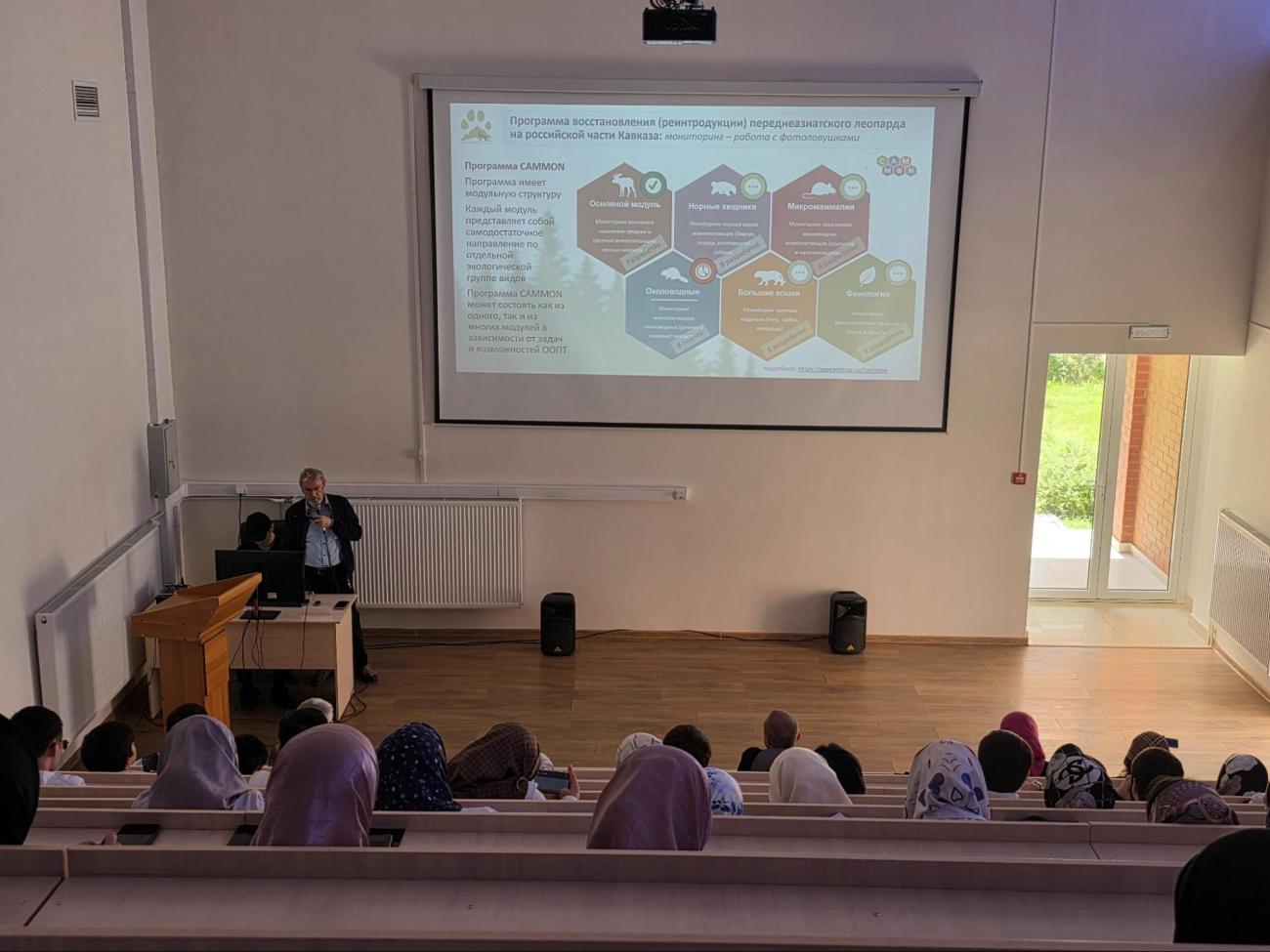
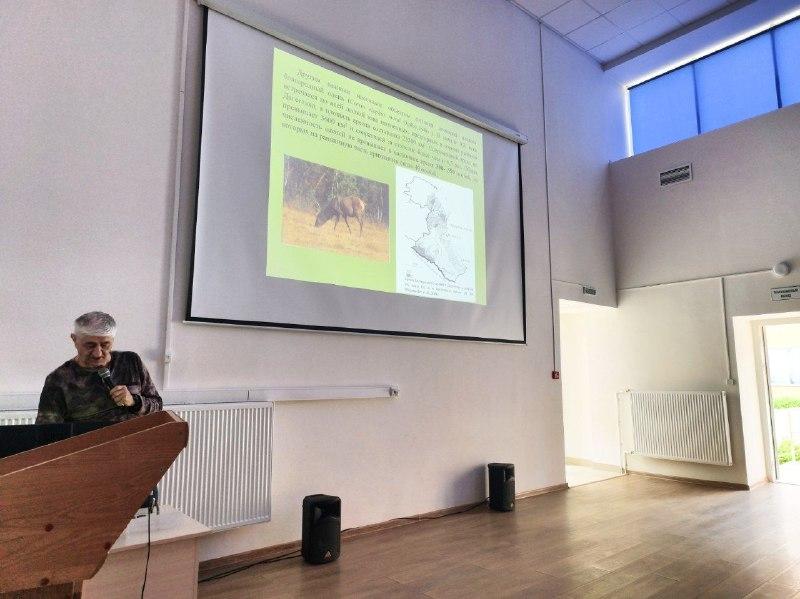
The central events of the series were the presentations on May 20 and 21 by two eminent scientists: Academician of the Russian Academy of Sciences V.V. Rozhnov and Corresponding Member of the Russian Academy of Sciences M.-R.D. Magomedov (Dagestan Scientific Center of the Federal Research Center of the Russian Academy of Sciences). On May 20, the first two lectures were held at the ChSPU site. They were dedicated to the scientific foundations of biodiversity monitoring and restoration, with a special emphasis on key predatory mammal species in the Russian Federation. V.V. Rozhnov discussed long-term conservation programs for endangered species in Russia and, in particular, the program for the restoration of the Persian leopard in the Caucasus, which has been implemented by the Russian Ministry of Natural Resources with the scientific support of the Institute of Ecology and Evolution of the Russian Academy of Sciences since 2007. He emphasized that despite significant successes (for example, the successful adaptation of a female Khosta in Kabardino-Balkaria, confirmed by recent camera trap images), the work remains highly relevant. M.-R.D. Magomedov delivered lectures on the current status of key ungulate species in the Caucasus, as prey for large predators, and the need for effective modern monitoring of these species, as well as the importance of using modern research tools such as camera traps. He provided a detailed analysis of the current population status of the Caucasian red deer, chamois, tur, and wild boar, and discussed the ecological principles of assessing the habitat capacity of these species in the Chechen Republic.
The lecture series concluded with a presentation by A.Yu. Rodnikova, which focused on the history of photomonitoring worldwide and the formation of a modern photomonitoring system in the Chechen Republic. The lecturer detailed the evolution of the method - from the first semi-automated cameras for capturing wild animals to modern digital camera traps with remote data transmission capabilities - as well as the key principles of systemic research conducted using camera traps.
A key focus of all presentations was communicating to the audience the importance of implementing and organizing a modern photomonitoring network in the European part of Russia under the CAMMON (CAMtrap MONitoring) Program. This program was developed by the Central Forest State Nature Reserve in 2022 to standardize mammal monitoring in specially protected natural areas (SPNAs). In 2026, a large-scale project, "Formation of a National Photomonitoring Network in Protected Areas of Russia," was launched, supported by a grant from the Presidential Fund for Nature. The project involves six nature reserves and one wildlife refuge. Scientists explained that only a unified, standardized camera trap network will allow for the following: meta-analysis of data from different territories; calculation of population densities of prey species (ungulates and medium-sized carnivores); assessment of risks posed by competitor species (wolves and lynxes); and recording of possible new incursions of the Persian leopard.
The information that the work in Chechnya is being conducted on the territory of the former Sovetsky Federal Nature Reserve has caused particular resonance. This territory, located in a belt of broadleaf forests, is the main ecological bridge (corridor) connecting key Persian leopard habitats in the Central Caucasus. The scientists expressed hope that the results of systematic photo monitoring, prey analysis, and anthropogenic threat assessment will make it possible to justify the need to restore this territory to federal protected area status. As Academician V.V.Rozhnov noted in his lectures, restoring the protected status of the Sovetsky Nature Reserve is one of three lofty goals the institute has set for itself in deploying a photo-monitoring network in the region. The other two are the creation of a leopard monitoring system in the Caucasus comparable to the one in operation in Land of the Leopard National Park in the Russian Far East, and the development of a specialized mountain module for the CAMMON program, taking into account the complex terrain and mosaic distribution of the animals.
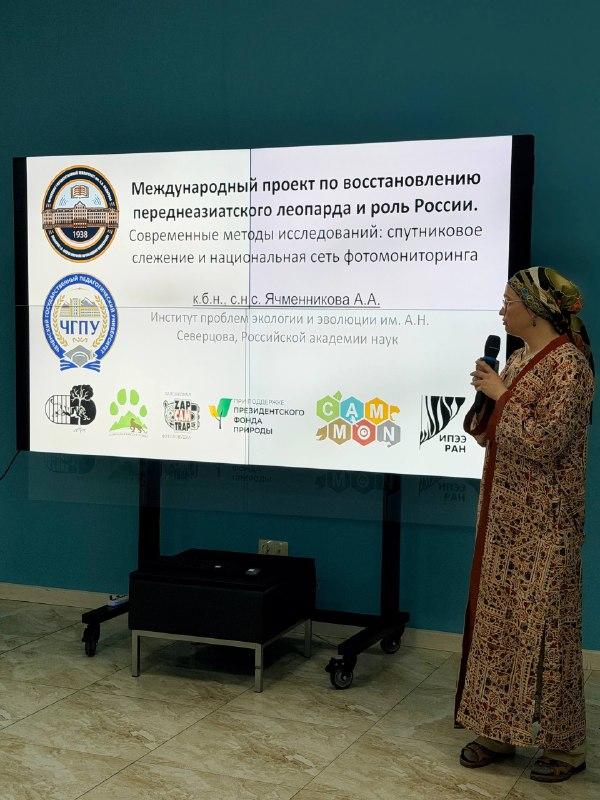
All lectures in the May series not only introduced attendees to the latest data and methods but also emphasized the need for a systematic approach to monitoring, including satellite tracking of animals (using domestic GPS collars) and ground-based photomonitoring according to CAMMON program standards.
The IEE RAS staff expresses gratitude to the leadership of the Chechen State University and the Chechen State Pedagogical University, and personally to D.D. Arsanukaev, for their organizational support. They also look forward to continuing their joint educational work, which is an integral part of the Persian Leopard Recovery Program in the Caucasus.
The project to restore this leopard subspecies in the Russian Caucasus has been ongoing for 19 years, and, as demonstrated by the May lectures in Grozny, the Chechen capital, the scientific work not only remains relevant but is also taking on new dimensions in the form of direct dialogue between high-level academic research and a student audience.
Related news:
https://sev-in.ru/node/4409
https://sev-in.ru/node/4616
https://sev-in.ru/node/879
https://minprirod.kbr.ru/news/ostorozhno-leopard.html
https://sev-in.ru/node/3918
https://sev-in.ru/node/4572
https://sev-in.ru/node/4435
https://sev-in.ru/node/2442
https://sev-in.ru/node/3692