



On February 6, research fellow, DBS L. A. Limantseva and postgraduate students of the Laboratory of Phytoparasitology of the IEE RAS conducted an excursion for participants of the Competition of specialized classes.
Scientists have obtained for the first time data on a rare fish species - the Alaskan sculpin Triglops metopias (Cottidae) from the Russian waters of the Kuril Islands.
Deputy Director for Science, Corresponding Member of the RAS A.V. Surov and Scientific Secretary of the IEE RAS, DBS N.Yu. Feoktistova took part in the discussion "Gone Viral!" about how to distinguish real animals from those generated by neural networks.
The annual Readings in Memory of Academician Vladimir Evgenievich Sokolov were held at the A.N. Severtsov Institute of Ecology and Evolution of the Russian Academy of Sciences.
Scientists have obtained for the first time data on the size composition, age, sex structure, growth and maturation of one of the most common deep-sea pelagic fish species - Sloane’s viperfish Chauliodus sloani.
Cases of catching two individuals of the three-toothed lamprey in the northwestern Pacific Ocean have expanded our knowledge of the morphological characteristics and biology of this species during its marine life.
Information on the current state of habitats and the degree of their suitability for the species in different parts of its range, which in the Russian Caucasus is its northwestern edge, is in great demand.
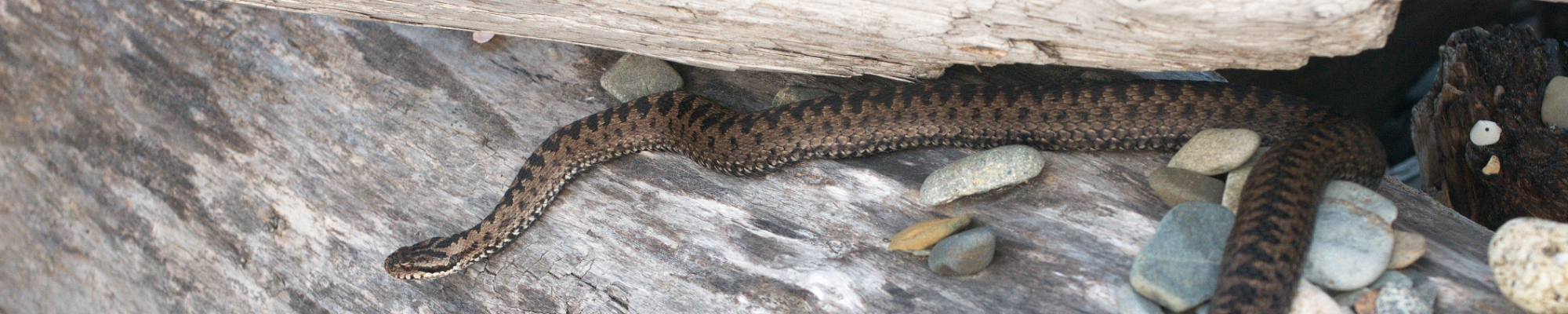
A new study on the phylogeography of the eastern subspecies of the grass snake has shed light on how this snake species spread across northern Eurasia after the Last Glacial Maximum.
The study of speciation processes occurring at the Pliocene-Pleistocene boundary in individual groups of mammals allows us to reconstruct the picture of the evolution of biological diversity in poorly studied parts of the world.
Advances in sequencing technologies and bioinformatics have led to a breakthrough in the study of viral diversity, but viruses of most soil animals (except ants) remain largely unstudied.
The film was shot in Kamchatka on the territory of the Kronotsky Nature Reserve over the course of three years. In total, three expeditions from 2020 to 2022 lasted 26 months.
These guidelines were developed based on the results of a study of reindeer helminths in fifty zoos and menageries in the Russian Federation, conducted in 2024.
Scientists have obtained new data on the slender eelblenny Lumpenus fabricii (Stichaeidae) and the bigeye sculpin Triglops nybelini (Cottidae) in the seas of the Russian Arctic.
Consortium "Microplastics in the Environment" and Tomsk State University invite you to take part in the first All-Russian meeting with international participation on microplastics pollution "MicroPlasticsEnvironment - 2022".
April 28-29, 2021 in the conference hall of the A.N. Severtsov Institute of Ecology and Evolution RAS, it is planned to hold the Conference with international participation "Environmental problems, biological resources and fisheries in the Volga-Caspian basin". Conference formats: face-to-face and online.
Conference organizers: Caspian Science and Innovation Council, IEE RAS, Russian Committee for the UNESCO «Man and the Biosphere» Program of the United Nations, VNIRO.
Venue of the meeting and online broadcast of the Conference: Moscow, Leninskiy prospect, 33, IEE RAS, 1st floor, conference hall.
Co-organizers of the round table "International cooperation in the development of ecological tourism and education: proposals and exchange of experience" (to be held within the framework of the Conference): Department of Recreational Geography and Tourism in conjunction with the Department of Physical Geography of the World and Geoecology of the Faculty of Geography of M.V. Lomonosov Moscow State University. Online broadcast of the round table - M.V. Lomonosov Moscow State University.
The conference will be devoted to topical issues of research and monitoring activities in the field of ecology and fisheries, conservation and sustainable development of the ecosystem during the operation of inland waterways, hydraulic structures, the development of shipping and fishing in the Volga-Caspian basin.
The third lecture in the IUBS Webinar Series will be delivered by Dr Jane Goodall, DBE. An ethologist and environmentalist, with ongoing research spanning more than six decades, Dr Goodall is a pioneer in studying the behavior, social organization, and cognitive abilities of chimpanzees. She is the founder of the Jane Goodall Institute & UN Messenger of Peace.
In this webinar, Dr. Jane Goodall will talk about the research that she began more than 60 years ago, which is ongoing today into the lives of the wild chimpanzees in Tanzania’s Gombe National Park. Her pioneering work has changed the way we look at wildlife and conservation activities across the world. The TACARE programme has empowered the communities living around Gombe to become JGI’s partners in conservation and is being replicated in other African countries. Dr Goodall will speak about her early work, how it changed the way we think about both chimpanzees and ourselves and about the many programmes established by the Jane Goodall Institute that are working to sustain both wildlife and human communities.
April 27th | 11:30 (Moscow time)
Esteemed colleagues!
The Yamal-Nenets Department for External Relations is pleased to invite you to take part in the "Siberian Crane (White Crane) - a Symbol of Hope for Biodiversity Conservation in the 21st Century" symposium that will take place in Salekhard (Yamal-Nenets autonomous okrug, Russia) on March 31 - April 1, 2021.
The main goal of the symposium is to discuss the research results and conservation of Siberian Crane populations and to develop long-term measures for the preservation and restoration of the Siberian Crane within its geographic range - on nesting sites, wintering grounds and migration routes. Along with the symposium there will also be a photo exhibition demonstrating the beauty, diversity and richness of the world of birds inhabiting the vast areas of Siberia and China.
The main topics of the symposium:
1. The population and distribution of the Siberian Crane.
2. Biology and behavior of the Siberian Crane.
3. Threats to Siberian Crane population and their mitigation.
4. Captive breeding and reintroduction of Siberian Crane.
5. Genetic structure of Siberian Crane populations.
6. The role of the Siberian Crane in the ethnography and culture of the peoples of Eurasia.
7. New methods of studying and preserving cranes and other rare bird species.
8. Strategic bases for the conservation of the Siberian Crane and other rare bird species:
- state (national) strategies for the conservation of the Siberian Crane;
- Russian Federal project "Conservation of biological diversity and development of ecological tourism";
- regional programs for the Siberian Crane preservation;
Everything in nature is regulated - from the numbers of vital molecules in our bloodstream to the number of lions in an African savanna. Over the past fifty years, two revolutions have unfolded in biology in understanding the regulation of life at these two scales.
In this lecture, Dr. Carroll will discuss the discovery of the "The Serengeti Rules," the ecological rules that regulate the numbers and kinds of animals and plants in any given place, and how they are being applied to restore some of the greatest wildernesses on the planet.
The International Union of Biological Sciences (IUBS) was established in 1919 as a non- governmental and non-profit organization comprising of National Academies and international scientific Associations and Societies. Since then IUBS is functioning as a global platform of scientists from all disciplines and nationalities for cooperation, interaction and collaboration to promote research, training, and education in biological sciences.
To commemorate completion of 100 years of promoting excellence in biological sciences, IUBS has launched a Webinar Series bringing the best of all disciplines to discuss evolution, taxonomy, ecology, biodiversity, and other topics that represent unified biology and the topics of prime importance to address contemporary problems such as climate change, endangered species, food and nutrition, health etc.
The first lecture of the webinar series was delivered by Rattan Lal, 2020 World Food Prize Laureate on “Forgetting How to Tend the Soil” on 2nd October 2020.