

The impact of early hearing loss on the acoustic repertoire of dolphins

A joint study by researchers from the Vertebrate Sensory Systems Laboratory at the A.N. Severtsov Institute of Ecology and Evolution of the Russian Academy of Sciences (IEE RAS) and the Moskvarium Center for Oceanography and Marine Biology assessed the impact of early hearing loss in a young bottlenose dolphin (Tursiops truncatus) on the development of its acoustic repertoire. This study addresses a poorly understood area, as most documented cases of hearing loss in dolphins occur in adult animals with a fully developed vocal repertoire. Toothed cetaceans, particularly dolphins, are among the few animals capable of learning to produce new sounds by imitating their relatives. The development of dolphins' acoustic repertoire progresses significantly in the first months after birth, thanks to vocal learning and imitation of significant individuals.
A four-year-old male dolphin born at the Moskvarium required a hearing test. According to the trainer, the dolphin's first signs of hearing impairment began to appear at a few months of age; it was noticeable that he relied primarily on eye contact with the trainer and imitating the behavior of other animals. However, the dolphin was actively vocalizing (Figure 1).
In the first stage of the study, hearing was assessed using an electrophysiological method, recording auditory evoked potentials. This procedure is painless for the animal and allows for rapid, accurate data collection without the need for special training. The test revealed that the dolphin indeed had profound hearing loss (Figure 2).
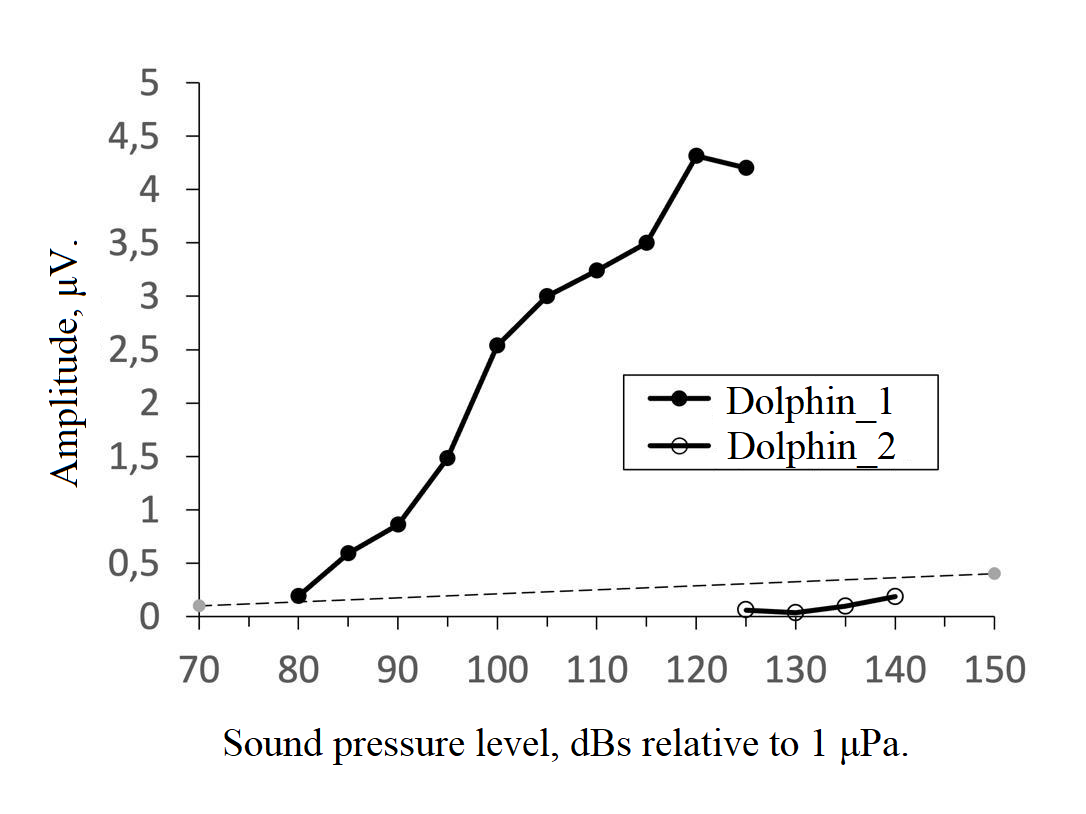
Figure 2. Dependence of the amplitude of auditory evoked potentials on the sound pressure level of the stimulus for a dolphin with normal hearing (Dolphin_2) and with hearing impairment (Dolphin_1). The horizontal dotted line shows the background level (the average amplitude of all spectral components during the recording of brain electrical activity).
The dolphin's vocal repertoire was analyzed and compared with that of healthy individuals. Despite its hearing loss, the test dolphin produced all the types of signals typical of adult dolphins of its species (clicks, whistles, and pulsed-tone signals). However, its signals had certain peculiarities that brought it closer to the basic characteristics of newborns: whistles were significantly shorter in duration than those of normally hearing dolphins; most whistles were combined with clicks; and its individual whistle—a "signature"—could not be identified. An intriguing result of the study was that the hearing-impaired dolphin, its sister, and its mother produced a specific, almost stereotypical signal consisting of a direct (unmodulated) pure tone, matching the frequency of the mother's trainer's whistle, combined with clicks (Figure 3). Apparently, the test dolphin shares a signal with its normally hearing significant individuals.
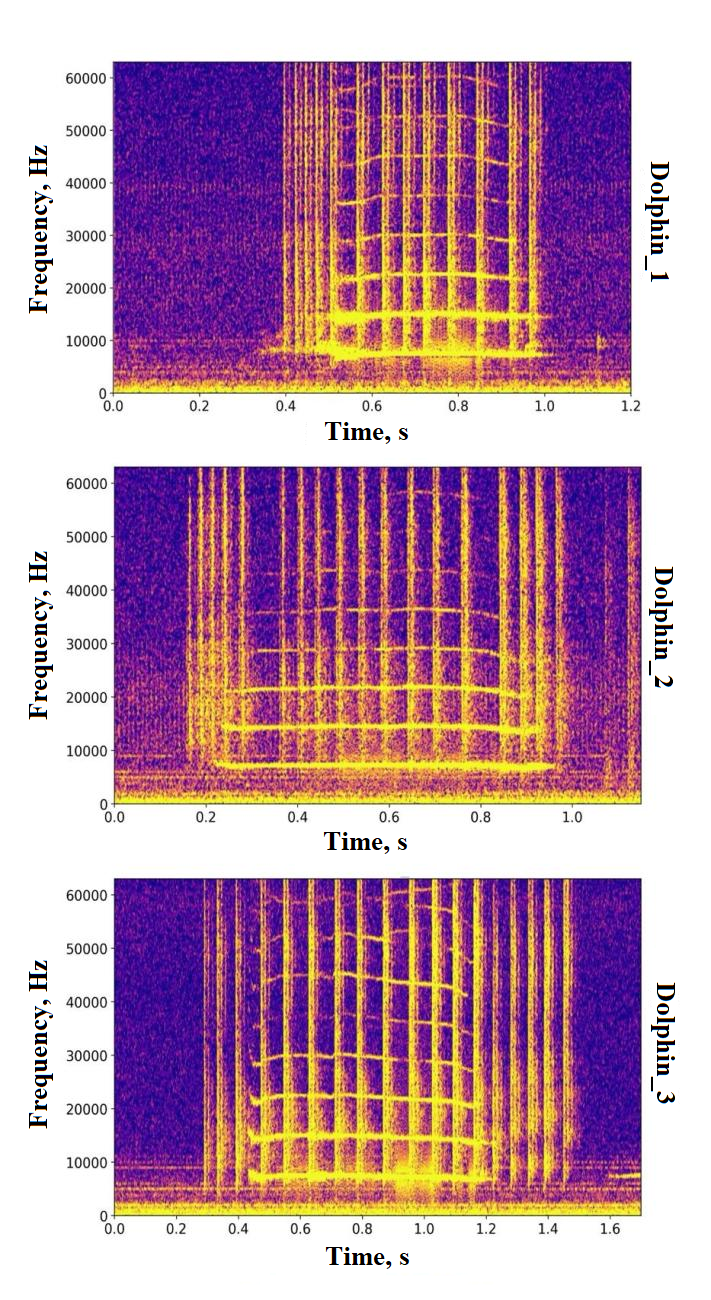
The results indicate that the dolphin's hearing problems are not congenital, but rather developed shortly after birth, presumably before the development of the distinctive whistle that most bottlenose dolphin calves typically develop before the age of one year.
"This research allowed trainers to establish feedback with a deaf dolphin without using a bridge signal by developing a customized training approach based on visual stimuli. In the future, such a dolphin with confirmed hearing loss could serve as a model for studying the effects of deafness on the acoustic activity, vocal repertoire, and social behavior of young dolphins as they mature and acquire new social roles," said Evgeniya Sysueva, PhD, Senior Researcher at the Institute of Ecology and Evolution of the Russian Academy of Sciences.
Note from the authors:
It is with deep regret that we report that Alexander Yakovlevich Supin, one of the authors of this article, passed away on February 21, 2026. His contribution to this work, as well as to marine mammal science in general, was invaluable. We are grateful for the opportunity to work with him and will cherish his memory with fondness.
This paper was published in the journal: Sysueva E, Sidorova I, Suvorova I, Supin A, Nechaev D, Tkachenko A, and Popov V (2026) Hearing abilities and acoustic signaling of the bottlenose dolphin Tursiops truncatus with early hearing loss. Front. Mar. Sci. 12:1634494. doi: 10.3389/fmars.2025.1634494
Related materials:
Science.Mail: "The characteristics of the deaf dolphin's 'language' have been studied in Russia"