

Swamps as a sink for atmospheric CO₂ are vulnerable to climate change
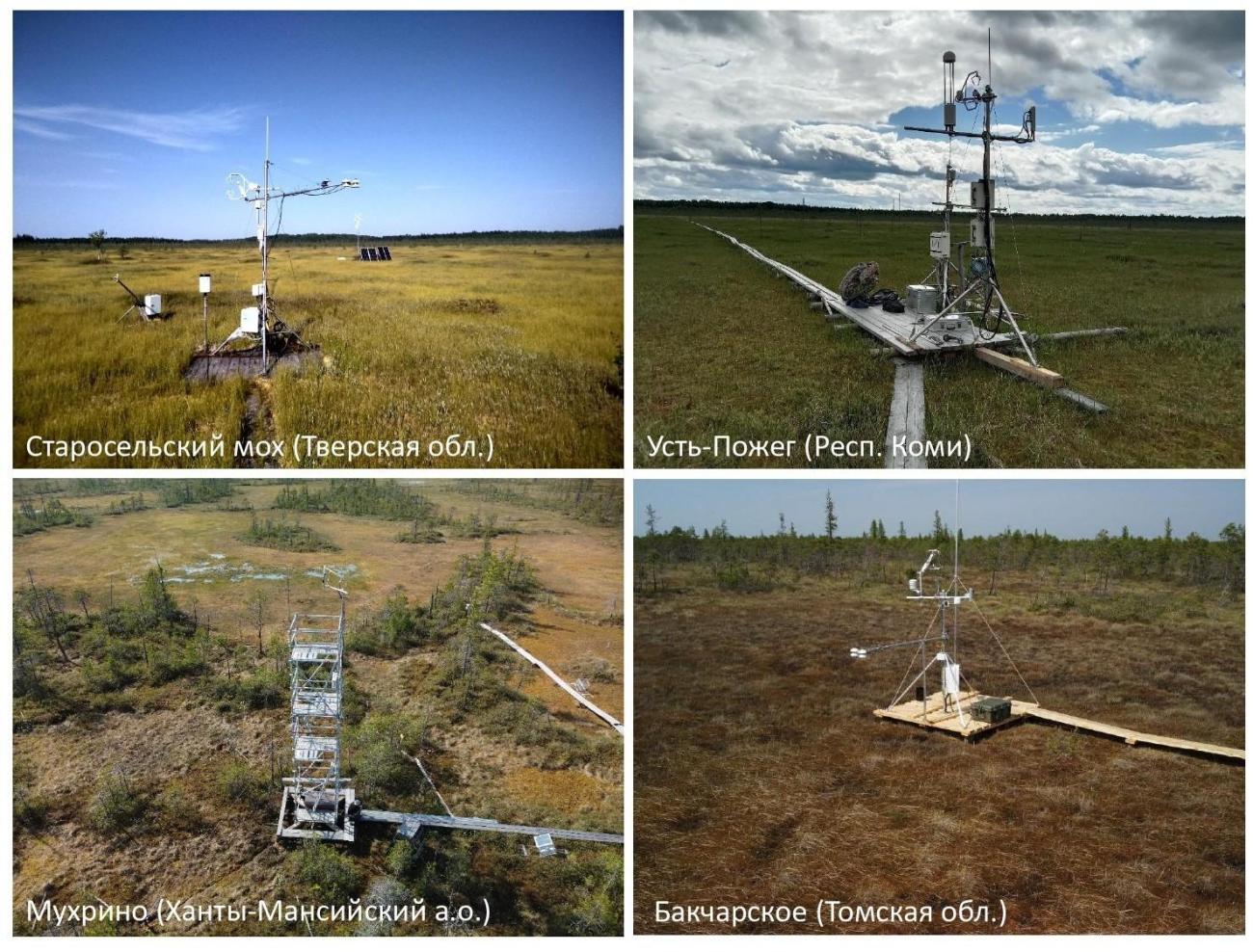
A group of Russian researchers compared the results of monitoring CO₂ absorption by taiga bogs in European Russia and Western Siberia.
Wetlands are considered one of the most effective natural tools for regulating atmospheric CO₂ concentrations. Swamps are generally considered to be a stable and long-term sink for atmospheric carbon dioxide. Over millennia, swamps in northern latitudes (north of 45° N) have accumulated an amount of organic carbon comparable to the mass of all vegetation on the planet. However, the increasing frequency of droughts and heat waves in northern latitudes, associated with current climate change, negatively impacts the productivity of swamp vegetation and increases the share of emissions in the carbon balance of swamps. Predicting the response of swamp ecosystems to climate change requires data on how photosynthesis and respiration in bog ecosystems change under the influence of external factors in various natural zones, taking into account the diversity of wetlands.
In a joint study by scientists from the A.N. Severtsov Institute of Ecology and Evolution of the Russian Academy of Sciences (Moscow), the Komi Institute of Biology of the Ural Branch of the Russian Academy of Sciences (Syktyvkar), Yugra State University (Khanty-Mansiysk), and the Institute for Monitoring of Climate and Ecological Systems of the Siberian Branch of the Russian Academy of Sciences (Tomsk), an analysis of direct observations of ecosystem CO₂ fluxes was conducted in four bogs in the southern and middle taiga of European Russia and Western Siberia. The studies were conducted at the raised (oligotrophic) swamps of Staroselsky Mokh (Tver Region), Mukhrino (Khanty-Mansi Autonomous Okrug), and Bakcharskoye Swamp (Tomsk Region), as well as at the fens (meso-oligotrophic swamps, transitional from lowland to raised) Ust-Pozheg (Komi Republic). Observations were conducted using automated measuring systems (ecological and climatic stations) and a uniform methodology. The study established that all its objects act as sinks for atmospheric CO₂ during the growing season. Moreover, the highest absorption values were observed in the fen, under temperature and precipitation conditions close to the climatic norm. It was found that CO₂ absorption processes in the meso-oligotrophic swamp are more resilient to elevated temperatures and low air humidity.
"In addition to the negative impact of abnormally dry and hot weather conditions, it has been found that extremely high precipitation can also negatively impact the absorption of atmospheric carbon by meso-oligotrophic swamps. Considering that climate change in many regions of Russia is leading to a transformation of precipitation patterns—from continuous torrential—it is essential to advance research aimed at studying the influence of precipitation intensity and duration on the condition and functioning of various natural ecosystems," said Vadim Mamkin, PhD in biology and head of the Youth Laboratory of Ecological and Climatic Research at the Institute of Ecology and Evolution of the Russian Academy of Sciences.
Predicting the structural and functional organization of wetlands can only be based on long-term comprehensive environmental and climate monitoring data using modern methods.
This work was carried out with the support of the state assignment of the Youth Laboratory of Ecological and Climatic Research of IEE RAS (FFER-2025-0001, No. 1024100700075-7-1.6.19), the most important innovative project of state significance "Development of a system for ground-based and remote monitoring of carbon pools and greenhouse gas flows in the territory of the Russian Federation, ensuring the creation of a system for accounting for data on the flows of climate-active substances and the carbon budget in forests and other terrestrial ecological systems" (reg. No. 123030300031-6)", the state assignment of the Institute of Biology of the Komi Federal Research Center of the Komi Scientific Center of the Ural Branch of the Russian Academy of Sciences (No. 125020501547-8), a grant from the Government of the Tyumen Region within the framework of the program of the West Siberian Interregional Scientific and Educational Center of World Class (National Project "Science"), the state assignment of the Institute for Monitoring of Climatic and Ecological Systems of the Siberian Branch of the Russian Academy of Sciences (FWRG-2021-0001 No. 121031300154-1) and the Fundamental Research Program of the National Research University Higher School of Economics.