

Ancient DNA has helped scientists understand the evolutionary history of root vole populations

Climate change during the late Pleistocene and Holocene profoundly impacted the demographic characteristics of many species. Small mammals, especially rodents, provide a good model for studying such questions due to their high population sizes and high environmental sensitivity. One of the most suitable subjects is the root vole, Alexandromys oeconomus, a species of the order Rodentia, whose range has varied widely in the past and present throughout the Holarctic region.
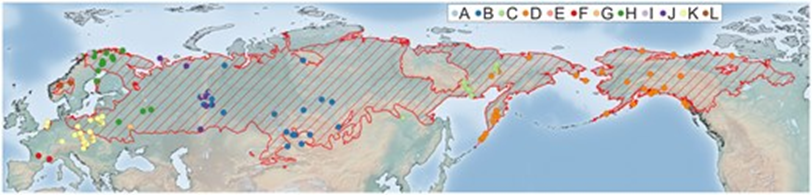
An international team of authors, including Svetlana Pavlova, PhD, from the A.N. Severtsov Institute of Ecology and Evolution, Russian Academy of Sciences (IEE RAS), used ancient DNA samples isolated from the molars of fossil tundra voles from the late Pleistocene and Holocene to understand the evolutionary history and reconstruct the phylogeography of this widespread rodent species. The scientists identified 12 major genetic lineages within the species, including extinct lineages, highlighting the extensive historical variability of A. oeconomus (Fig. 1).
An important result was that climate change led to repeated eastward and westward expansions of lineages, as well as the extinction and replacement of individual lineages (Fig. 2). Thus, it was found that, having originated in Central/Western Asia, the root vole migrated to Europe approximately 110,000 years ago and diversified into several lineages.
Two return migrations from Central Asia to Northeast Asia occurred approximately 70,000 and 16,000 years ago, preceding the colonization of North America approximately 11,500 years ago. Europe also experienced intense population changes, with subsequent migrations to Western Asia. Fennoscandia was colonized three times after 15,000 years, via two different routes.
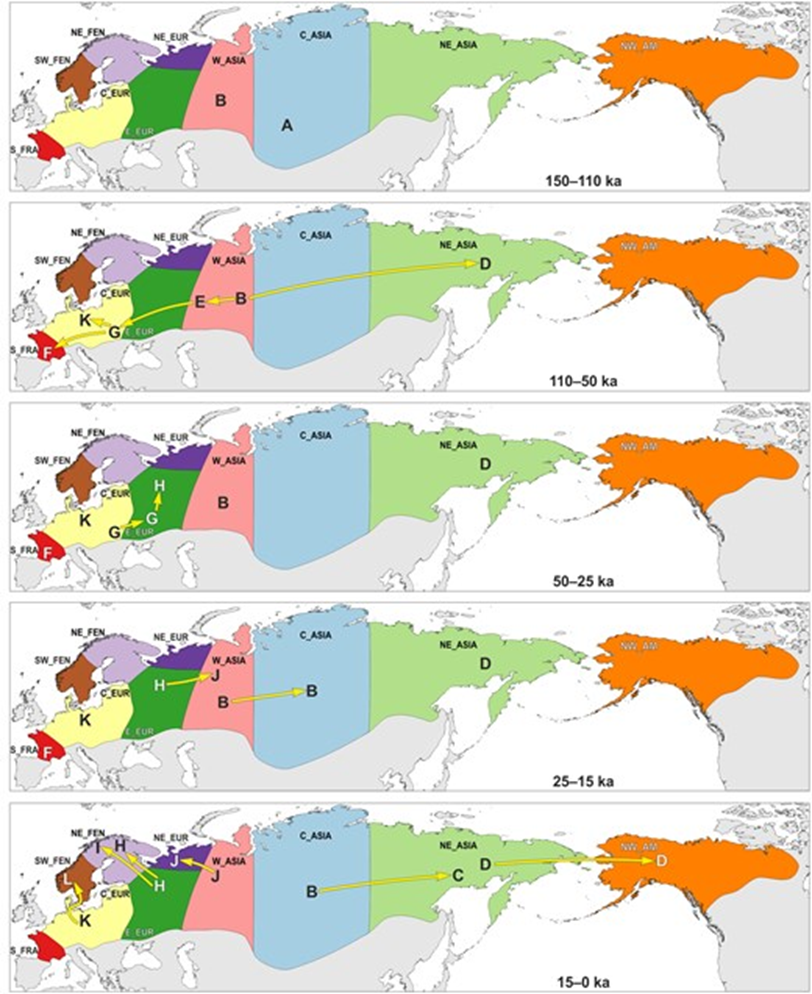
Fig. 2. Probable phylogeographic relationships and potential directions of migration of genetic lineages of Alexandromys oeconomus in the selected periods.
All of these migrations were linked to climate change, with populations increasing during warming periods and decreasing during cooling periods, most noticeably during the Last Glacial Maximum.
"This study sheds light on the evolutionary history of the studied rodent species (A. oeconomus), highlighting the complex interactions between geographic distribution, climate, and genetic diversity. These results are important for understanding past population dynamics and the adaptation of root voles in response to changing environmental conditions," said Svetlana Pavlova.
The article was published in the Zoological Journal of the Linnean Society (Q1).
Related materials:
Science.Mail: "Ancient DNA reveals root vole migrations"