

Brandt's voles balance between monotony and variety in their alarm calls

Photo: Brandt's vole often makes alarm calls without fully emerging from its burrow.
The Brandt's vole is one of the few vole species in the subfamily Arvicolinae that emits loud alarm calls within the human hearing range when confronted with terrestrial and avian predators. They also perceive humans as potential predators and begin calling out in alarm from a distance of several dozen meters. Researchers from Lomonosov Moscow State University, the Institute of Natural Resources, Ecology, and Cryology of the Siberian Branch of the Russian Academy of Sciences (INREC SB RAS), and the A.N. Severtsov Institute of Ecology and Evolution of the Russian Academy of Sciences (IEE RAS) studied the individual characteristics of the alarm calls of Brandt's voles (Lasiopodomys brandtii) in a natural population of these steppe rodents in the buffer zone of the Daursky Nature Reserve in the Zabaikalsky Krai. Brandt's voles live in family colonies consisting of a breeding pair and several successive litters. During the peak population period, when this study was conducted, the distance from one colony to another could be no more than 100 meters. Typically, when a human appeared near a colony, one rodent would emerge from its burrow and emit a long sequence of alarm calls, then the first member would fall silent and another would begin calling.
In Brandt's vole family colonies, the researchers recorded long sequences of alarm calls from one animal per colony. From these recordings, they selected those that included at least 50 calls. These sequences were recorded in 50 colonies, for a total of 2,500 alarm calls included in the analysis. The acoustic parameters of the calls were then measured and their variability was assessed within long individual sequences and between voles from different colonies.
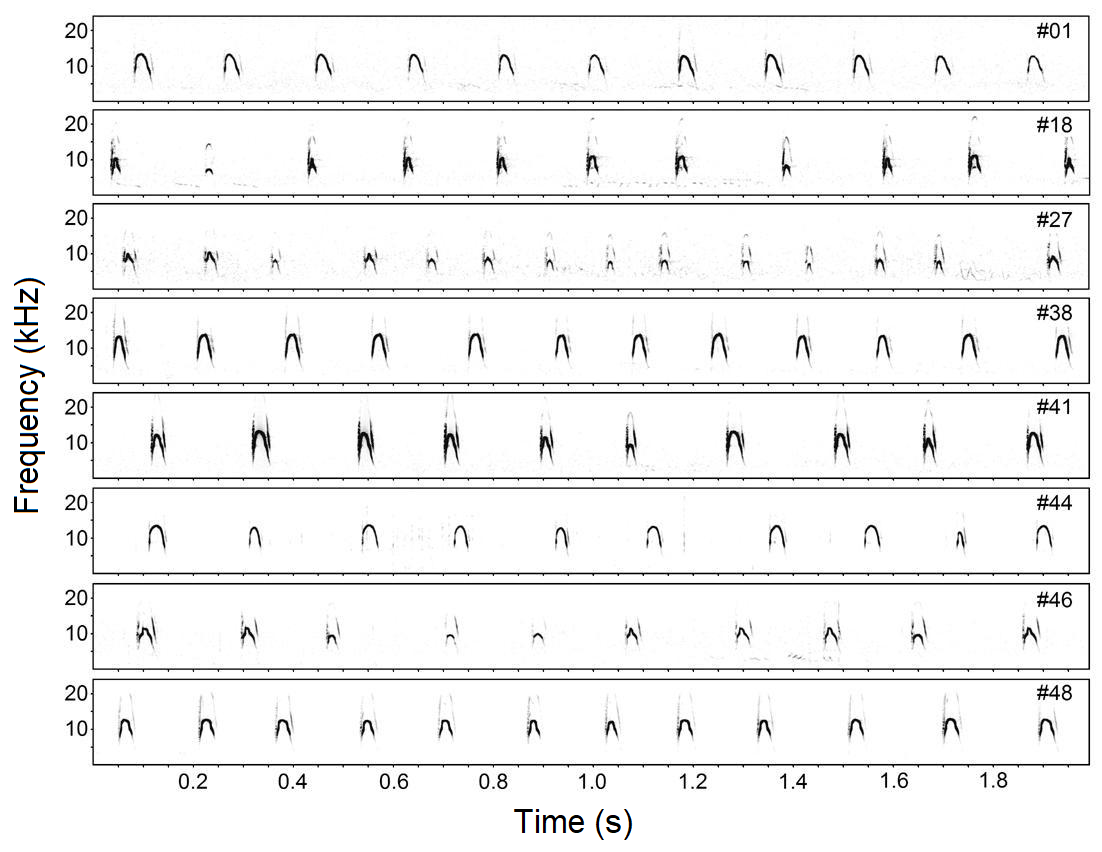
The alarm vocalizations of Brandt's voles are very long (up to several hundred) series of short alarm calls, uttered at short intervals. The production of alarm calls in long sequences may help listeners identify the caller even when some of the calls are masked by noise or disrupted by wind, which is common in the open habitats of Brandt's voles. Listeners may experience an illusion of auditory continuity (first demonstrated by Canadian researchers in Richardson's ground squirrels) based on the call duration of repeated calls, even when some of them are obscured by noise.
Although the alarm calls of Brandt's voles could have up to four different contour shapes even within a call sequence in the same individual, all individuals were recognizable by their calls with a probability 15 times greater than chance. The study demonstrates that the alarm calls of Brandt's voles maintain a balance between individualization and diversity of acoustic structure, which may have important biological implications. Individualized calls within a sequence form the basis for reliable recognition by colony members. However, diversity in alarm calls within a sequence of a single individual helps prevent monotony and family members from becoming accustomed to the same calls. Thus, a variety of calls within a sequence will maintain the vigilance of other family members until the dangerous predator leaves the colony.