
Life forms of marine copepods and their ecological characteristics
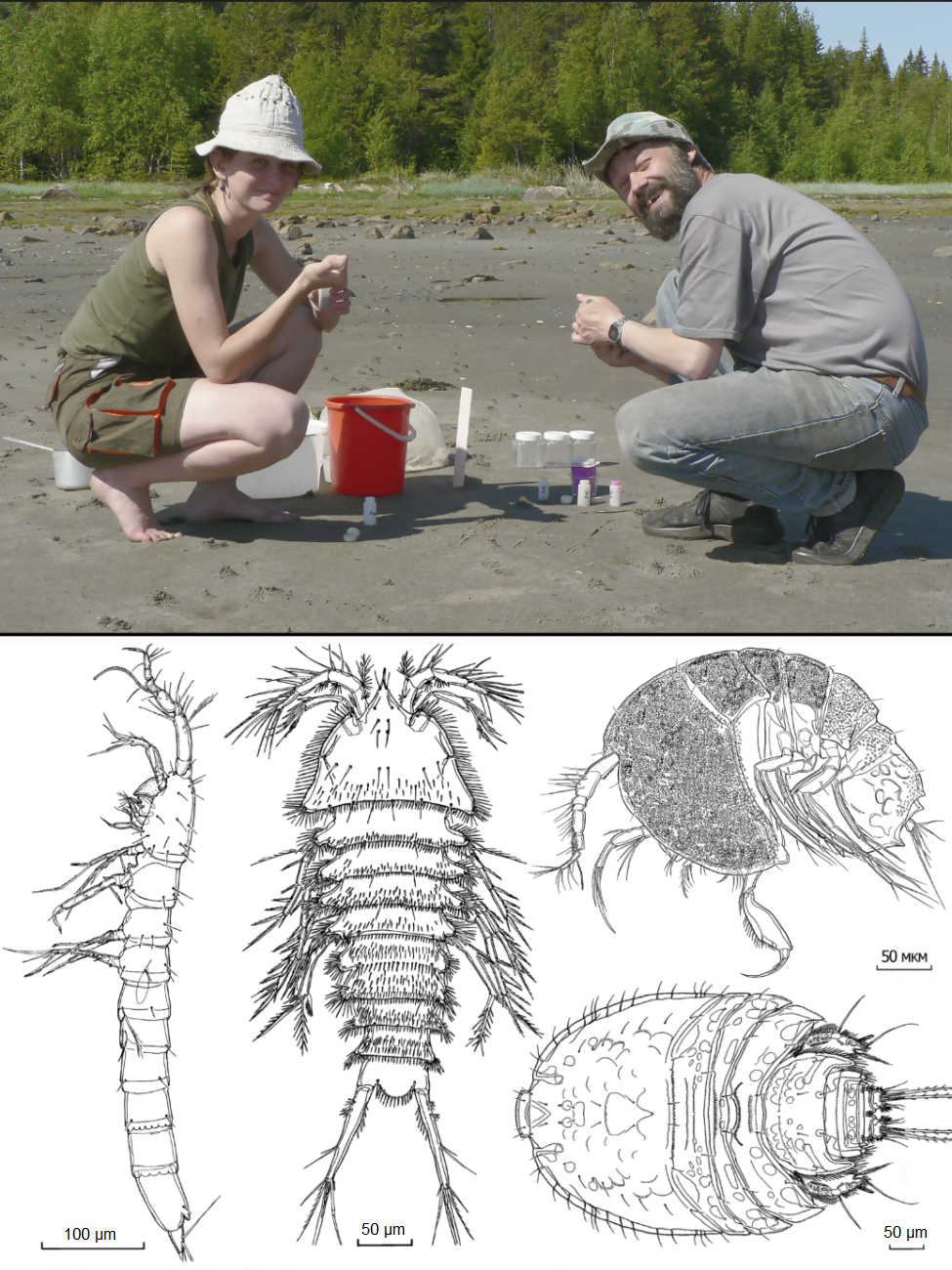
Photo: Andrey Azovsky and Elena Chertoprud study crustaceans in the littoral zone; figure: interstitial, epibenthic, and phytal species of Harpacticoida (left to right).
Research into the ecology of copepods of the order Harpacticoida in the intertidal zone of Gryaznaya Bay, Kandalaksha Bay, White Sea, began in the 1990s. A team of taxonomists and ecologists spent the summer in the village of Chernaya Rechka, at the research facility of the Department of Hydrobiology of Lomonosov Moscow State University, in the hospitable home of Andrei Igorevich Azovsky. Since then, many articles have been published and dissertations defended—legend has it that the pages of these scientific papers could cover the entire intertidal zone of Gryaznaya bay and the Chernorechensky estuary several times over.
Recently, scientists from Lomonosov Moscow State University, together with colleagues from the A.N. Severtsov Institute of Ecology and Evolution of the Russian Academy of Sciences (IEE RAS) and the P.P. Shirshov Institute of Oceanology of the Russian Academy of Sciences, published a review article devoted to a comparative analysis of various life forms of Harpacticoida. The appearance of these predominantly benthic crustaceans never ceases to amaze the researcher – some resemble worms, others sea urchins, or simply an inverted plate (Figure 1). It has been established that the life forms of Harpacticoida possess certain ecological characteristics that can be confirmed statistically. In particular, different life forms differ in the following: types of preferred biotopes; dispersal abilities, and consequently, the colonization of new habitats; and biogeographic patterns of faunal distribution. Thus, interstitial species that inhabit the sedimentary layer prefer coarse-grained sands and are reluctant to enter the water column. Consequently, they disperse slowly and, as a result, comprise the largest number of endemic taxa worldwide. In contrast, epibenthic and phytal species, which inhabit silty sediments and macrophyte thickets, actively swim in the water themselves or are carried by currents along with algal fragments. Among them, many species have a widespread distribution, although the true “cosmopolitans” are the planktonic representatives of the group. It has been noted that physiological differences in reproductive rates, feeding habits, and dietary preferences, as well as, likely, the rate of speciation, are also possible between representatives of different life forms. However, the available data are still insufficient to support sound judgments on this matter.
"It's important to emphasize that all of the above-mentioned distinctive features of Harpacticoid life forms manifest themselves as statistical trends, not strict rules. The fact is that any life form system, like other biological classifications, is not strict. Many species exhibit transitional features and, therefore, cannot be unambiguously assigned to a specific category," explained Elena Chertoprud, PhD, Senior Researcher at the Institute of Ecology and Evolution of the Russian Academy of Sciences.
Thus, the diversity of Harpacticoid life forms cannot be represented by discrete classes but should be interpreted as a continuum in a multidimensional space of morphological and ecological traits. On the other hand, "typical representatives" of life forms form clusters within this space, each with a unique combination of traits. Thus, the composition of life forms is an informative characteristic and can be a promising tool for identifying patterns in community functioning and analyzing their connections with natural processes.
This research was supported by grant No. 25-14-00030 from the Russian Science Foundation.
This work was published in the journal Hydrobiologia: Azovsky A., Chertoprud E., Garlitska L., Kondar D., Rosinskaya A. 2025. Ecological properties of life forms of marine harpacticoid copepods // Hydrobiologia. https://doi.org/10.1007/s10750-025-06074-y. Online published.