

A comparative analysis of the ultrasonic calls of young voles of nine species

Fig.1. Voles are small rodents with a wide variety of species. Their lifestyles vary greatly: they live underground and above ground, in forests and steppes, and can vary considerably in size.
Environmental and social factors can influence the evolution of call structure in mammals. Researchers from Lomonosov Moscow State University and the Severtsov Institute of Ecology and Evolution of the Russian Academy of Sciences (IEE RAS) compared the ultrasonic calls of nine vole species to test hypotheses about the influence of body size, genetic relatedness, whether the vole lives underground or above ground, and lifestyle (group or solitary) on the acoustic structure of calls in young animals.
Comparative studies of vocal behavior among several genetically closely related mammalian species help identify evolutionary adaptations of acoustic communication to life under different social and environmental conditions. Unlike humans, whales, bats, and seals, which have vocal learning, rodents' acoustic repertoires are genetically predetermined from birth, and thus the development of sounds during ontogeny represents a self-unfolding program. Scientists have hypothesized that if adaptation to environmental and social conditions leads to evolutionary changes in the acoustic structure of adult calls, these changes may also affect the acoustic structure of calls in juveniles. Voles of the subfamily Arvicolinae have proven to be a convenient model group for comparative studies of vocal behavior, as species within the subfamily vary in body size, subterranean or terrestrial lifestyle, habitat (high or low vegetation), and degree of sociality (living in groups or alone).
Like many other rodents, young voles of the Arvicolinae subfamily cry out when they fall from their nests, thus summoning their parents or other family members for help. These calls, known as isolation calls, are found in young rodents of all species. Young rodents are born blind and hairless for the first week. They are unable to thermoregulate independently and are unable to move independently, so they are completely dependent on adult assistance.
Ultrasound recordings of young voles of nine species, aged 2 to 5 days, were conducted during a 2-minute isolation period from their nests in laboratories at the Biological Institute of St. Petersburg University, the Chernogolovka Research and Experimental Base of the Institute of Ecology and Evolution of the Russian Academy of Sciences, the Zoological Institute of the Russian Academy of Sciences in St. Petersburg, and the Moscow Zoo. For five of the nine species, these calls were described for the first time. A total of 905 ultrasounds from 87 young were included in the analysis.
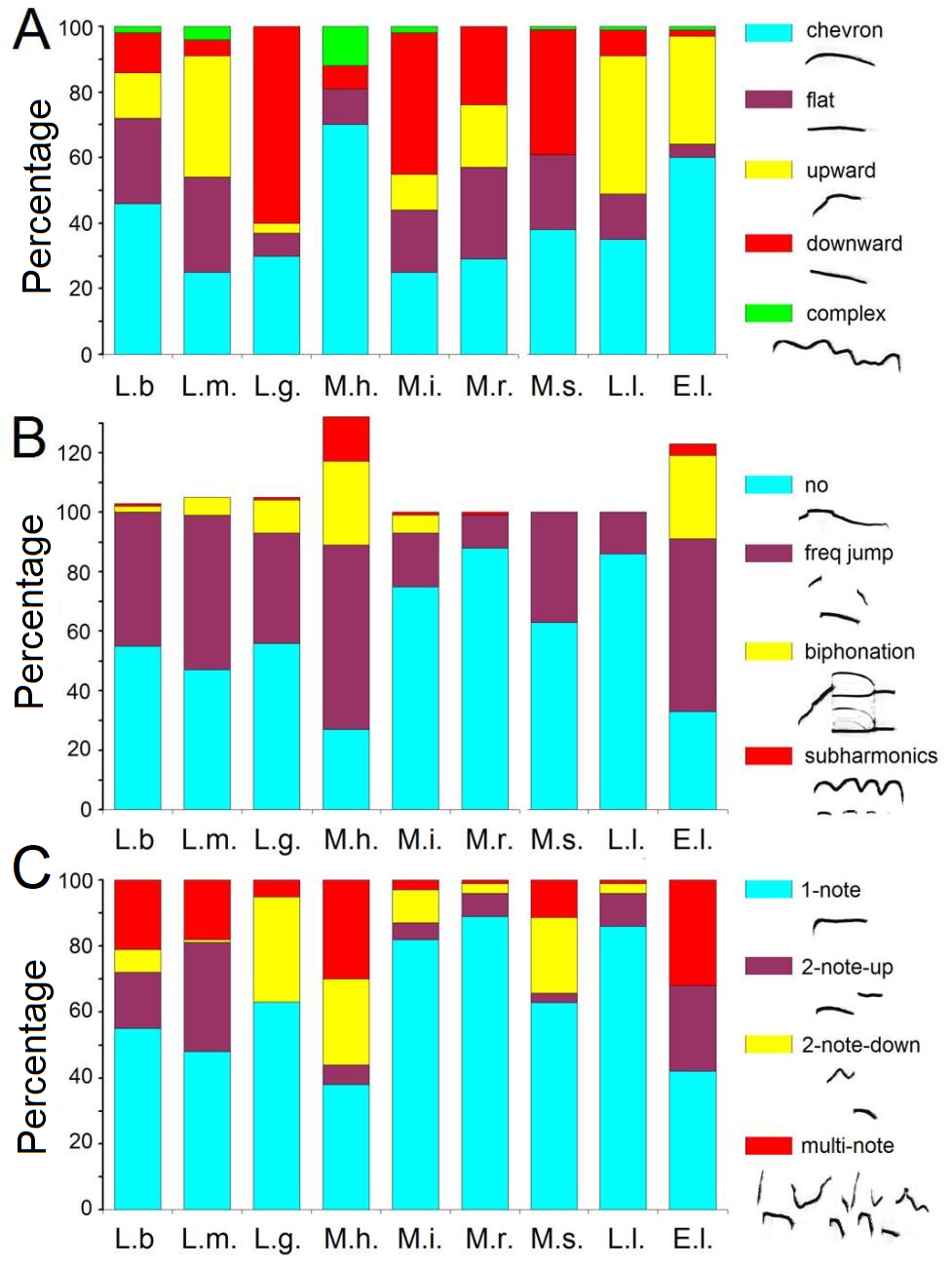
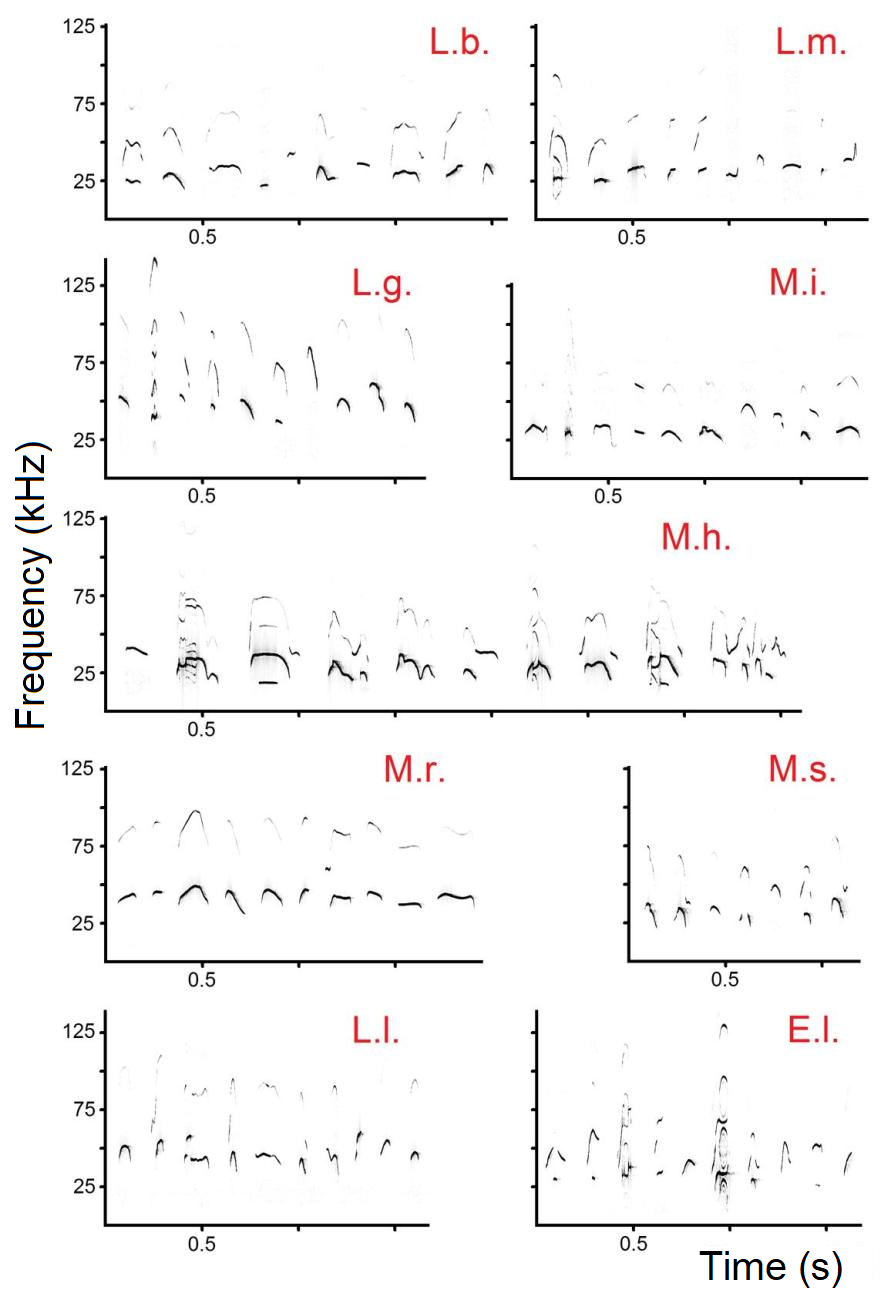
The acoustic parameters of the ultrasonic calls were compared for the pups, and then each was weighed, and their body, tail, and metatarsal lengths were measured. Pups of different species differed in body size and ultrasonic acoustic characteristics (duration, fundamental, and peak frequencies), allowing species to be distinguished by their calls with a 67.8% probability. The average duration of ultrasonic calls varied between species from 35 to 166 milliseconds, while the average maximum fundamental frequency ranged from 39.9 to 61.6 kHz and the minimum fundamental frequency from 23.1 to 43.1 kHz. The ultrasonic calls of different vole species varied significantly in the shape of the frequency modulation contour, the occurrence of nonlinear vocal phenomena, and the number of notes in the calls.

Fig.4. Acoustic parameters of ultrasounds from the pups of nine vole species: (A) duration, (B) peak frequency, (C) maximum fundamental frequency, (D) minimum fundamental frequency. The mean is shown as the center point of the deviation. Relative body size of the pups is shown with animal symbols.
"The collected data allowed us to test hypotheses regarding the influence of body weight, phylogenetic relatedness between species, the influence of biotopes (acoustic adaptation hypothesis), and the influence of adaptation to a subterranean lifestyle and social environment (social complexity hypothesis) on the acoustic parameters of ultrasound. The only factor statistically influencing the acoustic parameters of pup ultrasounds was body size. This factor showed a positive effect on the duration and a negative effect on the frequency parameters of calls. However, neither phylogenetic relatedness, nor subterranean or terrestrial lifestyle, nor living conditions in tall-grass or short-grass habitats, nor the complexity of family groups of different species significantly influenced the differences in the acoustic properties of ultrasounds of pups of nine vole species," explained Elena Volodina, PhD, Senior Researcher at the Institute of Ecology and Evolution of the Russian Academy of Sciences.
The results of the study were published in the Q1 journal Behavioural Ecology and Sociobiology: Volodin I.A., Dymskaya M.M., Rutovskaya M.V., Golenishchev F.N., Vasilieva N.A., Volodina E.V. Comparative analysis of acoustic traits of pup ultrasonic calls across nine vole species. Behavioral Ecology and Sociobiology, 2025, v. 79, N 11, 108.