

Lynx cubs use very complex sounds to communicate

Until now, nothing was known about the sounds lynx cubs make in their dens. But with the advent of automatic recorders operating independently of human interaction, it has become possible to record and study them.
Researchers from the A.N. Severtsov Institute of Ecology and Evolution of the Russian Academy of Sciences (IEE RAS) and Lomonosov Moscow State University studied the vocal behavior of Eurasian lynx cubs from birth to three months of age at the IEE RAS Chernogolovka Research and Experimental Base. The cubs from four litters, kept with their mothers in large outdoor enclosures, were recorded both immediately after birth in their maternity houses and outside, after the cubs entered their enclosures. Two automatic recorders were used for each litter: one mounted behind a false panel inside the house and the other suspended from a tree outside the enclosure. Recordings from outside the enclosure were also made during visual observations of the broods using a conventional, non-automated recorder.
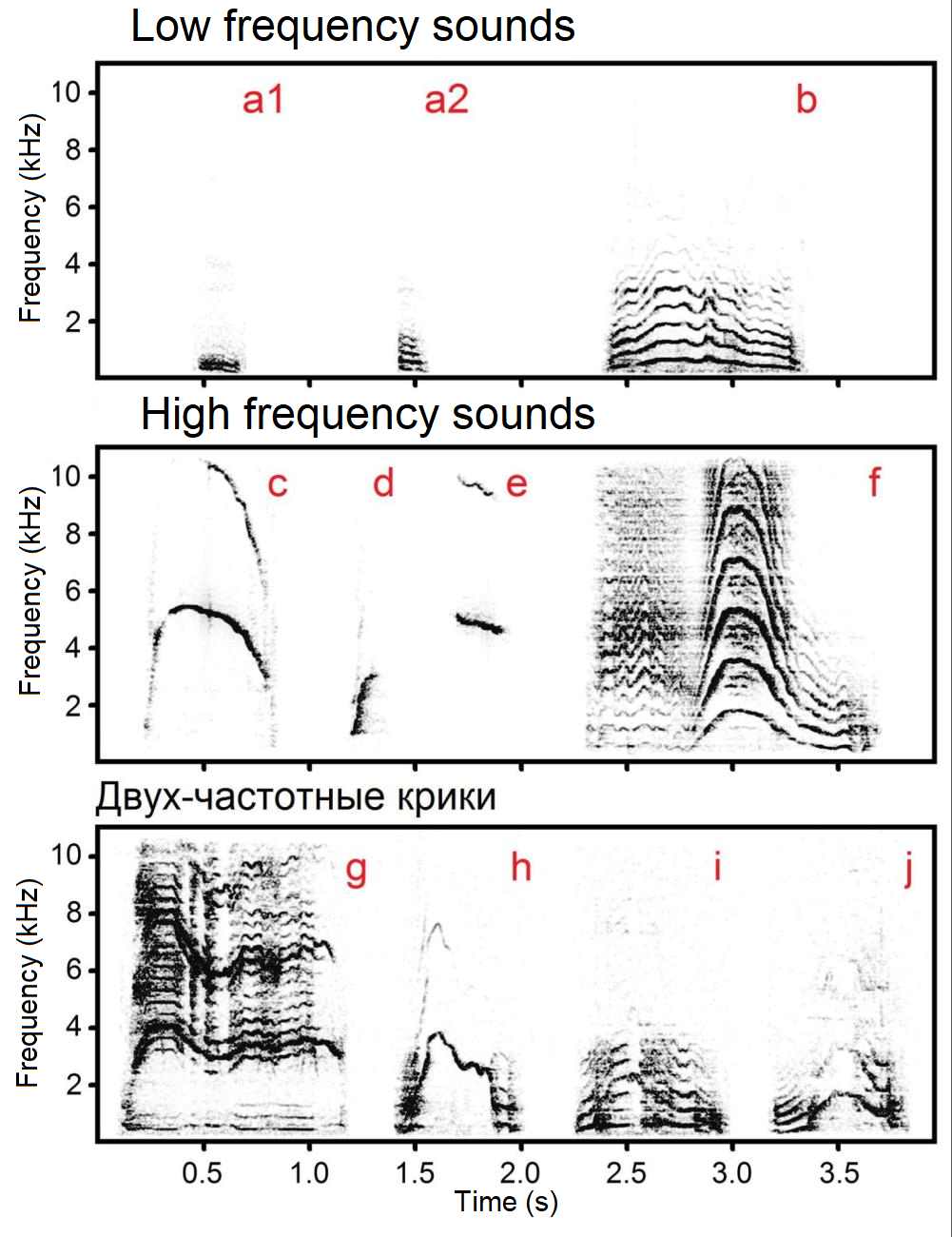
Fig.1. The vocal repertoire of Eurasian lynx cubs is very complex, and includes low-frequency, high-frequency, and dual-frequency calls.
In the vocal repertoire of Eurasian lynx cubs, scientists identified three structural classes, which together comprised 10 call types. These three structural classes were classified based on the presence or absence of one or two fundamental frequencies: two low-frequency call types with only a low fundamental frequency, four high-frequency call types with only a high fundamental frequency, and four biphonic call types containing both low and high fundamental frequencies. The low frequency varied from 0.17 kHz to 1.19 kHz between call types, and the high frequency varied from 0.21 kHz to 7.19 kHz. All 10 call types were present in Eurasian lynx cubs from the first days of life, and none of these call types disappeared by three months of age.
The classification of sounds into types using discriminant analysis was 94.5% for low-frequency sounds, 89.3% for high-frequency sounds, and 67.8% for biphonic sounds, confirming the correct classification of sounds into types. Both low- and high-frequency sounds decreased in frequency as the young matured.
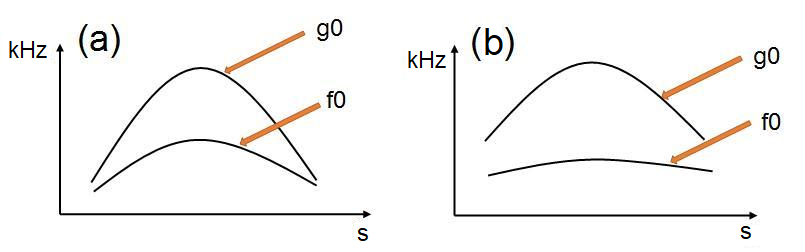
Fig.2. In biphonic cries (a) the two frequencies f0 and g0 can have the same values, as in lynxes and ungulates, and (b) they can lie in different ranges, as in canids and rodents.
Eurasian lynxes are the only felids in which biphonic calls with two independent fundamental frequencies have been described. These two frequencies are likely produced by two different sound sources. It has previously been shown that adult lynxes can also produce biphonic calls as part of the courtship during the mating season (primarily males) and when calling cubs (females). Among carnivorous mammals, biphonic calls are common among wolf-like canids, but are absent from fox-like canids.
By structure, biphonic calls can be divided into two types. In the first type, the maximum low fundamental frequency can have the same values as the minimum high fundamental frequency. This type includes the biphonic calls of lynxes and eastern red deer. In the second type, the maximum low fundamental frequency and the minimum high fundamental frequency never overlap, since the two frequencies lie in different ranges. This type of call is known among canids and rodents.
The work was published in the journal Behavior: Sedova L.M., Volodin I.A., Naidenko S.V., Erofeeva M.N., Alekseeva G.S., Volobueva K.A., Kim M.D., Volodina E.V. "Early vocal development of Eurasian lynx cubs (Lynx lynx) before and after leaving the natal den." Behavior, 2025, v. 162, no. 3-4, pp. 299-328.
Related materials:
Science.Mail: "Scientists have deciphered the language of lynx cubs"
MosTimes: "Lynx cubs are not so simple: their 'conversations' are more complex than those of other cats"