

Pygmies in Sicily: What a detailed analysis of white-toothed shrew karyotypes revealed
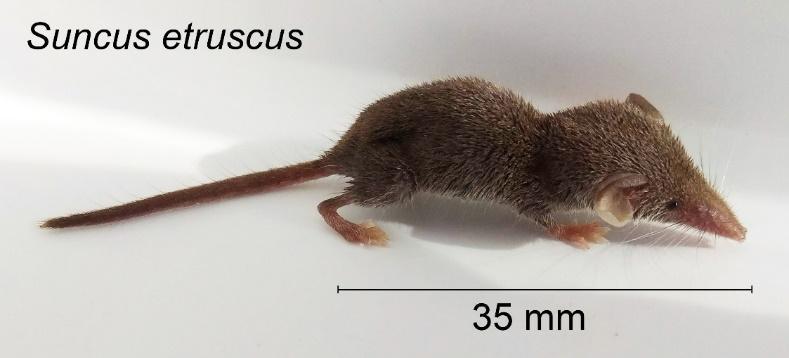
A team of authors from the A.N. Severtsov Institute of Ecology and Evolution (IEE RAS) and the Institute of Molecular and Cell Biology (IMCB SB RAS) have for the first time used a set of modern molecular cytogenetic methods to perform a detailed karyotype characterization of two chromosomally poorly studied species of the subfamily Crocidurinae (family Soricidae) – the world's smallest mammal, the pygmy white-toothed shrew (Suncus etruscus Savi, 1822), and the Sicilian shrew (Crocidura sicula Miller, 1900), endemic to the island of Sicily.
The Etruscan shrew is one of 18 species of the genus Suncus (Fig. 1), with a vast range from the west coast of Southern Europe and North Africa to the island of Borneo in Southeast Asia. This animal's body length is only 3-4.5 cm, and its weight does not exceed 2 grams. According to the "Mammals of Russia" portal www.rusmam.ru, it is known from only a few localities in the Republics of North Ossetia-Alania and Ingushetia (1987 and 2015) and is classified as a locally rare species.

Fig. 2. Sicilian shrew Crocidura sicula Miller, 1900. Photo by S.V. Pavlova
To date, only two species in the genus Suncus have been characterized cytogenetically. Unlike the Asian house shrew S. murinus Linnaeus, 1766, which has been extensively studied due to its extensive chromosomal polymorphism (2n=30–40), the chromosomal data for the pygmy white-toothed shrew S. etruscus (2n=42) were limited to two routine karyotypes from the eastern Pyrenees and India, differing in the number of chromosome arms (FN=72–78). The genome of S. etruscus was recently assembled, although high-resolution, differentially stained karyograms have not yet been presented.
The Sicilian shrew is a member of the most numerous shrew genus, Crocidura, which includes 220 species (Fig. 2). The range of C. sicula is limited to Sicily and some islands of the Maltese archipelago, but it is currently considered extinct in Malta.
"Many species of white-toothed shrews are rare and phenotypically similar, so to clarify the taxonomic status of a specific species or complex of species, morphometric, molecular genetic, and cytogenetic analyses are often required," said Svetlana Pavlova, PhD in Biology and a senior researcher at the Institute of Ecology and Evolution of the Russian Academy of Sciences.

However, the karyotypes of many shrew species remain unknown or are limited to routine 2n descriptions. The Atlas of Mammalian Chromosomes contains data on differentially stained karyotypes for only 15 of the 220 species in the genus Crocidura.
A detailed cytogenetic description of the karyotypes of both species studied in this work (Fig. 3) can be used in further studies of the genetic and chromosomal diversity, genomics, systematics, and evolution of shrews from the large and interesting subfamily Crocidurinae.
The work was published in the journal: (Q1) Pavlova S.V., Biltueva L.S., Lemskaya N.A., Serduykova N.A. 2025. Detailed characterization of karyotypes of white-toothed shrews Suncus etruscus and Crocidura sicula (Eulipotyphla, Mammalia) // Mammalian Biology 105: 589–598.
Related materials:
RAS: "A detailed analysis of white-toothed shrew karyotypes has been conducted."
Science.Mail: "Scientists have described a new species of pygmy shrew."