
The monograph "A Brief Guide to Invertebrates of Freshwater in Eastern Europe and the Caucasus" has been published
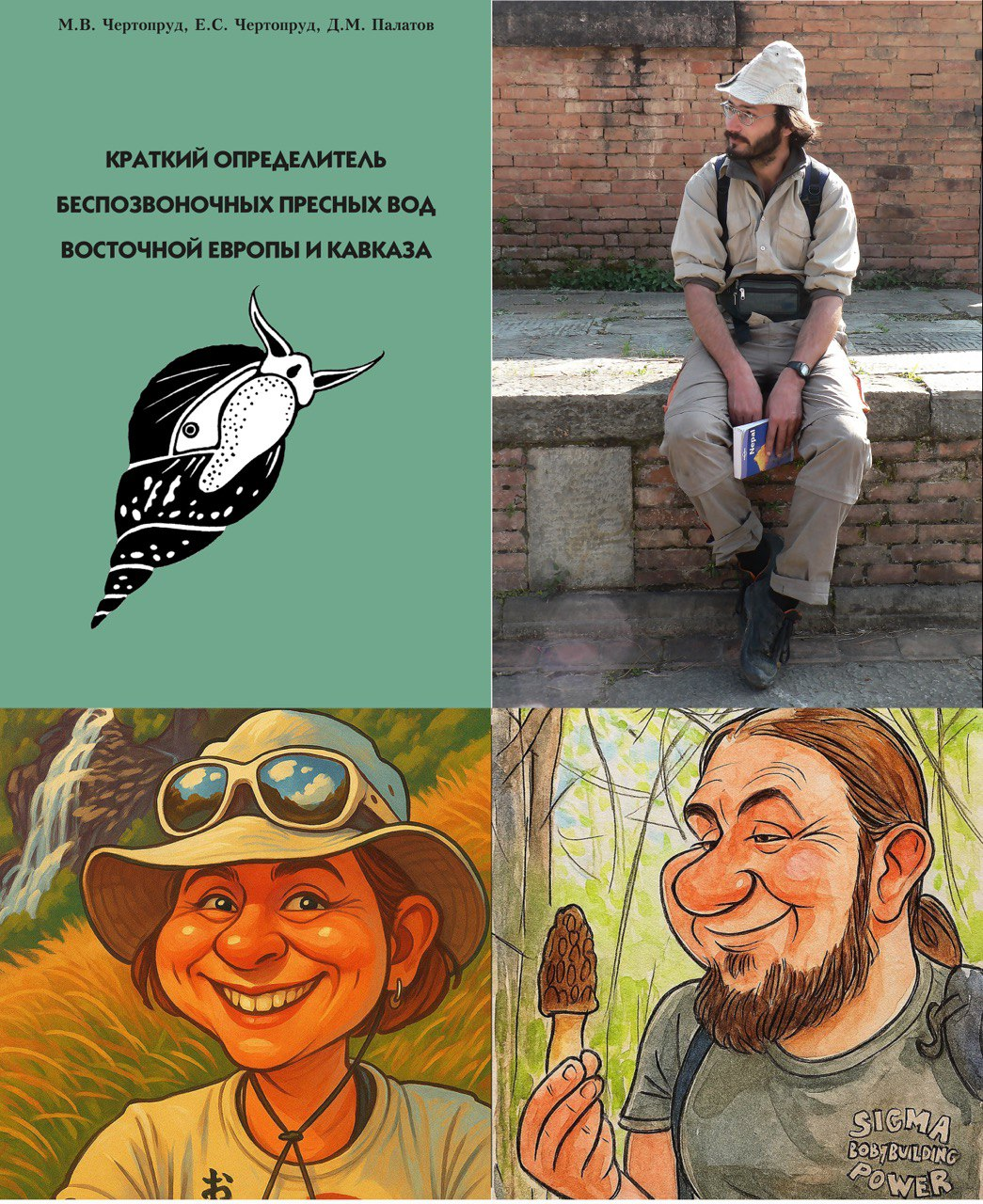
This monograph is a continuation, a more expanded version of the book "A Brief Guide to Invertebrates of Freshwater in Central European Russia," widely known to school biology students and university students. The primary creative and scientific inspiration for this monograph was the late Mikhail Vitalyevich Chertoprud, associate professor in the Department of General Ecology and Hydrobiology at the Faculty of Biology at Lomonosov Moscow State University. The other two authors of this guide are E.S. Chertoprud and D.M. Palatov, both employees of the Synecology Laboratory at the A.N. Severtsov Institute of Ecology and Evolution of the Russian Academy of Sciences (IEE RAS).
This new invertebrate identification guide is intended for schoolchildren and students interested in biology, limnologists, ecologists, toxicologists, and all inquisitive researchers of aquatic ecosystems. It contains identification keys for the main groups of zooplankton (Cladocera, Copepoda, Phyllopoda, Rotifera) and macrozoobenthos (Insecta, Malacostraca, Gastropoda, Bivalvia, Hirudinea, Oligochaeta, Polychaeta, Turbellaria, Bryozoa, Porifera), as well as tables for identifying the types and classes of freshwater invertebrates. The guide describes the main aquatic biotopes and their fauna, provides a brief description of methods for collecting and processing plankton and benthic samples, presents a number of methods for bioindicating water quality, and lists identification keys for freshwater invertebrates of Eastern Europe. The level of identification varies across taxonomic groups depending on their complexity, and for most organisms, it is extended to the genus level.
The new guide has been significantly improved compared to previous editions. It offers more precise diagnostic characters, expanded taxonomic and geographic coverage, and a more user-friendly layout of the text and illustrations. The updated taxonomy, which takes into account the extensive revisions that have occurred in recent years in such important groups of freshwater animals as mollusks (both gastropods and bivalves), higher crustaceans (order Amphipoda), and insects (order Ephemeroptera), makes this edition particularly valuable. An additional advantage of the book is the increased number of original illustrations, ensuring highly accurate visual identification.
There are some drawbacks, and they unavoidably stem from the strengths. The book is large and thick, so you won't be able to carry it in your pocket on an expedition or field trip. The identification keys are more complex and require in-depth knowledge of organism morphology, so students will have a hard time identifying certain groups.
Publisher: Chertoprud M.V., Chertoprud E.S., Palatov D.M. Moscow: KMK, 2025. 469 pages. ISBN 978-5-907747-80-7.
The paperback version of the book is available for purchase from KMK Publishing House.