

Dental radiography as a non-invasive method for age determination of a subterranean rodent, the common mole vole, in natural populations
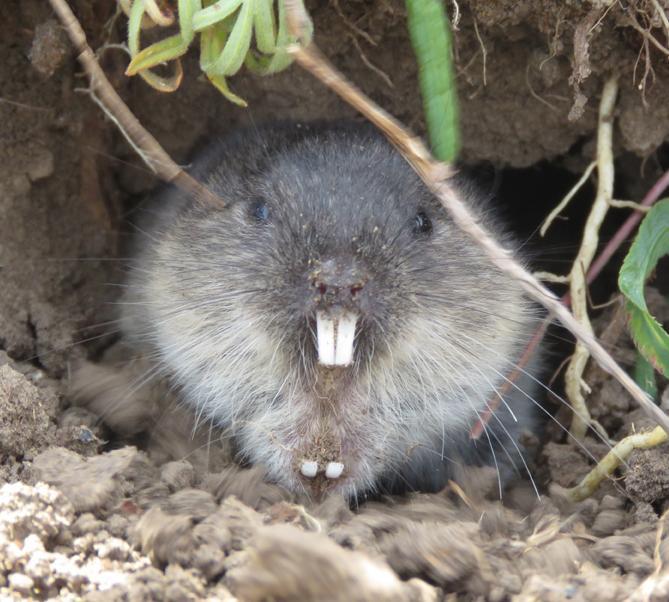
The subterranean rodent, the northern mole vole (Ellobius talpinus), is an interesting subject for ecological research. A key requirement for ecological projects is the ability to reliably estimate the age of living mole voles when capturing them in the field. Researchers from the Herzen St. Petersburg Pedagogical University, St. Petersburg State University, the University of Tokyo, and the A.N. Severtsov Institute of Ecology and Evolution of the Russian Academy of Sciences (IEE RAS) conducted an X-ray study of various age cohorts of individually tagged northern mole voles in a natural population in the Saratov region of Russia.
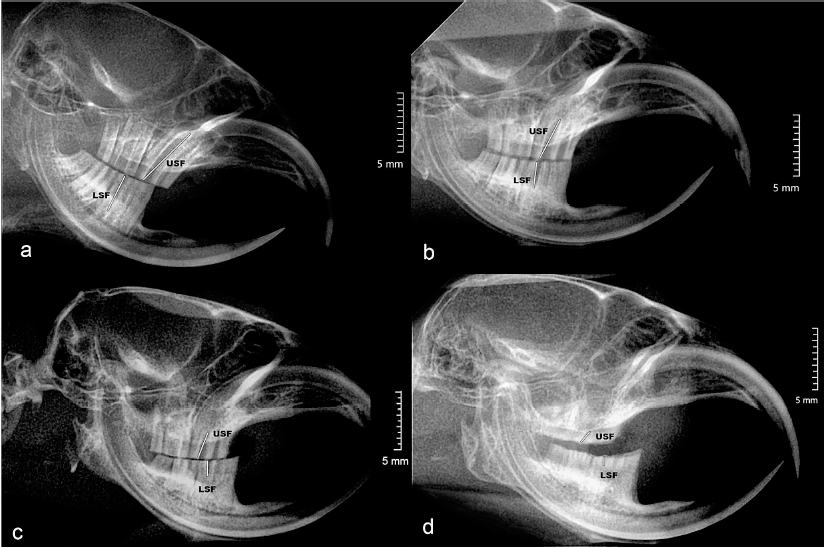
Photo: X-rays of the skulls of northern mole voles of three age classes: a - class 1 (young of the year), b - class 2 (yearlings); c, d - class 3 (overwintered two or more winters). USF - synclinal fold of the first upper molar; LSF - synclinal fold of the first lower molar.
Radiography is one of the most promising methods for non-invasively determining the age of animals. In this study, the researchers applied it for the first time to live rodents from a wild population. Radiographs were obtained in the field using a portable X-ray machine and a digital radiovisiograph. Thanks to intensive capture and tagging of mole voles at the model site since 2021, the ages of many individuals were known, which allowed them to identify age-related dental traits, develop a model for age class determination, and successfully validate this model.
"The use of field radiography can significantly improve the efficiency of many ecological studies, expand the range of tasks that can be solved, save scientists time, and ensure the ethical welfare of the mole vole under study," said Elena Volodina, PhD, Senior Researcher at the Institute of Ecology and Evolution of the Russian Academy of Sciences.
Two traits were selected as age-related indicators: the length of the second synclinal groove of the upper first molar and the length of the second synclinal groove of the lower first molar. Both indicators decreased with age. No sex differences were found in the age-related dynamics of these traits. Discriminant analysis showed that reliable discrimination between age classes is possible when adding radiograph date as a predictor to the molar traits. Model accuracy was 99%, and cross-validation accuracy was 97%. The primary contribution to discrimination comes from the first discriminant function, primarily related to the indicator characterizing molar length.
The article was published in the European Journal of Wildlife Research: Nikonova V.R., Naumova A.E., Bergaliev A.M., Dymskaya M.M., Rudyk A.I., Volodina E.V., Smorkatcheva A.V., 2024. Dental radiography as a low-invasive field technique to estimate age in small rodents, with the mole voles (Ellobius) as an example. European Journal of Wildlife Research, 2024, v. 70:46.