
“Freeloaders” exhibition has opened in the Darwin Museum on June 2nd
The Darwin Museum presents a new exhibition, "Freeloaders," which transforms dull parasitology into five chilling blockbusters, where the main villains are not the work of screenwriters, but inhabitants of our own planet. This is an honest conversation about the dark side of evolution, ruled by those who are accustomed to living at the expense of others, manipulating consciousness, and turning the bodies of other creatures into incubators, zombies, and canned food.
Exhibition partners: the Parasitology Center of the A.N. Severtsov Institute of Ecology and Evolution of the Russian Academy of Sciences, the Parasitological Collection of the All-Russian Research Institute of Fundamental and Applied Parasitology of Animals and Plants – a branch of the K.I. Skryabin and Ya.R. Kovalenko Federal State Budgetary Scientific Institution "VIGIS" of the Russian Academy of Sciences, and the Creative Union Association for the Promotion of Culture and Art.
Instead of the usual museum halls, visitors to the "Freeloaders" exhibition will be treated to five stylized zones, each dedicated to a unique survival strategy:
* "World of the Worm" – a sci-fi action film starring roundworms, flatworms, and acanthocephalans, with the main battle unfolding over the host's body. Wet mounts of giant helminths and their complex life cycles will reveal how tapeworms grow three-meter-long bodies, depriving their victims of resources, and how heartworms take over the bloodstreams of dogs and cats. Will the victims be able to prevail in this battle?
* "Alien" – the most terrifying section, dedicated to parasitoids. Visitors will learn how these insects insert their ovipositors into living caterpillars, which continue to live, move, and feed until they are devoured alive. The moth and the wasp, the horntail and the megaryssa, the osmia bee and the ephialtes – visitors will see both innocent victims and those who bring them death.
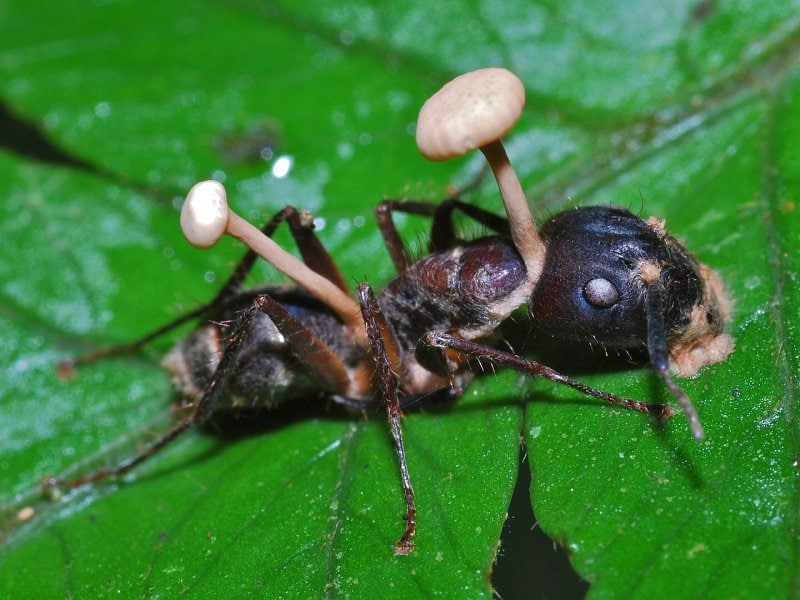
* "Night Stalker" is a thriller about killer fungi. Their threads are thinner than a spider web, but they gradually take over the living world, transforming it into a kingdom of the dead... It's a world where mycelium suffocates trees, and cordyceps turns ants into zombies. Viewers will learn how the parasite forces insects to climb to maximum possible height before dying, so that their spores can spread further.
* "Parallel Mothers" is a soap opera that tells the heartbreaking story of abandoned children and their biological parents, from bumblebees to cuckoos, who have put the responsibility for raising their offspring on the shoulders (or wings and beaks) of others. The chicks of cuckoos, cowbirds, and widowbirds never knew the embrace of their mothers, and only with time did it become clear how different they were from those who nursed and raised them. Exhibits include nests with abandoned eggs, and visitors have the chance to guess which egg is the adopted one.
*Anime fans are invited to the premiere of "The Juice of Eternal Life," about parasitic plants. Mistletoe and marshmallow, toothwort and rafflesia are living "vampires" of flora. They are members of a secret society whose adherents are indistinguishable from ordinary plants. This section will explain how plants lose chlorophyll and develop suckers to steal the lifeblood of their fellow plants.
"The topic of parasites traditionally evokes disgust or revulsion," comments exhibition director Anna Alexandrova. "But we decided to take a different approach. We offer viewers a terrifying yet fascinating 'movie' about creatures that don't kill instantly. They do it slowly, over years, manipulating the bodies and minds of their victims. And this scenario, written by nature itself, is far more captivating than any fictional story."
The exhibition will feature real biological objects. Organizers warn: particularly sensitive viewers, as well as those with a pronounced phobia of worms and insects, may want to refrain. For everyone else, welcome to the world of parasites!
June 2 – August 23, 2026
Location: Darwin Museum Exhibition Halls / 3rd Floor / Exhibition Hall #6