
Scientists have conducted a large-scale genomic study of the roach genus (order Cypriniformes)
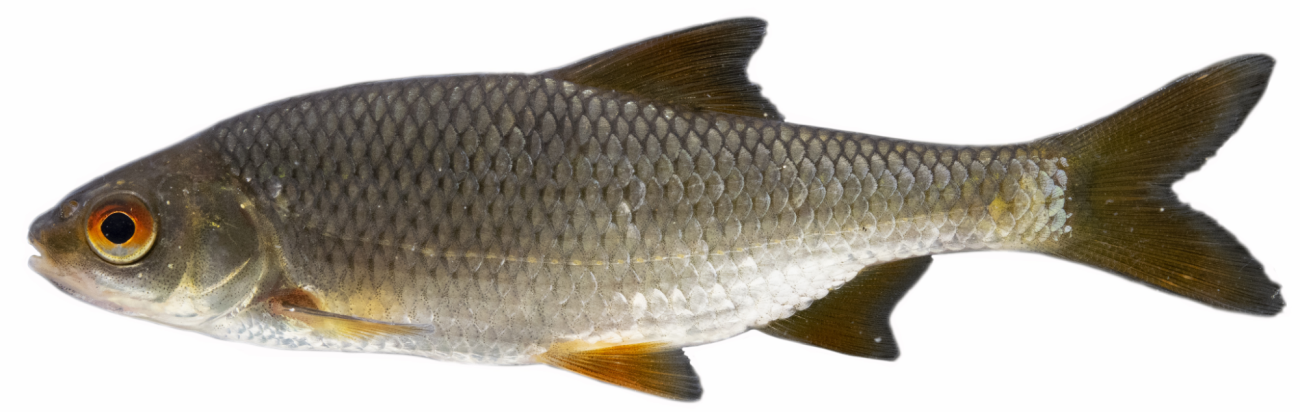
Common roach (Rutilus rutilus) from the Baltic Sea basin. Photo by O.N. Artayev
An international team of researchers led by Boris Levin, a PhD candidate in biology, ichthyologist and leading researcher at the A.N. Severtsov Institute of Ecology and Evolution of the Russian Academy of Sciences (IEE RAS), studied the taxonomy, phylogeny, and evolutionary history and established the extensive role of hybridization in the evolution of one of the most common and widespread fish species in Northern Eurasia — the common roach. The genus's range extends from the British Isles in the west to Yakutia in the east, and from Scandinavia in the north to the southern parts of the Caspian and Aral Sea basins in the south.
"Thanks to scientific collaboration and extensive expeditions, we were able to collect representative material from all species of the genus throughout its entire range. Roach taxonomy was highly complex and controversial, perhaps because roach readily hybridize with other fish species. Furthermore, roach are extremely flexible phenotypically and ecologically, and species boundaries defined by standard phenotypes are not always valid," explained B.A. Levin, PhD in Biology.
Genetic markers of maternally transmitted mitochondrial DNA used in previous studies yielded results that contradicted the generally accepted taxonomy of this group. For this reason, the scientists decided to employ a more technologically advanced method of genome analysis - ddRAD-seq - using high-throughput second-generation sequencing (Illumina). Extensive bioinformatic processing of the genomic data allowed them to resolve a number of issues that seemed intractable using classical methods.
Firstly, hidden evolutionary and species diversity was discovered — three "old" species that had been unjustifiably synonymized with other species were recovered, and three new evolutionary lineages — candidates for new species — were also discovered. "It is noteworthy that these new evolutionary lineages were discovered in Europe, one of the most studied regions." "In particular, one lineage was discovered on the Balkan Peninsula, one in the Danube basin, and another in the Dnieper," reported the article's lead author, B.A. Levin. Ultimately, the species diversity of the genus Rutilus can be reduced to 22 species, divided into three subgenera.
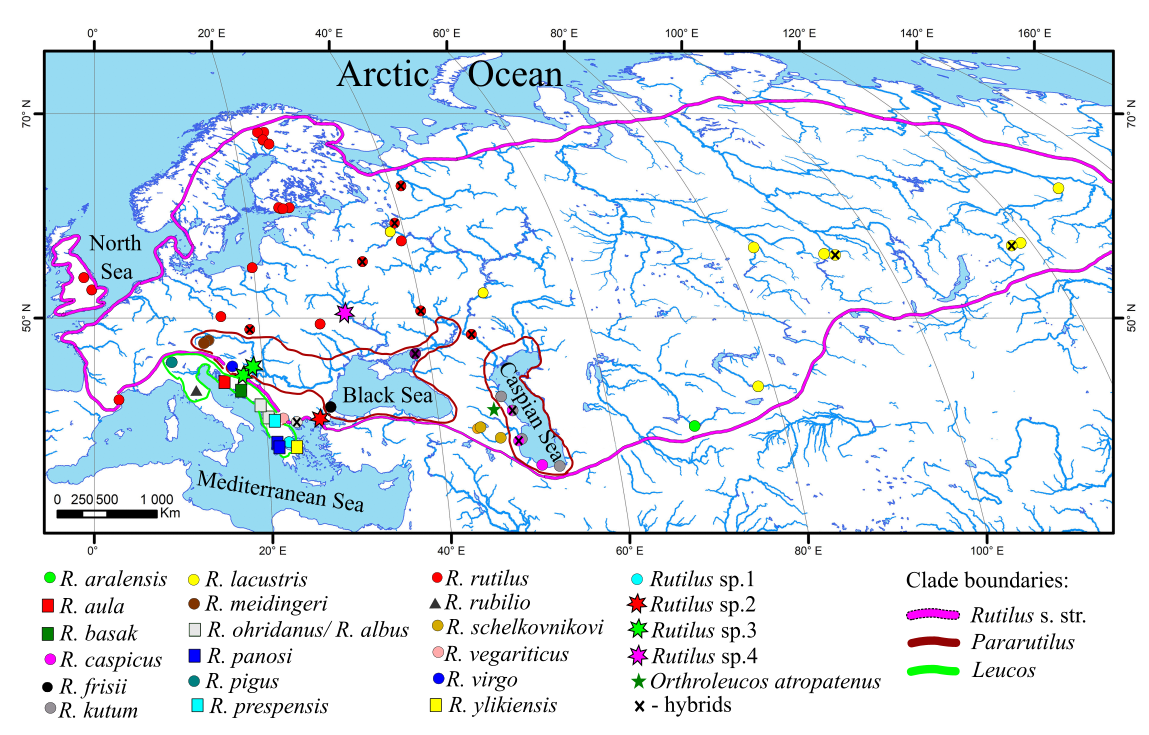
Secondly, the extensive role of introgressive interspecific and intergeneric hybridization in the evolutionary history of the genus has been revealed, often manifested in discordance between mitochondrial and nuclear phylogenies. For example, in the Caspian Basin, frequent hybridization between the kutum (Black Sea roach) and the Caspian roach — both historical and modern — has been discovered. Here, kutum often possesses the mitogenome of the Caspian roach, and vice versa. Extensive mitochondrial "masking" has also been observed in other species. Throughout most of the genus's range, extending up to 5,000 km longitudinally — from Eastern Siberia to the Balkan Peninsula—and approximately 3,700 km latitudinally — from Scandinavia to Iran—mitochondrial genes of the Ponto-Caspian lineage of roach are found in many species inhabiting this vast swath of Eurasia. The species in question are the Siberian roach R. lacustris, the Aral roach R. aralensis, the Armenian roach R. shelkovnikovi, and the common roach R. rutilus, which are genetically isolated species according to nuclear genome data. This pattern (mitonuclear dissonance) is a consequence of historical hybridization. The authors of the article believe that the global expansion of the Caspian-Black Sea roach lineage into northern ecosystems occurred as a result of pluvial epochs of the Pleistocene postglacial periods. These expansions were accompanied by secondary contact and hybridization with local species. The most complex hybridization situation between different closely related roach lineages was observed in the Volga River basin, where three species converged to form a vast hybrid zone: the common roach R. ruiltus, which originated from the Baltic basin; the Siberian roach R. lacustris, which originated from the Ob River basin; and the Caspian roach R. caspicus, which originated from the Caspian Sea.
Thirdly, the unusually frequent intraspecific hybridization of roach, as well as hybridization with other fish genera, has led to the development of a heterogeneous genome, which facilitates high phenotypic and ecological plasticity in roach, which quickly develops different ecological forms. However, this study also revealed the negative impact of hybridization on species with limited ranges and small populations, using the example of the Transcaucasian species, the Shirvan roach. Although called a roach, this study found that it belongs to a separate genus, Orthroleucos. The Shirvan roach genome consists of up to 15-20% of the genome of the roach native to the Transcaucasus, and its mitochondrial genome has been completely replaced by that of the common roach. The population of this species is declining, which could lead to negative consequences of hybridization. If hybridization continues, a more numerous species could "dissolve" the small population of the Transcaucasian endemic.
This work was supported by the Russian Science Foundation grant 24-44-20019.
AI-Novosti: "Scientists conducted a large-scale genomic study of the roach genus (order Cypriniformes)"