

Scientists have discovered why lampreys are infected with a parasite in some rivers but not in others
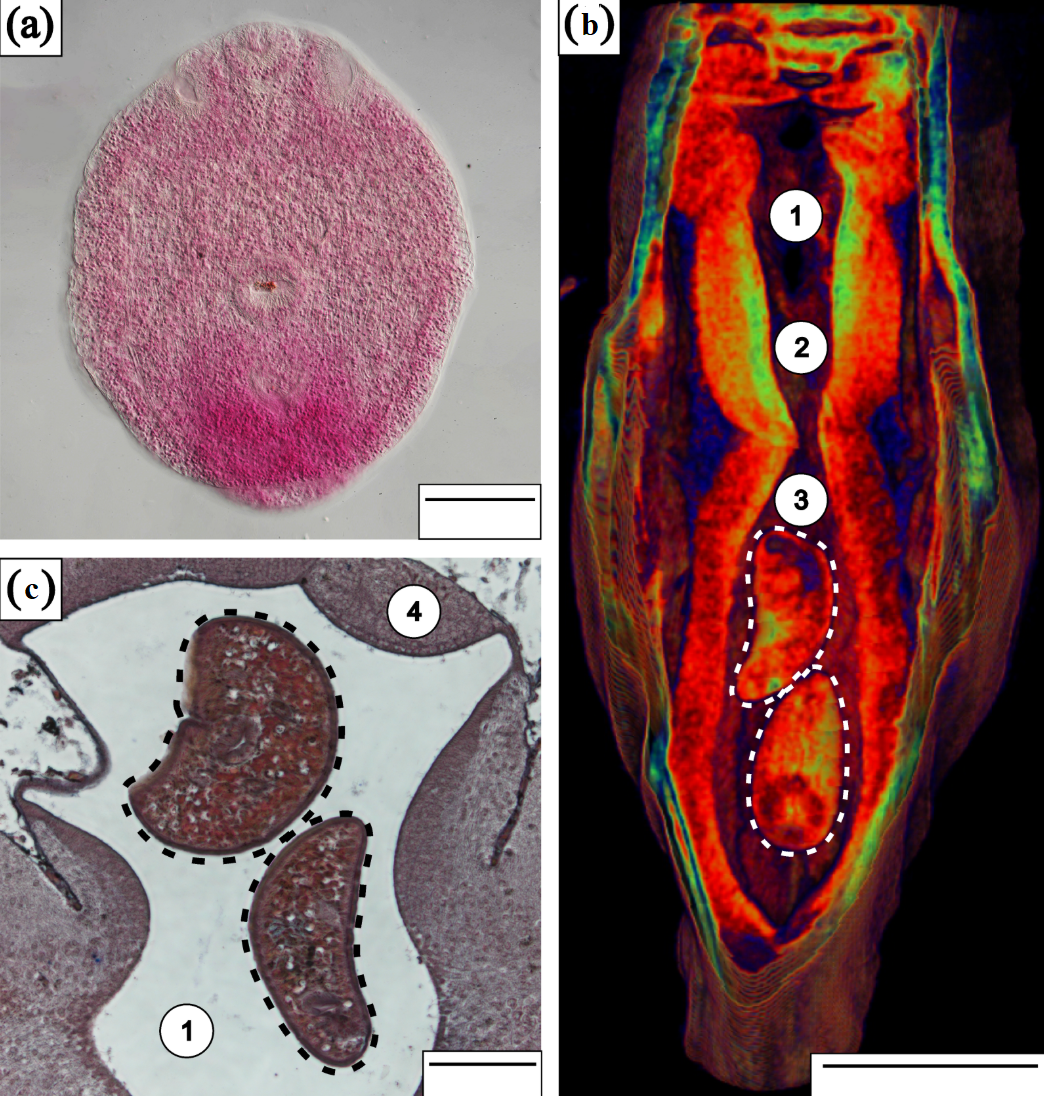
Fig.1. Metacercariae of Diplostomum petromyzifluviatilis and their location in the ventricular system of the brain of the river lamprey Lampetra fluviatilis: a – whole mount (carmine stain) of metacercariae, b – image (computer microtomography) of a longitudinal section through the brain of an infected lamprey larva (TL=117 mm), c – transverse section (Mallory stain) through the diencephalon of a lamprey larva (TL=84 mm); 1–3 – cavities: 1 – III ventricle, 2 – midbrain ventricle, 3 – IV ventricle; 4 – choroid plexus, metacercariae are outlined with a dotted line. Scale bar, µm: a, c – 100; b – 500.
A team of researchers from the A.N. Severtsov Institute of Ecology and Evolution of the Russian Academy of Sciences, St. Petersburg State University, the Zoological Institute of the Russian Academy of Sciences, and the University of Exeter (UK) conducted a comprehensive study of the infection of the river lamprey Lampetra fluviatilis with metacercariae of the trematode Diplostomum petromyzifluviatilis in small rivers of the Leningrad Region.
Significant differences in the infection rate of lamprey larvae were found between rivers dominated by anadromous spawners (the Chernaya and Sista rivers) and rivers dominated by resident (freshwater) spawners (the Kamenka and Serebristaya rivers). In the former type, larval infection rates were high, while no infected larvae were detected in the latter type. This indicates a close relationship between the parasitic system, the structure of the river ecosystem, and the host's life strategy.
An analysis of the habitat conditions and life cycles of the parasite and host allowed us to propose and substantiate a hypothesis explaining the observed differences. It was shown that the existence of a stable parasitic system of D. petromyzifluviatilis is possible only in rivers that provide conditions for the completion of the parasite's life cycle: the presence and availability of the first intermediate host (the mollusk Ampullaceana balthica), a high population density of the second intermediate host (lamprey larvae), and the presence of probable definitive hosts (fish-eating and waterfowl). Rivers dominated by the resident lamprey, due to their small size, frequent drying up, and the lack of extensive floodplains, are unattractive to birds—the parasite's definitive hosts—which is likely the key factor interrupting the life cycle of D. petromyzifluviatilis.
For the first time, the localization of D. petromyzifluviatilis metacercariae in the ventricular system of the brain was studied in detail in lamprey larvae using computed microtomography and histology. It was found that the metacercariae are distributed unevenly, with the highest density in the fourth ventricle.
"Since this region of the brain is involved in regulating motor activity, it has been suggested that the parasite potentially influences host behavior, which could potentially impact life strategy choices. The presence of metacercariae in resident spawners from the Kamenka River indicates that, if such an influence exists, it is likely modulated by other environmental factors," explained Alexey Kucheryavy, PhD, Senior Researcher at the Institute of Ecology and Evolution, Russian Academy of Sciences.
The results were published in Volume 65(6) of the journal Voprosy Ichthyologii: Infection of the River Lamprey Lampetra fluviatilis (Petromyzontidae) with Diplostomum petromyzifluviatilis (Diplostomidae) in Some Rivers of Leningrad Oblast, December 2025, Journal of Ichthyology 65(6):1109–1122.
This work was carried out as part of a Russian Science Foundation project.